Who Pays When a Landlord-Supplied Washing Machine Breaks?
October 22, 2026
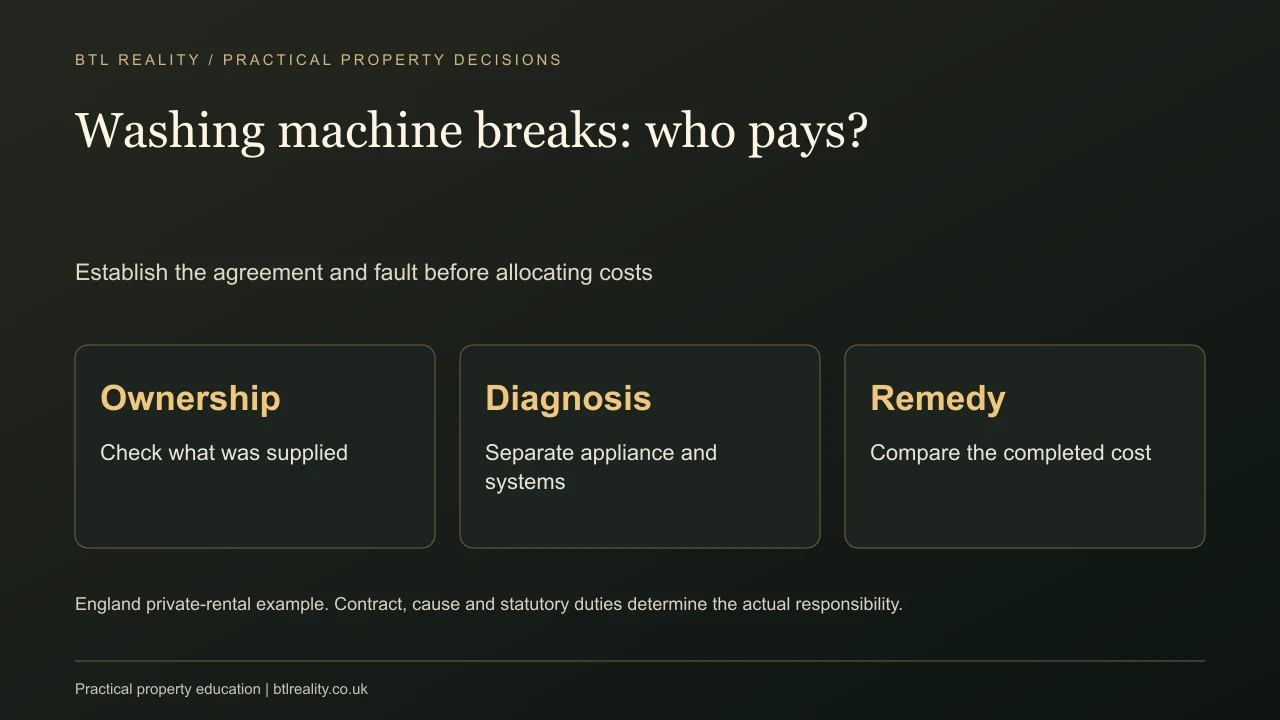
A washing machine breaking in a rental does not automatically mean the tenant must pay. It also does not mean every appliance issue is governed by the same rules as the boiler or fixed wiring. Start with ownership, the tenancy terms, the actual fault and any safety or installation problem.
The useful response is to get the facts, arrange an appropriate assessment and decide the remedy without treating normal breakdown as proven misuse. A disagreement over the final bill should not delay action on an actual hazard.
This guide focuses on ordinary private tenancies in England, using government guidance checked on 19 October 2026. The precise obligations depend on the agreement and circumstances. Different housing standards and rules apply elsewhere in the UK.
Whose washing machine is it?
Check the inventory, tenancy agreement, purchase record and any later written agreement. Was the machine supplied by the landlord, bought by the current tenant or left by a previous occupier? “It was already there” is not a complete ownership history.
If you supplied it as part of the letting, identify what the agreement says about repair and replacement. A listing describing a furnished or equipped kitchen may also be relevant to understanding what was offered.
Do not decide after it breaks that the machine was a gift simply because you would prefer not to repair it. If a genuine ownership transfer was agreed, keep the evidence. Avoid unilateral changes to the arrangement disguised as clarification.
Separate the appliance from the property’s systems
Government repairs guidance sets out responsibilities for the structure and key systems, including water, heating and wiring. A fault inside an appliance and a fault in the supply, drainage or electrical installation can require different analysis.
For example, a machine not draining might have an internal fault, a blocked connection or a problem further along the property’s waste system. Do not assume the appliance motor is broken because the tenant reports water remaining in the drum.
The government’s safety responsibilities page also says landlord-supplied appliances must be safe. Whatever the eventual repair-cost allocation, a credible electrical or water hazard needs an appropriate response.
If the contractual position is disputed, get advice on the actual terms and statutory duties. An inventory entry establishes useful facts about supply and condition, but it is not a complete legal opinion about every future repair.
Ask for safe, useful fault information
Ask which machine is involved, what happened, any displayed error message and whether there is visible leaking or damage. A photograph of the model information and display can help the repairer identify the device.
Do not ask the tenant to dismantle it, bypass a safety feature or keep running a suspect appliance to prove the fault. Where there is immediate danger, follow appropriate professional or emergency advice.
Keep the initial report and response time. If a leak affects the flat below or fixed electrics, widen the response to the actual building problem. The appliance dispute is not a reason to ignore consequential damage.
| Report | What needs establishing? | Useful next step |
|---|---|---|
| Machine will not start | Device identity and nature of fault | Appropriate appliance assessment |
| Water escaping | Source and immediate damage risk | Prompt safe mitigation and professional help |
| Drainage failure | Machine, connection or wider waste system | Diagnosis before allocating blame |
| Damage alleged | Cause, evidence and reasonable remedy | Written findings and fair cost assessment |
Read the repair clause before instructing a bill
Locate the actual clause and consider it with the rest of the agreement. Do not select one sentence about tenant care while ignoring another about landlord-supplied equipment.
If an agent drafted the contract, ask for a clear explanation of the intended arrangement and any relevant advice. Where it is unclear or potentially unfair, obtain qualified help rather than treating your preferred reading as settled.
Keep ordinary use, accidental damage and proven misuse distinct. A broken part after years of service does not itself prove the tenant used the machine badly. Conversely, a properly evidenced cause may be relevant to a fair claim.
Even if you believe costs can be recovered, explain the basis and evidence. An appliance engineer’s invoice is not automatically a lawful fixed fee to add to the rent account.
Repair or replace: compare the completed cost
Assume an illustrative repair costs £160 and includes the call-out, part and labour. A suitable replacement costs £340, delivery and installation £45, and removal £20. Replacement totals £405, which is £245 more than the repair.
The decision still depends on condition, diagnosis, likely reliability and suitability. A cheap repair that cannot restore safe service is not the answer. An expensive replacement is not automatically necessary just because the old machine is inconvenient.
Ask whether the call-out is credited against the repair and whether parts, VAT, installation, hoses, connection work and disposal are included. Compare the same completed scope across quotes.
If a second repair would cost another £150 soon afterwards, the two repair invoices total £310. That does not prove the replacement would have been better in advance; it shows why the first diagnosis and any warranty matter.
These figures are assumptions, not current market averages. Use the quote comparison guide to make exclusions and total cost visible.
What if the tenant buys a replacement?
Agree the arrangement before purchase where possible. Who chooses the machine, who pays, who owns it, who installs it and what happens to the old item? Put those points in writing.
If the tenant buys their own machine, record whether it leaves with them and whether any landlord item is being removed with permission. Otherwise a future check-out can become an argument about a missing appliance nobody intended to abandon.
Do not assume the tenant can deduct any chosen purchase from rent without an agreed or legally supported basis. Equally, do not promise reimbursement and then dispute the amount after the machine has been installed.
For replacement work, use an appropriate installer and retain the completed work record. Do not turn a cost-sharing agreement into instructions for somebody unqualified to alter the property’s electrical or water installation.
Update the inventory and appliance record
When a machine is repaired or changed, retain the diagnosis, invoice, model identity and any guarantee. A later contractor should be able to tell which machine is now installed.
Remove obsolete information from the current inventory while preserving the history where needed. Keep a clear note of any changed ownership or repair arrangement, agreed by the relevant parties.
The EICR guide explains the separate installation checks. A new appliance does not cancel an outstanding installation issue, and an installation report does not describe every repair inside the machine.
Keep the tenant’s user instructions accessible and explain the reporting route for new faults. A machine returning to service should not end the conversation if there is still a leak or incomplete work.
Allow for normal appliance replacement
Do not assume the protected deposit will finance ordinary ageing. Keep a reasonable cash allowance in the maintenance budget for equipment you choose to supply.
Using the illustrative £405 completed replacement cost over a six-year saving period gives £67.50 annually, or about £5.63 monthly. That is a planning allowance, not a promised appliance lifespan or a tax deduction calculation.
If you manage remotely, agree a sensible repair authorisation and escalation process with the agent. The remote management guide helps keep the diagnosis, approved spend and completion record visible.
Make the conclusion specific
A useful decision says which machine is affected, what failed, the obligation relied on, the chosen remedy and who bears the cost. It should be possible to explain without relying on a blanket claim that “tenants always pay for white goods” or “the inventory settles everything”.
Good records and a competent diagnosis can turn a frustrating breakdown into a manageable repair. They also leave the next tenancy with a clear equipment arrangement rather than another unresolved assumption.
Your questions answered
Must a landlord always repair a washing machine on the inventory?
Do not rely on the inventory alone. Establish ownership, the tenancy terms, the actual fault and any applicable statutory or safety duties. Get advice if the contractual position is disputed.
Does an appliance breakdown prove tenant misuse?
No. A competent diagnosis and other evidence are needed. Age and normal use can cause faults, so do not assume the tenant caused damage simply because the machine stopped working.
Can I call the broken machine a gift to avoid repairing it?
Do not unilaterally change ownership or the agreed arrangement after a fault arises. Any genuine transfer should be clearly agreed and recorded, with appropriate advice where needed.
What if the fault is in the drain rather than the machine?
Identify the actual cause. The appliance, its connection and the property’s drainage or electrical systems can involve different obligations. Diagnosis should precede allocation of the bill.
Can the tenant buy a new machine and take it when leaving?
Agree ownership, payment, installation and removal arrangements in writing. If it is the tenant’s purchase, the property record should make clear what happens at the end of the tenancy.
Is the six-year saving period a legal lifespan?
No. It is a hypothetical budget period for a £405 completed replacement. Actual safety, condition and repair decisions should follow the equipment and competent advice.