What Does Trace and Access Cover Mean for a Landlord?
October 22, 2026
Finding a hidden leak can cost more than repairing the failed fitting. A plumber may need specialist detection, an opened floor or access through a wall before the source is visible. Trace and access cover is the policy feature to check for those investigation and access costs.
It is not the same as cover for all water damage, and it does not automatically pay to repair the pipe or appliance that failed. You need to read the actual wording, the limits and the conditions for authorising work.
This guide explains UK landlord policy comparisons using insurer information checked on 19 October 2026. The examples are hypothetical and are not a recommendation of a particular product or a promise that your claim will be covered.
Separate three parts of a leak claim
First is finding and reaching the source. Second is repairing the failed pipe, fitting or appliance. Third is dealing with the resulting damage. The same contractor may invoice more than one part, but the policy may treat them differently.
For example, a damaged ceiling may fall under an insured escape-of-water event, while the cost of locating a concealed pipe sits under a trace-and-access extension. Repairing worn-out pipework may remain outside cover. Do not use the word “leak” as though it describes one indivisible bill.
Admiral’s landlord product information displays trace and access separately, with different availability and limits across its tiers. That is a useful illustration of why you should check the selected cover rather than assume every buildings policy includes the same feature.
Read the section that actually applies
The published Uinsure landlord wording provides a specific example: its buildings trace-and-access section addresses locating the source and making good access damage after specified insured events, while excluding the apparatus from which water or oil escaped. The optional home-emergency section has separate treatment of access damage.
That is one wording, not a universal definition. Its value here is showing how a policy can distinguish the emergency repair service from the wider buildings claim. You need to check the wording and schedule supplied for your own cover period.
If a broker says trace and access is “included”, ask them to identify the section, limit, excess, trigger and material exclusions. A tick on a comparison page should lead to the actual terms, not replace them.
A checked cost breakdown
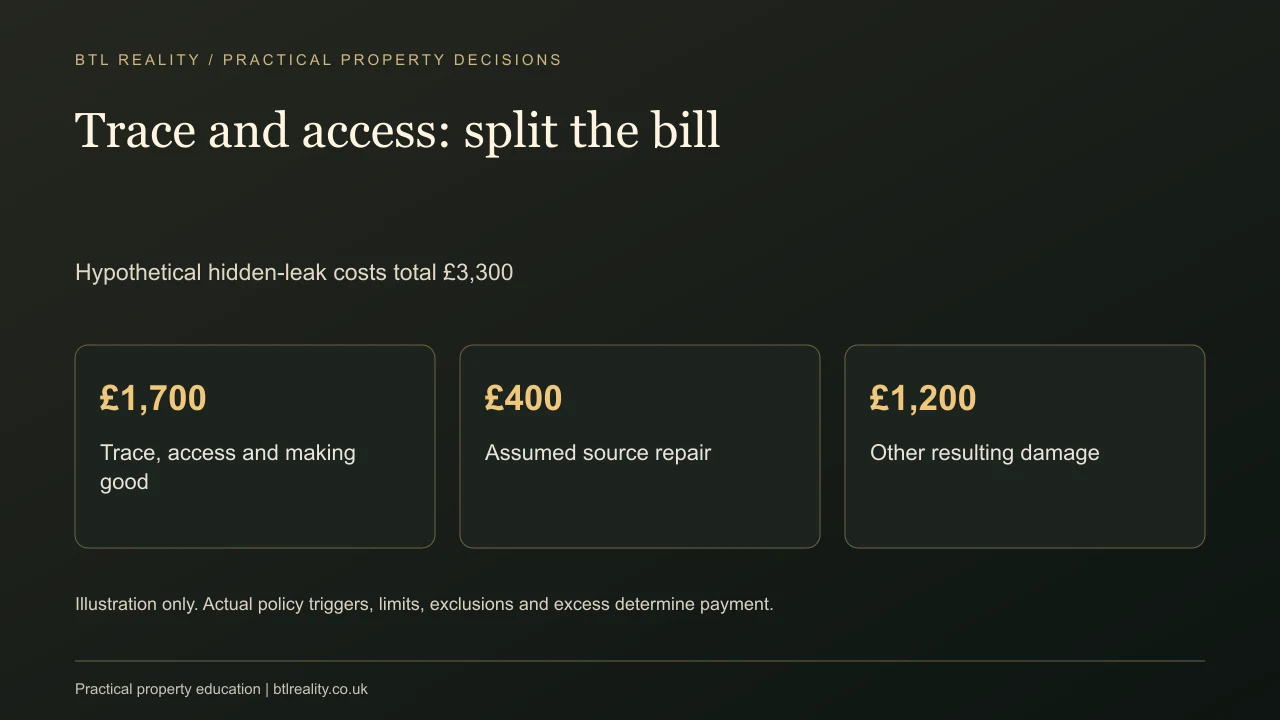
Suppose a hypothetical leak produces the following invoices. The figures are assumptions chosen to show the categories, not typical contractor prices.
| Work | Assumed cost | Category to investigate |
|---|---|---|
| Specialist detection | £250 | Trace |
| Opening the floor | £800 | Access |
| Repairing failed pipework | £400 | Source repair |
| Making good the access opening | £650 | Access reinstatement |
| Restoring other water-damaged finishes | £1,200 | Consequential building damage |
The full cost is £3,300. The trace, opening and access reinstatement total £1,700. The failed pipe costs another £400, and the resulting finishes damage is £1,200.
Assume, solely for this example, that the £1,700 access-related work and £1,200 resulting damage are accepted, the source repair is excluded, and one £500 excess applies to the accepted £2,900. The simplified insurer contribution is £2,400, leaving £900 of the £3,300 total for you to fund.
The £900 comprises the assumed £400 excluded repair plus £500 excess. A different policy, claim classification, limit or excess could produce another answer. The calculation makes the questions visible; it does not determine cover.
Ask about limits before committing to extensive work
A trace-and-access limit may be lower than the total buildings sum insured. Confirm whether it applies per claim, event or another basis and whether professional fees or VAT are included. Do not assume “unlimited buildings” means unlimited investigation spending.
If the proposed access route is destructive or expensive, ask what authorisation is required and whether another suitable investigation method should be considered. Keep the contractor’s technical explanation and the insurer’s response.
That does not mean leaving an emergency untreated while waiting for routine correspondence. Take appropriate urgent professional action and notify the insurer promptly. Separate necessary immediate mitigation from later non-emergency reinstatement choices.
Record any instruction or approval precisely. “Please send photographs” is not necessarily approval of a £5,000 scope. Keep the claim reference, contact and agreed next action together.
Give the contractor a useful reporting brief
Ask for a factual description of the symptoms, investigation, identified source and completed work. Where the cause remains uncertain, the report should say so rather than suggest a certainty it cannot support.
Request an itemised invoice separating detection, access, source repair, drying and reinstatement where practical. An invoice headed “plumbing repairs £3,300” is harder to reconcile with the policy sections than the same work described clearly.
Keep relevant photographs before, during and after access. They can explain why the opening was needed and what was found. Avoid taking photographs that unnecessarily expose tenant documents or possessions.
If several professionals attend, keep the sequence clear. A later decorator may rely on the source having been repaired and the area dried; identify who confirmed each stage rather than assuming the previous invoice proves everything.
Do not confuse a home-emergency add-on with full reinstatement
A home-emergency service may focus on an immediate or temporary repair subject to its own limit and contractor process. It may not cover the later work needed to put floors and decoration back.
Ask how a buildings claim and emergency attendance interact. Which number should be called, can your own contractor be used, and what costs need prior agreement? Keep the answers accessible to the agent handling out-of-hours calls.
A policy can include both sections without their cover being identical. If an emergency contractor makes access damage, establish which section considers the making good rather than assuming the same attendance authorises a full refurbishment.
Where there is another policy, such as block buildings insurance, disclose it as required and ask how the insurers coordinate. Do not claim the same cost twice or assume the existence of another insurer removes the need to notify your own.
For a flat, check the block arrangements
Identify who holds the buildings policy and who can authorise a claim. A leaseholder landlord may insure contents separately while the freeholder arranges the main building cover. Your personal policy summary may therefore be only part of the picture.
The service-charge guide helps place block insurance in the broader ownership budget. Ask for the relevant schedule and claims process before a leak occurs, rather than discovering them while a tenant’s ceiling is wet.
If water comes from another flat, responsibility and insurance allocation are separate from the trace-and-access feature. The major-works guide covers a different type of building cost; a reactive leak should not be assumed to follow the same planned-work process.
Retain enough cash for the uninsured part
Even an accepted claim can leave an excess, excluded source repair or timing gap before reimbursement. Keep the actual cash requirement separate from the eventual insurer contribution.
In the example, a £900 unfunded amount could arrive alongside mortgage interest and management costs. If the entire reserve were £1,500, only £600 would remain after that amount. The policy may be valuable, but it does not remove the need for cash.
Use the cash-reserve guide and maintenance budget guide to plan for that retained exposure. Do not count a possible insurance payment as cash already received.
Review the policy before the next leak
Check the selected trace-and-access cover at renewal, especially if the property has concealed pipework, previous incidents or changes in occupancy. Give accurate information to the insurer and ask about any new limitations.
You should be able to explain what investigation costs may be considered, what source repairs remain your responsibility, the relevant limit and who authorises work. That is more useful than remembering that the policy included “water cover”.
Check the quote against the schedule
When cover is renewed, save the wording version and schedule together. A product page can change after you buy, and an old comparison table may describe a different tier. If the schedule and your understanding do not match, ask for clarification before assuming the extension is active. Keep the answer with the policy rather than relying on a sales conversation alone.
Your questions answered
Does trace and access pay to repair the leaking pipe?
Not necessarily. Some wording distinguishes locating and reaching the source from repairing the failed apparatus. Check the actual section, exclusions and claim decision.
Is escape-of-water damage the same as trace and access?
No. Resulting water damage and the cost of finding or reaching the source can be treated under different policy provisions. Keep the invoices and categories separate.
Does a home-emergency add-on cover all reinstatement?
Do not assume it does. Emergency attendance, temporary repairs and later reinstatement can have different terms, limits and authorisation requirements.
Should I obtain approval before opening a floor?
Check the insurer’s requirements promptly and seek appropriate approval for non-emergency destructive work. Do not delay necessary urgent professional action on an actual emergency.
Is the £2,400 insurer payment a typical claim?
No. It follows expressly assumed costs, coverage and one excess. Your schedule, event, limits and exclusions determine the actual result.
Who deals with trace and access in a leasehold flat?
Establish who holds the relevant buildings policy and the claim-authorisation process. The block insurer and your own contents or landlord cover may address different costs.