Can a Landlord Be Liable for a Tenant’s Water Bill?
October 22, 2026
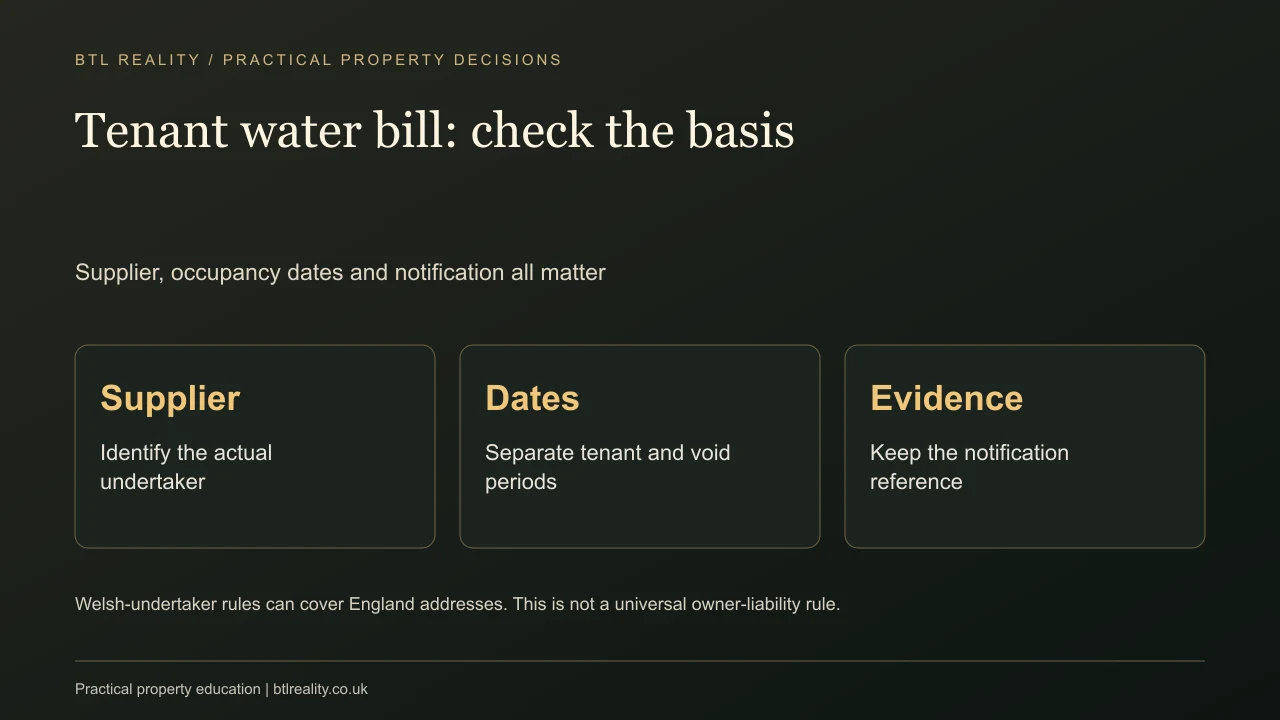
A tenant’s unpaid water bill does not become the landlord’s bill merely because the landlord owns the house. But ownership, the supply arrangement, occupancy dates and specific notification rules can create responsibilities you should check before ignoring a demand.
There is a particularly important exception to understand for properties served by Welsh water undertakers. A property can be in England and still fall within a supplier-based notification rule. Looking only at the postcode’s country can therefore miss the point.
This guide uses water-company and Welsh Government information checked on 19 October 2026. It focuses on a practical landlord handover and the Welsh Water example, not a universal statement about every water company or every UK tenancy.
Start with the actual supply and agreement
Identify the company providing water and sewerage services, the account holder and who the tenancy says pays. A tenant paying the supplier directly is different from a landlord including water in the rent or charging under another arrangement.
Check whether the demand relates to an occupied period, a void, a shared supply or an earlier account error. “Water bill” can cover several situations with different explanations. Ask for the dates, address, basis and account information before accepting or rejecting the whole amount.
If the supplier has written to the owner because it does not know the occupier, provide the relevant accurate information through the proper route. Do not assume an unanswered account automatically sorts itself out when the next tenant moves in.
Understand the Welsh-undertaker notification rule
The Welsh Government’s explanation of the 2014 regulations says the non-owner occupier information duty concerns properties served by the specified Welsh undertakers, including relevant properties in England. Failure to provide required information within 21days of an occupier change can create joint and several liability for charges during the period of non-compliance.
Welsh Water’s landlord services page says landlords should notify tenant changes within 21days. It identifies occupier information and the Landlord TAP route, which retains a record of the update. Check the current supplier instructions and the actual statutory requirements for your circumstances.
This is not a new rule requiring every English landlord to pay every tenant’s water arrears. It is a reason to identify the supplier and complete the relevant handover rather than assuming all companies follow one rule.
Give the agent a specific move-in task
Ask who will notify the supplier, what information is needed and how completion is evidenced. An agreement saying the agent “handles utilities” should lead to a visible record for this particular tenancy.
Record the actual occupation or tenancy information required by the supplier accurately. Do not use the date the agent happened to upload the agreement as a substitute for the relevant start date.
Check all required adult occupier details through the proper process. Where information is unavailable, obtain advice or clarification rather than inventing a date of birth or omitting the issue from the record.
| Stage | Information to check | Completion evidence |
|---|---|---|
| Before move-in | Supplier, account arrangement and responsible person | Agreed management instruction |
| Occupation change | Required names, dates and property details | Submitted information and reference |
| Metered handover | Reading, date and meter identity where applicable | Photograph or supplier record |
| Void or move-out | Changed occupancy and account responsibility | Supplier acknowledgement or reference |
Keep the receipt or reference, not merely a task marked “done”. A record of what was submitted helps correct an error if the supplier later has the wrong occupier.
Separate the tenant period from the void
Where a property is empty between lettings, establish the supplier’s charging treatment and the owner’s responsibility for that period. Do not assume no occupant means no possible water charge.
For metered supplies, take appropriate readings at the change and retain the date. For an unmetered supply or shared arrangement, ask how the supplier calculates the relevant period. The same method may not apply to both.
Suppose an illustrative final reading is 143cubic metres and the next opening reading is 146. The difference is3cubic metres. That observation identifies recorded consumption between the readings; it does not by itself decide who legally pays.
If the assumed combined variable rate were £4 per cubic metre, that amount would be £12 before standing or fixed charges. These are invented inputs, not current water tariffs. Use the actual supplier rates and occupancy facts.
What should you do when an arrears letter arrives?
Read it promptly and ask the supplier to identify the charge period and legal or contractual basis for seeking payment from you. Provide the relevant tenancy and notification evidence through a secure route.
If the bill includes several periods, ask for a breakdown rather than arguing about the total. An owner may agree that a void amount is theirs while disputing an occupied-period charge. Keep the separate items visible.
Do not alter account dates to make the bill disappear or tell the supplier a tenant occupied a period they did not. An accurate correction is more useful than moving an error onto another person.
Where the supplier relies on notification failure, check the submission record and seek appropriate advice if liability is disputed. The fact that your agent was meant to notify does not automatically make the supplier’s claim vanish.
Keep the tenant charging arrangement separate
Even if you pay the water company, that does not automatically authorise any additional charge you choose to make to the tenant. The tenancy terms, permitted payments and applicable water-resale rules need their own assessment.
The bills-inclusive rent guide explains the wider pricing and agreement issues. Do not add a guessed margin or a separate “admin penalty” to recover an awkward bill.
If an amount is to be reconciled under an agreed arrangement, show the actual period, basis and calculation. Avoid mixing a historic tenant debt with the incoming tenant’s first rent payment.
A dispute with a supplier and a potential claim against an agent are also separate matters. Preserve the records and obtain advice on each route rather than assuming one party’s error settles everybody else’s obligations.
Build a small financial reconciliation
For illustration, imagine a supplier demand of £420 containing £300 for an occupied period,£80 for an accepted void period and £40 of disputed adjustments. Those three items add to £420, but they do not all need the same response.
The accepted £80 can be recorded separately from the £340 still being queried. That is an accounting presentation, not advice to withhold a lawful payment or a conclusion about the disputed liability.
Use the empty-property cost guide to budget actual void charges. Keep supplier refunds and later credits linked to the original bill so they are not mistaken for new rental profit.
The separate rental account guide helps make these movements visible. A dedicated account is useful only if the underlying period and responsibility are also recorded correctly.
Protect personal information in the handover
Use the supplier’s official portal or confirmed contact route. Provide the information required for the purpose rather than forwarding a complete tenant reference file with bank statements, identity documents and unrelated personal details.
Tell the tenant how the relevant account information is handled in the normal privacy information. Do not assume a supplier handover needs the tenant’s email password or access to their personal account.
Retain an appropriate submission record securely. A task reference and the required details are easier to manage than several unprotected copies scattered across personal messages.
Review the process before the next change
Confirm which properties fall under which supplier arrangements and put a move-in and move-out task in the agent’s workflow. A supplier change, portfolio purchase or new shared-meter arrangement should prompt another check.
For an overseas landlord, the remote management guide helps assign responsibility and escalation. You should be able to identify the actual supplier, the notified occupier dates and the evidence of completion without travelling to the property.
A clear water handover is usually a small administrative job. Leaving it ambiguous can turn a tenant account question into an avoidable owner liability dispute.
Your questions answered
Does a tenant’s unpaid water bill automatically become mine?
No blanket answer follows from ownership alone. Check the account, agreement, period, supplier rules and any specific notification duty or other basis for liability.
Does the Welsh notification rule only affect properties in Wales?
The Welsh Government explanation says the duty is linked to the relevant water undertaker and can include properties in England. Identify the actual supplier rather than relying only on the property’s country.
What is the 21-day Welsh Water rule?
Welsh Water says landlords should notify changes of tenants within 21days. Failure to comply with the applicable regulations can create joint and several liability for charges during non-compliance.
Is telling my agent enough evidence of notification?
Keep evidence that the required information actually reached the supplier through the proper route. An instruction to the agent is useful, but it is not the same as a supplier submission reference.
Who pays during a gap between tenants?
Check the actual supply and charging arrangement for the void period. Record dates and readings where applicable rather than assuming an empty property creates no charges.
Can I add the bill and an admin penalty to the tenant’s rent?
Do not assume so. Any tenant charge needs its own lawful and contractual basis, including applicable permitted-payment and water-resale rules. Separate actual costs from an unsupported penalty.