Landlord Possession Claims Rise 21% as Repossessions Fall
November 13, 2026
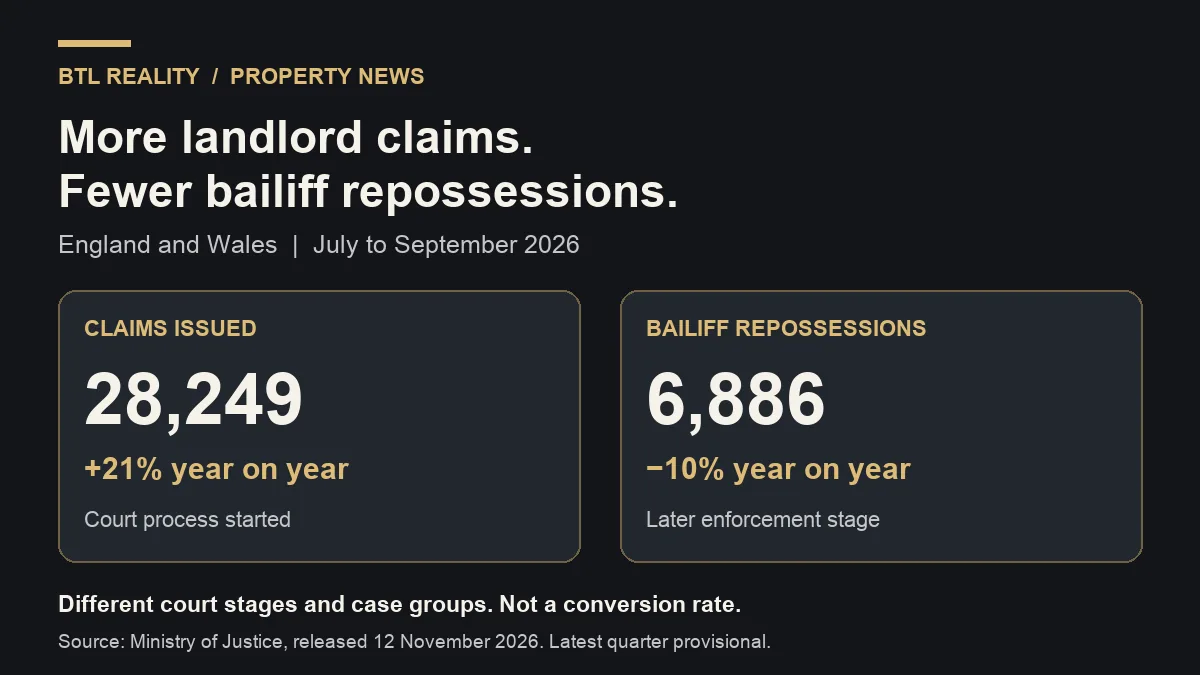
Landlords started more possession claims in the third quarter of 2026, while fewer repossessions were carried out by county court bailiffs. That distinction matters if you are using the latest headline to judge the practical risk of owning a rental.
The new Ministry of Justice figures show claims rising 21% compared with the same quarter last year. They do not show a 21% rise in completed evictions, and they do not reopen Section 21 in England. For an investor, the useful question is whether the property can keep meeting its bills when the income or the possession timetable changes.
Read the stages separately: a claim, an order, a warrant and a bailiff repossession are different events. The people entering one stage this quarter are not necessarily the people completing another stage in the same quarter.
What do the new possession figures show?
The official statistical tables compare the following landlord actions in England and Wales county courts. These are year-on-year comparisons for July to September, rather than changes since June.
| Court stage | 2025 | 2026 | Annual change, rounded |
|---|---|---|---|
| Claims issued | 23,319 | 28,249 | +21% |
| Possession orders | 18,243 | 20,196 | +11% |
| Warrants | 11,512 | 10,760 | −7% |
| Repossessions by county court bailiffs | 7,680 | 6,886 | −10% |
A claim asks the court to begin possession action. An order is a court decision, while a warrant concerns enforcement. Repossession by a county court bailiff is a later event. None of those labels should be replaced casually with “landlords selling up”.
The MoJ supporting guide explains the administrative data and its revisions. Court actions are not a count of all occasions when tenants move out, and some claims involve more than one subsequent action. The latest quarter can change as records are amended.
Why did accelerated claims increase?
The MoJ bulletin records 12,156 accelerated claims, up 68% over the year. Standard private-landlord claims were 7,291 and social-landlord claims were 8,802, with both described as stable. The MoJ considers the accelerated increase likely to reflect the English Renters’ Rights Act transition and its final court deadline.
That is an explanation offered by the statisticians, not proof that every additional claim had the same motivation. The quarter includes July, when landlords could still meet the final deadline for eligible old notices. It is a poor basis for assuming the same pattern will repeat indefinitely.
There is another important classification point. Accelerated cases are recorded separately and cannot be reliably divided between private and social landlords in these tables. Calling all 12,156 “private landlords evicting tenants” would add a conclusion the data does not support.
The data does not create a new Section 21 window
England’s official guidance on notices served before 1 May explains that a landlord who had not already applied in time cannot now use an old Section 21 notice to start a possession case. The usual final court deadline was 31 July 2026, or an earlier expiry where applicable.
A case validly begun before the deadline can still be progressing. That is different from being able to serve a new Section 21 notice or start a late claim now. Check the actual notice, service and court history with the adviser handling the case.
For current English assured-tenancy possession decisions, use the current grounds and notice guidance. Our guide to what landlords do after Section 21 gives the wider context. A national statistical headline does not select the appropriate ground for an individual tenancy.
The numbers cover England and Wales. The English reform explanation is not Welsh law: a Welsh property needs the relevant occupation-contract process and Welsh possession guidance. Scotland and Northern Ireland are outside this release.
What does the 25.9-week median actually mean?
The MoJ reports a median of 25.9 weeks from landlord claim to repossession, compared with 27.4 weeks a year earlier. This concerns the completed cases contributing to that measure, across the published landlord categories. It is not a promise about a new case.
The clock also starts at the claim. Any notice period and work before issuing proceedings sit outside it. The time needed after a tenant leaves to repair, prepare and relet the property is another separate period.
Table 6 notes that timeliness uses the first relevant action for each claim. Its underlying observation counts therefore need not match the headline action totals in Table 4. That is another reason not to divide this quarter’s repossessions by this quarter’s claims and present the answer as an eviction success rate.
The quarter mixes older cases, different procedures and different circumstances. It cannot, on its own, establish how a newly started Section 8 case will perform. Build several cash scenarios instead of turning a historical median into a completion date.
A practical cash-buffer example
Suppose a property has £150,000 of interest-only debt at an assumed 6%. Interest is £9,000 a year, or £750 monthly. Add a fixed £250 monthly operating allowance. The assumed continuing cash requirement is £1,000 a month.
Now assume no rent is received for three, six or nine months, plus a £1,500 one-off budget for legal and enforcement work. That £1,500 is an illustrative allowance, not a solicitor’s quotation, a court-fee schedule or a prediction of the bill.
| Zero-rent period | Monthly outgoings | One-off allowance | Cash buffer |
|---|---|---|---|
| 3 months | £3,000 | £1,500 | £4,500 |
| 6 months | £6,000 | £1,500 | £7,500 |
| 9 months | £9,000 | £1,500 | £10,500 |
These are planning periods, not expected court durations. The example excludes tax, major works, lender charges and costs beyond the allowances. Replace the figures with your own payments, legal advice and maintenance needs before relying on the buffer.
If the expected rent were £1,100 monthly, six unpaid months would also mean £6,600 of rent not received. Keep that revenue shortfall separate from the £7,500 needed to pay the assumed bills. Adding both figures and calling the result the necessary cash reserve would count different things together.
Use the buy-to-let deal calculator beside the purchase budget. The mortgage stress calculator can help test a different borrowing rate. Neither calculates a legal timetable or replaces a possession adviser.
What should a landlord check now?
Start with the tenancy and the payment record. Keep a clear rent schedule, copies of notices and dated correspondence. Establish whether there is an existing claim or a new decision to make. A statistic cannot fix a missed deadline or defective paperwork.
Then separate the legal route from the cash plan. Our guide to tenants not paying rent explains the practical checks. Keep communication, evidence and professional advice organised while testing whether the property can meet its obligations without the expected income.
Finally, review any purchase that depends on quick vacant possession. Obtain advice about the actual occupation and documents before committing to a refurbishment or sale timetable. These figures are a reason to ask better questions about resilience, not evidence that every tenant or property presents the same risk.
Frequently asked questions
Did landlord evictions rise by 21%?
No. The 21% increase concerns possession claims issued in England and Wales county courts in July to September 2026. Repossessions by county court bailiffs fell 10% compared with the same quarter of 2025. A claim begins a court process; it is not a completed eviction.
Can landlords start a new Section 21 claim because accelerated claims rose?
No. The figures describe a past quarter and do not reopen the old route in England. Existing valid Section 21 claims had to meet the earlier notice deadline and the court deadline, generally no later than 31 July 2026. Get advice about an existing case or the appropriate current grounds.
Are all 12,156 accelerated claims private-landlord cases?
The statistics do not establish that. Accelerated cases are recorded separately from standard private and social landlord claims, and their tenure type cannot be split reliably in this dataset. Do not add every accelerated case to a private-landlord total or describe every claim as an eviction.
Does the 25.9-week median predict my possession case?
No. It describes claim-to-repossession timeliness for the relevant completed cases in the quarter, across the published landlord categories. It excludes the notice period before a claim and is not a forecast for a new claim. A median also leaves substantial variation between cases.
How does the six-month cash-buffer example reach £7,500?
The assumed £150,000 interest-only debt at 6% costs £750 monthly. Add a £250 monthly operating allowance to give £1,000 a month. Six months with no rent needs £6,000, plus the assumed £1,500 one-off legal and enforcement budget. The result is £7,500 before tax and major works.
Do these figures apply to Welsh properties?
The court statistics cover England and Wales, but the English Section 21 transition explanation must not be applied as Welsh law. Welsh landlords need the possession requirements relevant to their occupation contract and circumstances. Scotland and Northern Ireland are outside this statistical series.