Should a Landlord Choose a Higher Insurance Excess?
October 20, 2026
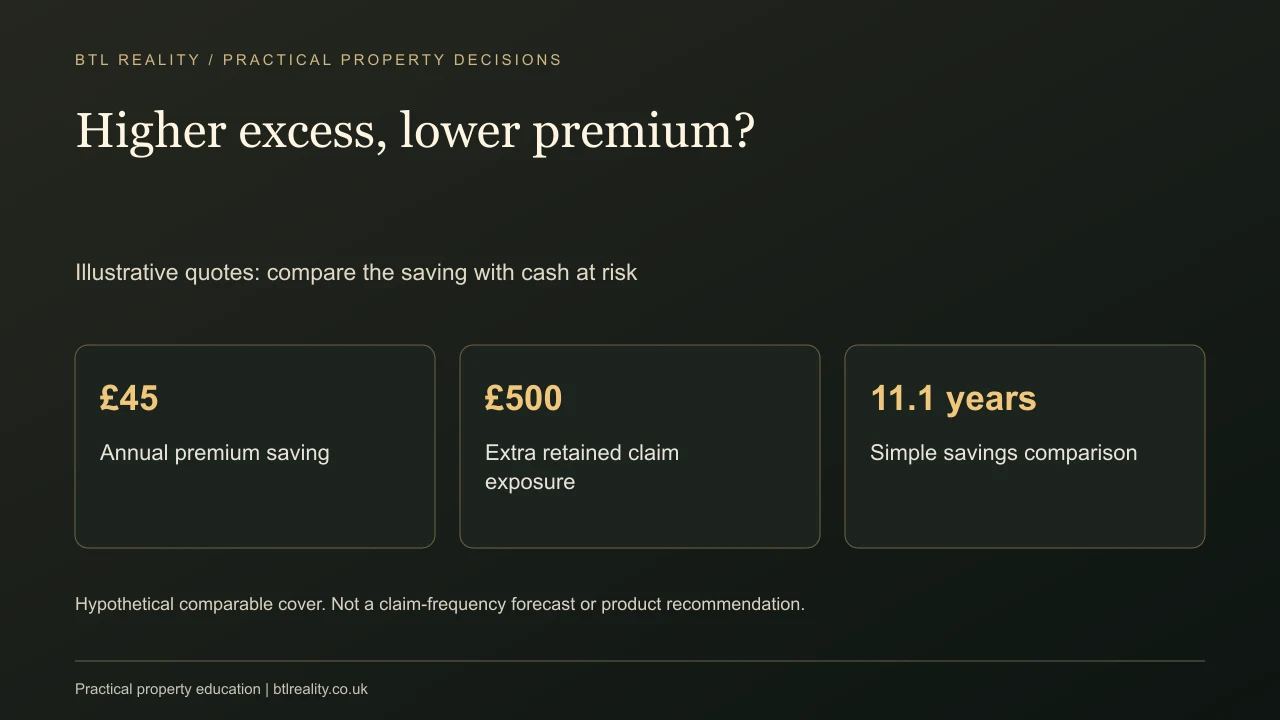
A higher insurance excess can reduce the premium, but it also leaves more of each applicable claim for you to fund. The right comparison is therefore the annual saving against the extra cash at risk, with the actual policy terms kept alongside the numbers.
A £40 saving can look attractive on a renewal email. It feels different when a claim requires another £500 from your repair reserve. Neither figure tells the whole story on its own.
This guide explains a method for comparing UK landlord insurance quotes. It uses hypothetical prices and claim amounts, not product recommendations or an estimate of how likely you are to claim. Insurer information was checked on 19 October 2026; your own policy schedule and wording govern the cover.
What is an excess?
The excess is the amount of a covered claim you must bear under the policy. A compulsory excess is set by the insurer. A voluntary excess is an additional amount you choose, where the insurer offers that option.
Admiral’s landlord claims explanation describes voluntary excess as payable on top of compulsory excess and says claims below the excess are not covered. It also shows why you need to check the particular claim category rather than assuming one number applies everywhere.
As another example of differing structures, Frontier’s published information distinguishes buildings and contents excesses from an escape-of-water excess. Those examples illustrate the questions to ask, not which insurer you should choose.
Compare the total excess for the event you are considering
A quote might display a voluntary excess prominently while the compulsory amount sits elsewhere. Add the amounts that apply under the wording. If a £250 voluntary excess is added to a £500 compulsory excess for a particular claim, the total retained amount is £750.
Then check the circumstances that may produce a different figure. Escape of water, subsidence, storm or other insured events can have different terms. Do not copy the smallest excess from a quote summary into every line of your comparison.
For a flat, find out whether you are examining the block buildings policy, your own contents cover or a separate landlord policy. Paying a premium does not necessarily mean you personally chose the building’s excess.
Also check whether several losses would be treated as one event or separate claims. You cannot establish that by dividing the annual premium by the excess. Ask the insurer or broker to explain the relevant wording in writing.
A checked two-quote example
Suppose two hypothetical quotes provide genuinely comparable cover. Quote A costs £330 for the year with a £250 total applicable excess. Quote B costs £285 with a £750 total applicable excess. The cheaper premium saves £45 annually but retains another £500 on each claim where those excesses apply.
| Scenario | Quote A | Quote B |
|---|---|---|
| Annual premium | £330 | £285 |
| Total applicable excess | £250 | £750 |
| No claim: premium cost | £330 | £285 |
| £2,000 covered loss: insurer contribution | £1,750 | £1,250 |
| Premium plus retained part of that loss | £580 | £1,035 |
In the claim year shown, B leaves £455 more for you to bear after the £45 premium saving: £500 minus £45. In a no-claim year, B costs £45 less. That is the trade-off visible in pounds.
The extra £500 exposure divided by the £45 annual saving is about 11.1 years of unchanged savings. That is only a simple recovery comparison. It does not predict an event every 11 years, take account of future premiums or tell you the statistically best policy.
Small losses behave differently
Now assume a £400 covered repair. Under A, the simple illustration leaves £250 for you and £150 for the insurer. Under B, the £400 loss is below the £750 excess, so there is no insurer contribution in this model.
That does not automatically mean you should submit the smaller A claim. Consider the claims process, policy notification requirements and potential future pricing. A decision not to seek payment is different from whether the insurer requires you to report an incident.
Ask the provider rather than assuming that “I paid myself” means nothing needs disclosing at renewal. Record the answer. Do not omit an incident because a comparison form is inconvenient to complete.
Equally, avoid treating insurance as a general maintenance plan. A worn seal, gradual deterioration or a repair outside the covered events may not be payable at any excess. First establish whether there is a covered claim.
Can your reserve fund the excess promptly?
An excess needs to fit your available cash as well as your attitude to risk. If the property has little surplus and no separate reserve, a high retained amount can delay necessary work even when the overall premium looks affordable.
Suppose you hold £1,200 for this rental. A £750 retained amount would use 62.5% of that fund, leaving £450 before other bills. That may matter more than a £45 premium saving when a boiler repair or void occurs in the same month.
The cash-reserve guide helps think through that wider exposure. Do not count the tenant’s protected deposit as your emergency fund. It is not available to plug unrelated insurance or maintenance bills.
Across several properties, consider whether one event could affect more than one unit and how the policies respond. Do not assume diversification eliminates the need for readily available cash.
Make sure the cover is really comparable
Before celebrating a cheaper premium, compare the insured amounts, exclusions, unoccupied-property conditions, covered tenant types, legal cover and any loss-of-rent terms. The excess comparison is useful only after the essential scope is understood.
Check the rebuild basis too. The rebuild-value guide explains why market price and reconstruction cost are different. A low premium created by inadequate cover is not a successful excess decision.
Vacancy terms deserve their own review. If the property will be empty during works, use the empty-property insurance guide to identify the questions. An attractive excess does not override a condition that affects cover during the void.
Where a broker presents the options, ask for the reason one arrangement suits the circumstances and any material limitations. Keep the written comparison with the policy documents so you can revisit the decision at renewal.
Put the premium saving in the property numbers
A £45 annual saving is £3.75 a month. It is real money, but it should be viewed beside rent, borrowing costs and the amount retained on claims. It rarely transforms a weak rental into a strong one.
Use the Buy-to-Let Deal Analyser to compare the actual annual insurance cost beside the other operating assumptions. Keep an excess cash requirement separate from a recurring premium expense so the same amount is not counted twice.
If you set aside an additional reserve for the higher excess, label it as cash retained, not an insurance payment already spent. That makes both the ongoing profit view and the available-cash view clearer.
Ask four useful questions before accepting
What is the total excess for the losses most relevant to this property? What is the actual annual saving after any fees? Can the reserve comfortably fund the retained amount? What differences in cover or conditions remain between the quotes?
If the answer to one is unclear, resolve it before choosing. A renewal deadline can encourage a quick decision, so start the comparison early enough to ask questions and retain continuity of cover.
Revisit the decision when the property, occupancy or cash position changes. A higher excess that once fitted a large reserve may no longer suit a heavily committed budget. Equally, a well-funded landlord may reasonably choose to retain smaller losses. The important point is that the choice is deliberate and based on the complete terms.
Your questions answered
Does voluntary excess replace compulsory excess?
Often it is added to it. Check the actual policy schedule and the relevant claim category. Do not assume the voluntary amount displayed is the whole amount you retain.
Is a higher excess always cheaper?
No general saving is guaranteed. Compare actual quotes with the same required cover and conditions, including any fees and claim-specific excesses.
What happens if the loss is below the excess?
There may be no insurer payment for that loss. The exact wording governs. Also check whether the incident still needs to be reported even if you pay for the repair yourself.
Is the 11.1-year example a forecast of claims?
No. It divides £500 extra retained exposure by a £45 annual premium saving. It assumes unchanged figures and says nothing about the probability or timing of a claim.
Should I keep the excess in a separate reserve?
Make sure readily available cash can fund the retained amount alongside other property bills. A separate label or account can help, but the appropriate reserve depends on the whole property position.
Can the tenant deposit fund my insurance excess?
Do not treat the protected tenant deposit as your emergency reserve. Any claim against it needs its own lawful, evidenced basis and the appropriate agreement or dispute process.