How Much Can a Landlord Charge for Lost Keys or a Fob?
October 20, 2026
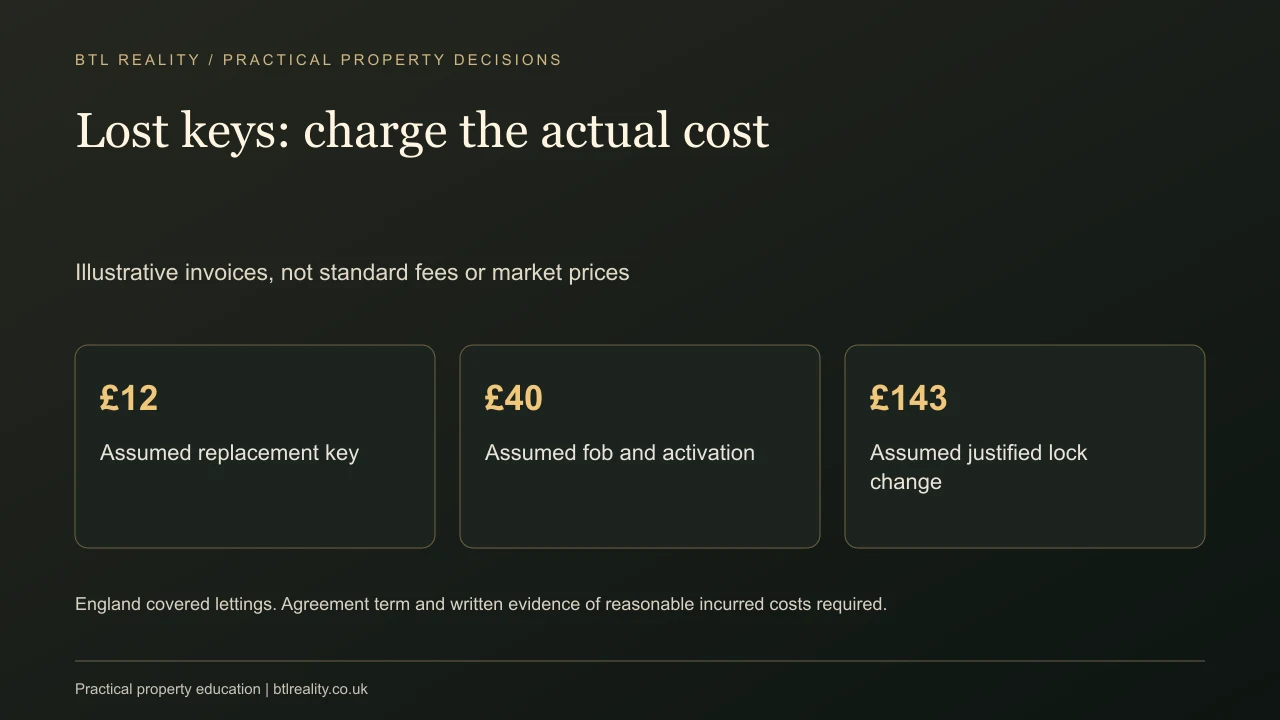
In England, a lost key or fob does not give a landlord permission to invent a fixed penalty. Where the applicable tenancy agreement permits the default fee, you can recover reasonable replacement costs with written evidence of what was incurred.
The practical questions are what actually needs replacing, what it reasonably costs and how you explain the amount. A simple cut key, a managed-entry fob and a genuine security-related lock change are different jobs.
This guide covers English lettings within the Tenant Fees Act, with government guidance checked on 19 October 2026. Different rules apply elsewhere in the UK and some types of occupation are outside that Act. The examples below use assumed invoices, not market prices or automatic charges.
What does the current guidance allow?
The government’s permitted-fees guidance allows a default fee for loss of a key or security device if the tenancy agreement includes it. The tenant must receive written evidence showing incurred costs are reasonable. The guidance applies in England and now reflects assured periodic tenancies.
That is different from setting a £100 “administration penalty” because a key was inconvenient to replace. The amount needs a proper basis. An agent’s fee list or a clause in a contract does not make every possible charge lawful.
Before requesting money, identify the applicable term and the actual expense. If either is unclear, resolve the point rather than adding a guessed charge to the rent account.
Find out what was lost
Ask which key or device is missing and whether any identifying information was attached to it. Does it open only the flat, a shared entrance or several parts of the building? Is it a physical key, a coded fob or a device that can be cancelled?
The answer determines the sensible response. A building manager may be able to deactivate one lost fob and issue another. Replacing the whole access system because a single device went missing may be unnecessary.
For a physical key, ask a suitable locksmith or relevant building contact what replacement is needed. Do not automatically replace every lock in the property without considering the circumstances and obtaining appropriate advice.
Keep security details private. The evidence you give the tenant should explain the charge, but it should not circulate access codes, identifying key photographs or other residents’ information unnecessarily.
Three illustrative invoices
| Situation | Illustrative costs | Total |
|---|---|---|
| Ordinary replacement key | Key cutting £12 | £12 |
| Managed entrance fob | Fob £25 plus building provider activation £15 | £40 |
| Justified lock change | Locksmith £90, cylinder £35 and replacement keys £18 | £143 |
In the first example, adding an unexplained £50 penalty would increase a £12 replacement to £62. The fact that £50 is a familiar number in tenancy guidance does not establish permission for that addition.
In the fob example, obtain the building provider’s invoice and explanation. Do not describe a £40 standard building replacement as a £100 charge unless there are separately justified, reasonable incurred costs and a lawful basis for recovery.
In the lock example, retain the reason the change was necessary. A receipt shows spending occurred, but it does not by itself explain why that particular work was needed because of the lost key.
Do not confuse the £50 variation rule with lost keys
The current government guidance separately discusses a tenant-requested change to the tenancy agreement, such as changing a named person, with a £50 figure and evidence requirements for higher reasonable costs. That is a different category from replacement keys.
A landlord should not use the tenancy-variation provision as a general £50 charge for every request. Equally, a genuinely reasonable lock replacement is not automatically limited to £50 just because that number appears elsewhere.
The useful approach is to name the payment category and explain its basis. “Replacement entry fob, provider invoice attached” is clearer than “tenancy charge”. It also makes it easier for the tenant to identify and query an error.
What written evidence should the tenant receive?
Provide a readable cost breakdown and the relevant invoices or receipts, with unnecessary personal or security information removed. Explain what was lost, what was done and why each part of the requested amount relates to replacement.
If more than one party was involved, reconcile their costs before billing the tenant. The agent and building manager should not both charge the same fob cost under different descriptions.
For example, if the building manager charges the agent £40 and the agent’s invoice passes that same £40 to you, there is one £40 expense, not two. Adding both documents would double count it.
Where a quote was used to arrange urgent work, replace it with the actual cost evidence when available and correct any overestimate. A request for reimbursement should match the completed work rather than the largest preliminary figure.
What about time, travel and administration?
Do not assume every minute spent dealing with the problem can be converted into a tenant charge. The detailed government landlord and agent guidance discusses reasonable costs in more detail. Read it alongside the current guidance and seek advice if an unusual charge is proposed.
Record what was actually done and why it was necessary. An arbitrary minimum fee can be difficult to justify where the only expense was a low-cost duplicate key. A genuine emergency locksmith invoice raises a different set of facts.
Do not treat an agent’s charge to the landlord as automatic proof the tenant owes it. Your management contract and the tenant’s permitted payments are separate relationships. Agree the process with the agent before a problem occurs.
The landlord rules guide helps keep fee rules within the broader tenancy framework. A convenient billing practice should not replace checking the permitted basis.
Help the tenant resolve the access problem
Start by establishing whether the person can safely enter their home. Provide a clear contact route and explain any building-authorised replacement process. Avoid making a difficult situation worse with a dispute about a guessed invoice before the facts are known.
If the tenant can arrange an appropriate replacement directly, consider whether that is a workable solution. For controlled keys or shared-entry systems, check the authorised route so the replacement does not compromise building security.
Once access is restored, confirm which devices are active and whether the original lost device was cancelled. Update the key register without recording unnecessary security information in an ordinary rent statement.
Do not use a lost-key incident as a reason to enter the home without the proper arrangements. Nor should a dispute about payment be used as a shortcut to changing locks to exclude a tenant. Get appropriate advice if the situation is contentious.
Set an agent process that avoids duplicate charges
Agree who instructs the locksmith, who can authorise a replacement fob and how invoices are checked. If you are abroad, put an appropriate spending and reporting arrangement in place before an out-of-hours call occurs.
The remote rental management guide helps make those responsibilities visible. Ask the agent for one reconciled account, with the permitted tenant request separated from any landlord-only management cost.
For an assumed £143 locksmith job, if £18 of the keys were duplicated on both the locksmith invoice and a separate claim, the mistaken total would be £161. A short review prevents that simple overcharge.
Budget for costs you cannot recover
Some costs remain with the landlord, whether because there is no valid basis for a tenant charge, the work exceeded what was necessary or the incident was not actually caused by a tenant losing a device. Do not build the property’s cash flow around recovering every inconvenience.
The maintenance budget guide provides a structure for small unplanned costs. A missing key should be a manageable incident with an accurate record, not an excuse for an unsupported fee or a prolonged argument.
Your questions answered
Can I charge a fixed £100 lost-key penalty?
Do not assume a fixed penalty is allowed. The applicable agreement must permit the default fee and the requested costs must be reasonable, incurred and supported in writing.
Is there a £50 maximum for a replacement key?
The £50 figure in government guidance concerns a different category: tenant-requested changes to the tenancy. Lost-key charges need their own reasonable-cost basis, not an automatic £50 allowance or cap.
Can I replace every lock when a key is lost?
Establish what was lost and obtain appropriate advice about the necessary security response. Keep the reason for any lock change and the cost evidence. The loss does not automatically justify every replacement you choose.
Do I need to give the tenant the receipt?
Provide written evidence showing the incurred costs are reasonable, with an understandable breakdown. Remove unnecessary personal or sensitive security details rather than withholding the basis of the charge.
Can my agent’s fee automatically be passed to the tenant?
No automatic conclusion follows from the agent charging you. The management agreement and the tenant’s permitted payments are separate. Check the lawful basis and avoid double counting costs.
What if the original fob is found after a replacement is ordered?
Check the actual costs incurred and whether the original remains cancelled or can be used. Explain the completed work and correct any amount no longer justified by the circumstances.