Why a High Rental Yield Can Still Mean Low Profit
October 16, 2026

By Mark Parham
BTL Reality · Practical property education
A high rental yield can still produce low profit because gross yield measures rent against purchase price, before mortgage costs, operating expenses, empty periods and tax. It is a useful screening number, but it cannot tell you how much cash the property leaves or how much work and risk sits behind that cash.
If a property is advertised at 10%, the next question should be: 10% of what, calculated using which rent, with which costs excluded? That question often reveals more than the headline itself.
Gross yield describes only two numbers
Gross rental yield = annual gross rent ÷ purchase price × 100.
At £1,000 monthly rent and a £120,000 purchase price, the calculation is £12,000 ÷ £120,000 × 100 = 10%.
The calculation contains no mortgage rate, management bill, service charge or repair cost. Those items can change dramatically without changing gross yield at all. It also ignores the cash spent on purchase taxes, fees, works and reserves.
Be careful with labels such as net yield and return on investment. Different people deduct different costs or use different denominators. Ask to see the calculation, not just the name. Our rental yield calculator is useful for exploring the distinction, with assumptions shown explicitly.
A 10% yield property with £200 monthly cashflow
Take the £120,000 property above. Suppose it has £90,000 of interest-only debt at 6%, costing £450 a month. Allow another £350 monthly for operating costs and reserves. That leaves £200 before tax and any costs not included in the allowance.
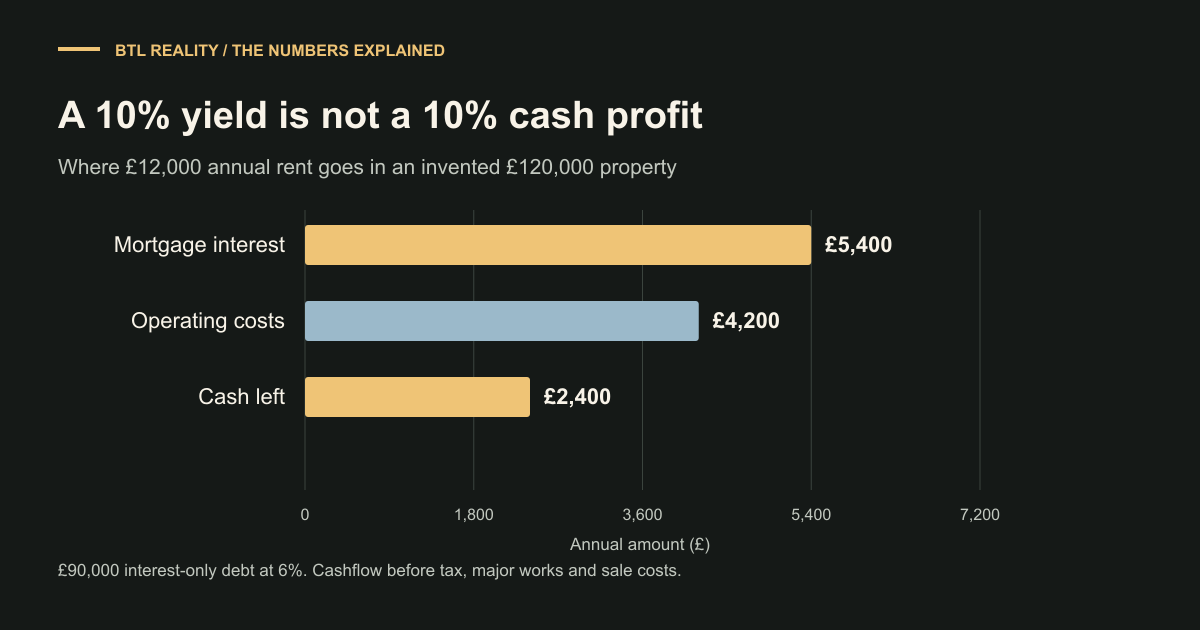
Over a year, £12,000 of rent is divided into £5,400 mortgage interest, £4,200 operating costs and reserves, and £2,400 remaining cash. The advertised 10% has not disappeared; it was simply measuring something different.
If the complete initial cash commitment was £40,000, the £2,400 represents a 6% annual pre-tax cash return on that money. Capital-value changes and sale proceeds are excluded. A different ownership structure, repair year or financing arrangement could materially change the result.
TRY YOUR OWN ASSUMPTIONS
See what sits between yield and spendable cash
Change the rent, interest and operating allowance on an invented £120,000 property. The purchase price stays fixed so you can see what gross yield misses.
Move a slider to explore the model.
Price £120,000; loan £90,000; initial cash £40,000 including the £30,000 deposit and £10,000 illustrative other costs/reserve. Annual cash return = monthly cashflow × 12 ÷ £40,000. No capital growth, sale proceeds, tax or major unexpected works. Inputs stay on this page. Figures stay on this page and are not submitted or saved.
Enable JavaScript to use the sliders. The default worked example remains readable below.
Where the illustrative £12,000 annual rent goes
Financing can squeeze cash without changing the yield
Increase the example's rate from 6% to 8%. Monthly interest becomes £600 and the cash left falls from £200 to £50. Gross yield is still 10%, because the price and rent have not changed.
At 10% interest, the same model has a £100 monthly shortfall. That is not a prediction of rates. It is a demonstration that a good-looking gross yield does not protect the investment from its funding structure.
Use the mortgage stress calculator to explore a range that is relevant to your actual borrowing. If a deal only works at a short-lived introductory payment, you need to understand what happens afterwards.
Operating costs are not interchangeable
A family house, a leasehold flat and an HMO can have very different cost patterns. Higher gross rent may come with higher bills, more intensive management or greater replacement costs. A flat's service charge can absorb much of an apparently attractive rent-to-price ratio.
My houses-versus-flats discussion uses historical price and rent estimates to explore this trade-off. It shows why I would compare the whole cost structure rather than declare one property type superior from gross yield alone.
For flats, the service-charge guide helps investigate recurring charges and major works. For any property, check whether the agent's fee includes VAT and whether tenant-find, inspections, renewals or other services are charged separately.
Check the rent behind the headline
Is the advertised rent currently contracted, actually collected or simply estimated? Does it assume all rooms are occupied, no concessions and no empty weeks? Is the number appropriate for the property's current condition, or only after a renovation that has not been priced?
For a multi-unit or room-let property, add up the individual rents and examine the occupancy assumption. A schedule showing every room at full rent every week is a capacity calculation, not necessarily a realistic annual receipt forecast.
Our rental-demand guide gives a practical evidence process. Compare similar homes and ask what achieved lettings support the figure. If the supported rent is lower, update the model before trying to defend the advertised yield.
Check the denominator as carefully as the rent
A 10% yield calculated on purchase price differs from a return on total project cost. Suppose the £120,000 purchase needs £20,000 of additional works and buying costs. £12,000 gross annual rent divided by £140,000 is about 8.6%, before operating costs and finance.
That does not mean one calculation is forbidden. It means they answer different questions. Purchase-price yield can help compare listings. A complete project-cost measure tells you more about the capital required to create the finished investment.
Return on your own cash is different again because borrowing changes both the cash invested and the interest cost. Keep those measures in separate rows. Do not put gross yield from one property beside leveraged cash return from another and call it a fair comparison.
Allow for the uneven year
Property costs rarely arrive as twelve identical monthly amounts. A repair, tenancy change or insurance payment may consume several months of surplus at once. A monthly reserve provision is helpful, but it must be supported by actual cash held somewhere accessible.
If the illustrative property leaves £2,400 over a normal year, a £2,000 unexpected bill is significant. It does not automatically make the investment bad, but it changes the spending power of that year's rent. The void-cost model demonstrates another way the yearly outcome can vary.
Also distinguish cashflow from accounting and taxable profit. Capital repayments, capital expenditure and tax treatment can create differences. Use an accountant's assessment for the actual ownership arrangement rather than assuming the cash left in the bank equals the tax figure.
Use yield as the beginning of the assessment
- Verify the rent. Establish whether it is achieved, contracted or estimated.
- Build the complete cash budget. Include works, fees, taxes and reserve.
- Itemise operating costs. Avoid one unexplained deduction that makes the answer look attractive.
- Use the actual financing basis. Identify interest-only versus repayment and product expiry.
- Stress the weak assumptions. Lower rent, higher rates and a realistic repair should be visible.
- Compare with your brief. Check effort, concentration and access to cash, not just the return percentage.
The two-deal comparison guide puts this into a side-by-side decision. A lower-yield property may have stronger net cashflow or a more manageable risk profile. A higher-yield property may still win, but the full evidence should explain why.
Learn to read the deal behind the headline
Starter Club can help you build a practical property plan and ask better questions of the numbers. Start by putting the full assumptions into the deal calculator.
Is high yield a warning sign?
Not automatically. It is a reason to investigate what supports the rent and price, what costs are excluded and what risks or work the investment involves.
Does this include capital growth?
No. The worked example focuses on operating cashflow. Value changes belong in separate scenarios and are not guaranteed or spendable until realised or financed.
Prepared using information checked on 30 September 2026. Check the linked product pages for current availability and terms. This is general property education, not personal financial, mortgage, tax or legal advice. Models and examples are illustrative. Property values and income can fall, and outcomes are not guaranteed.