What If My Buy-to-Let Mortgage Offer Expires Before Completion?
October 19, 2026
If your buy-to-let mortgage offer may expire before completion, tell your broker and conveyancer as soon as the risk becomes clear. An extension may be possible, but it is not automatic. The lender may require updated evidence, another valuation or a new application, and the rate or available borrowing could change.
The consequences are especially serious if you have already entered a binding purchase contract. This guide helps you organise the dates, identify the decisions and prepare a realistic fallback. It does not replace advice on your mortgage offer or purchase contract.
Check which deadline you are looking at
An agreement in principle, a product reservation, a formal mortgage offer and the final mortgage term are different things. Find the actual formal offer and read its expiry date and conditions. Do not rely on a date remembered from an earlier email or a general lender policy.
Ask the broker how the deadline is applied and ask the conveyancer what timing is needed to request funds and complete. Finishing legal work on the last valid day may not leave enough time for the necessary process.
As one example, The Mortgage Works publishes offer-validity and extension criteria. Its published standard validity is six months from the first offer, with specific extension arrangements. Other lenders and transaction types can differ, so use the document and policy relevant to your own case.
Put the transaction on one timeline
Record the offer expiry, expected exchange, expected completion and any other contractual deadlines. Add the outstanding tasks that could affect completion, such as leasehold information, enquiries, survey follow-up, seller arrangements or building work.
Give each task an owner and a realistic date. “Solicitors are dealing with it” is less useful than knowing which enquiry is outstanding, who must answer and whether the answer could change the transaction.
Then include a buffer. A completion forecast is not a commitment from every party, and one unresolved issue can shift the timetable. The purpose of the buffer is to expose fragility early, not to predict a precise number of days for every purchase.
Make the example your own
How much time remains after a completion delay?
Enter calendar-day estimates from the same starting date. Allow separately for lender and legal processing time.
Negative headroom means completion is after the entered expiry. No extension, lender processing time, weekends, holidays or contract terms are inferred. Confirm actual dates and conditions with the broker and conveyancer. Illustrative only. Inputs stay in this page and are not saved or sent.
The calculator uses calendar-day estimates that you enter. It does not know bank holidays, lender processing times, contractual requirements or the actual offer terms. Negative headroom means the modelled completion is after the entered expiry, not that an extension has been arranged.
A simple timing example
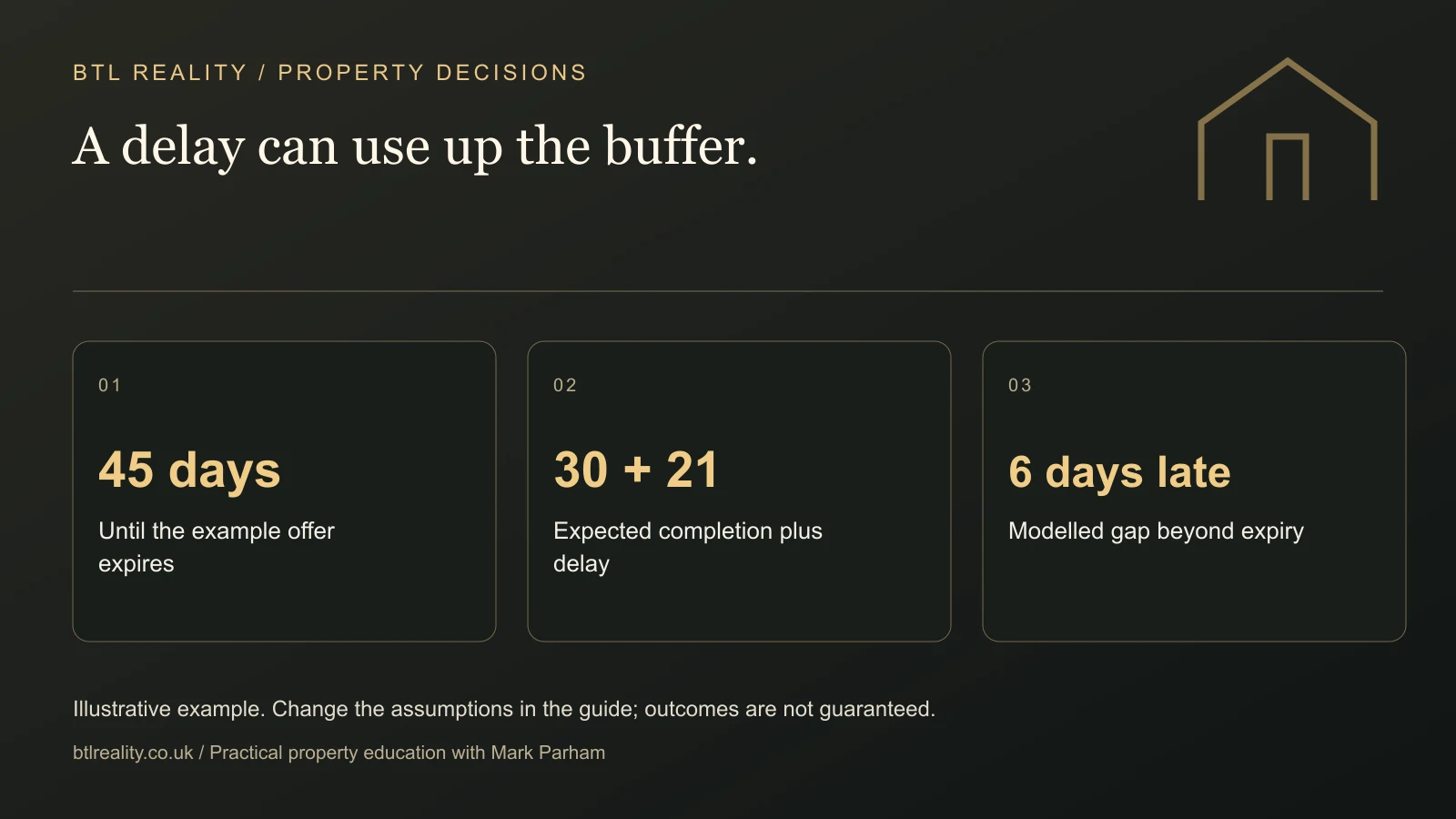
Suppose the mortgage offer expires in 45 days and the current completion estimate is 30 days away. You have 15 calendar days of apparent headroom. If an outstanding legal issue adds 21 days, completion moves to day 51, six days after the offer expiry.
That small calculation is useful because an apparently distant deadline can become immediate once a realistic delay is included. It also gives the broker and solicitor a clear question: what must happen, and by when, to preserve a workable funding route?
Do not confuse the result with a recommendation to rush exchange. An unresolved title or survey issue should not be ignored merely to fit the mortgage timetable. The purchase still needs to be suitable and legally understood.
Ask the broker what an extension would require
The lender may have a defined process, a discretionary review or no suitable extension route for the circumstances. Ask when a request can be made, what evidence is needed and how long a decision may take.
Clarify whether the same product and rate would remain available. An extension of time is not necessarily a promise to preserve every original term. Ask whether changes in income, credit commitments, rent, property condition or valuation could affect the review.
Keep the request factual. Explain the reason for delay, the expected completion date and any relevant changes. Do not hide changed circumstances to make an extension appear simpler; funding based on inaccurate information can create a much larger problem.
A new application can change the cash requirement
Suppose the original plan was a £150,000 purchase with a £112,500 mortgage at 75% loan-to-value. If a later accepted valuation is only £140,000 and the replacement loan is limited to 75% of that, borrowing falls to £105,000. At the unchanged price, you need an additional £7,500 deposit before new fees.
The finance rate can change the operating case too. On £112,500 interest-only borrowing, an illustrative increase from 5% to 6.5% adds £140.63 a month in interest. That is about £1,687.50 a year, before considering other changes.
These are stress examples, not predictions of future pricing. They show why “we will just reapply” is not a complete fallback. Check the new cash requirement and rental return using the buy-to-let deal calculator and mortgage stress calculator.
If you have not exchanged contracts
For a conventional purchase in England and Wales, the period before exchange usually gives more flexibility to resolve funding and legal issues. GOV.UK explains when the purchase becomes binding. Your conveyancer should confirm the position for your transaction, including any reservation or other agreement already signed.
Discuss whether the timetable can be revised and whether the property still works if the mortgage terms change. You may need updated finance, a price discussion, more time or a decision not to proceed. The available choices depend on the circumstances and any commitments already made.
Avoid treating expenditure on surveys and legal work as a reason to accept an unworkable replacement loan. Those costs matter, but the decision now concerns the much larger future commitment. A sunk fee does not make a weak investment stronger.
If you have already exchanged contracts
Contact the conveyancer and broker urgently. The purchase contract may create obligations and financial consequences if you cannot complete, including risks to the deposit and potentially further liability. The exact position must be assessed from the contract and applicable law.
Do not independently agree a new completion date, promise alternative finance or assume the seller will release you without cost. Your solicitor needs to advise on the options and communicate appropriately with the other side.
Short-term or bridging finance is not a harmless administrative solution. It can involve substantial fees, interest and a repayment risk, especially if the original problem also affects the exit mortgage. Any alternative funding needs proper advice and a realistic funded exit, not merely the hope of refinancing later.
Off-plan purchases need particular timing discipline
A development's projected completion date can move. If you are asked to commit before the property is ready, the gap between contractual commitment and mortgage drawdown deserves close attention.
Ask the solicitor to explain notice periods, long-stop provisions, deposit arrangements and what happens if the property or funding circumstances change. Ask the broker how new-build offer validity, extension and valuation processes apply to your lender.
Do not assume a developer's sales forecast is the same as a lender-backed completion plan. Keep the two timelines visible, and stress-test a delay alongside a lower valuation or more expensive loan. Several risks can arrive together.
Keep records of decisions and conditions
Maintain a short action log with the date, person responsible, agreed next step and deadline. Save written confirmation of any approved offer extension and check the revised document or lender confirmation rather than relying solely on a verbal reassurance.
Record whether additional conditions remain. For example, an extension might still depend on updated documents or confirmation of no material change. A message saying the request has been submitted is not the same as a lender's approval.
Ask the conveyancer to confirm when the funding position is sufficient for the next contractual step. The aim is one shared understanding of readiness, rather than the broker, buyer and solicitor each assuming another person has checked the critical point.
Prevent the next deadline from becoming a surprise
At the start of a purchase, add the mortgage expiry to your calendar with review reminders well before it. Revisit the date whenever a key task slips. The best time to discuss a likely problem is when options still exist.
For investors learning the process, Starter Club supports planning and practical decision-making. Our agreement-in-principle guide explains the earlier finance stages. Neither replaces the broker or conveyancer responsible for the actual mortgage and contract.
A good purchase process does not assume every party finishes on time. It makes the dependencies visible and responds early when the original timetable stops being credible.
Frequently asked questions
Can a buy-to-let mortgage offer be extended?
Possibly, depending on the lender, product, transaction and reason for delay. An extension is not automatic. Ask your broker about the process and required evidence as soon as the risk appears, and obtain confirmation of approval and the revised deadline before relying on it.
Will an extension keep the same rate?
Not necessarily. Some arrangements may preserve the existing product, while others require a change or fresh application. Confirm the exact terms with the broker and lender. Do not assume that an extra month of validity also guarantees the same interest rate, fees or loan amount.
Could the lender ask for new documents or a valuation?
Yes. The lender may need updated information about you, the property, rent or the transaction before extending or making a new offer. Changes can affect the outcome. Respond accurately and promptly, and ask how any revised assessment changes the cash needed for completion.
What if I have already exchanged contracts?
Speak to your conveyancer and broker urgently. You may have a binding obligation to complete and face financial consequences if you cannot. The contract determines the options and risks. Do not assume the seller must wait or accept a change without legal advice.
Are off-plan mortgage deadlines different?
New-build products and extension processes can differ, but the actual offer and contract still need checking. Development delays can leave a gap between a purchase commitment and available funding. Have the broker and solicitor review the timelines together before relying on projected completion dates.
How early should I raise a possible completion delay?
As soon as a credible risk appears. Waiting until the final days reduces time for updated evidence, lender decisions and legal discussions. Keep the expiry, likely completion and outstanding tasks on one timeline, and update everyone involved when the assumptions change.
Put the next step into practice
Use the free tools to test your numbers, then choose the level of support that fits your next decision.