Is a Mortgage Agreement in Principle Enough to Make an Offer?
October 19, 2026
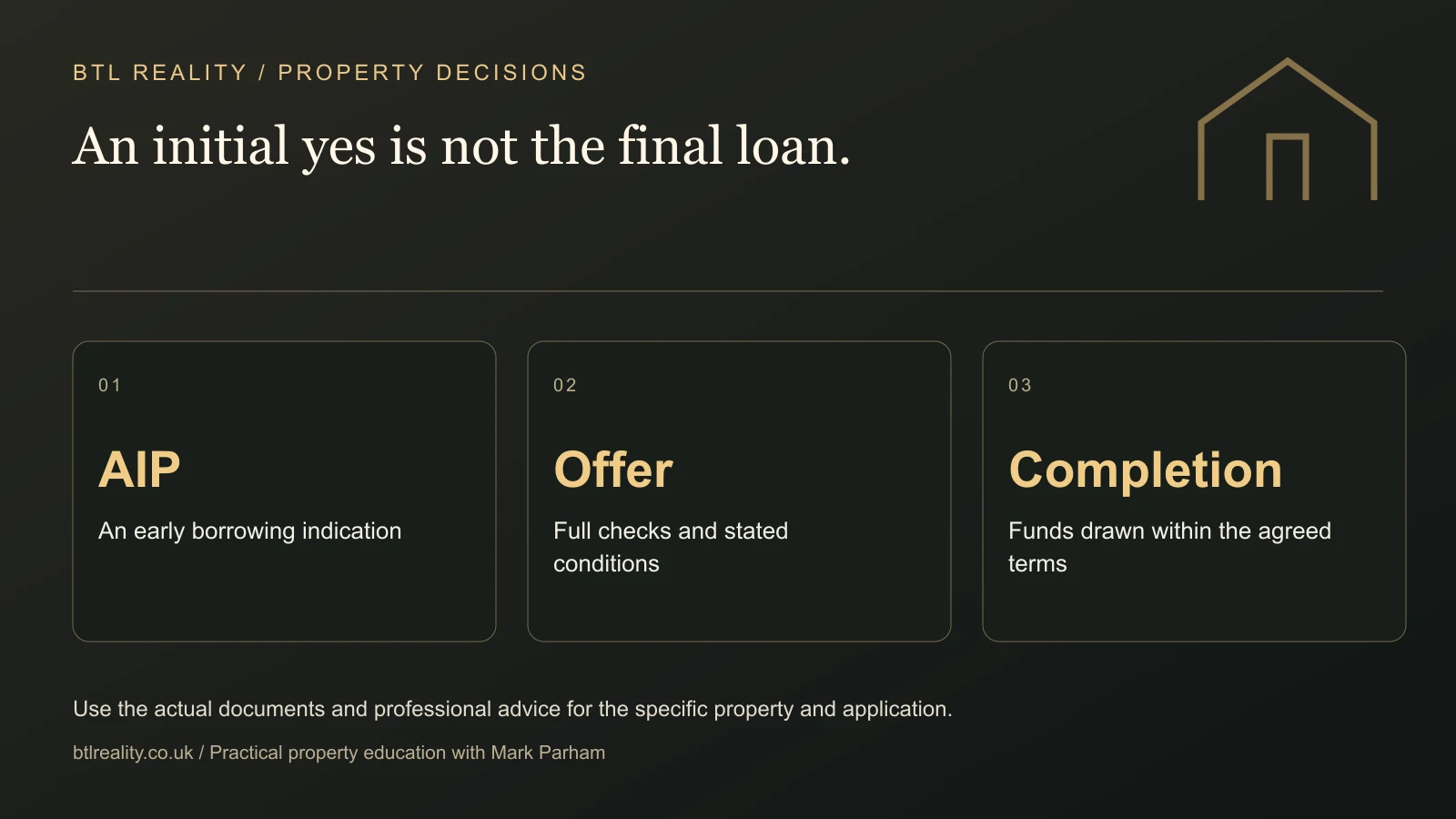
A mortgage agreement in principle can help you make a credible property offer, but it is not a guarantee that the lender will fund the purchase. It is an early indication based on the information assessed at that stage. The property, supporting documents and full application still need to satisfy the lender's requirements.
For a buy-to-let, that distinction matters because a suitable borrower can choose an unsuitable security, or an attractive rental can fail the lender's affordability test. This guide explains how to use an agreement in principle sensibly, what can change afterwards and which decisions should wait for stronger evidence.
What an agreement in principle tells you
An agreement in principle, sometimes called a decision in principle, gives an initial view of potential borrowing. The precise checks, validity period and conditions depend on the lender. It is useful for discussing a budget and showing an agent that you have begun arranging finance.
It does not establish every detail of the final loan. MoneyHelper's mortgage application guide explains the distinction between early borrowing checks and the full assessment. For buy-to-let, ask your broker what the chosen lender has actually reviewed and what remains outstanding.
Keep the underlying assumptions visible: income, deposit, ownership structure, existing borrowing and the type of property being considered. If those change, the early indication may no longer describe the application you intend to make.
Making an offer is not the same as exchanging contracts
For a conventional purchase in England and Wales, GOV.UK explains that an accepted offer is not legally binding until contracts are exchanged. That gives a period in which the mortgage, survey and legal work can progress, although you may incur costs and the transaction can still fall through.
Different transaction routes and jurisdictions need their own advice. Auction conditions and Scottish purchases should not be treated as though they follow the same non-binding-offer sequence. Understand when you become committed before relying on an initial mortgage indication.
An agent may ask for an agreement in principle and proof of deposit to assess your position. That commercial request is useful context, but the agent's willingness to accept the offer does not turn the AIP into a binding loan offer.
Four stages to keep separate
The first stage is a realistic buying budget, including deposit, transaction costs, works and reserves. An AIP is not a substitute for deciding what you can afford to commit without weakening the rest of your finances.
The second stage is the lender's initial indication. The third is the full mortgage application, with evidence and property assessment leading, if successful, to a formal offer. The fourth is satisfying the remaining conditions and drawing funds for completion.
A formal offer is much stronger than an AIP, but it also contains conditions and an expiry date. Your conveyancer and broker should confirm what must be done before relying on it for a legally binding purchase commitment.
Make the example your own
How far has the finance evidence progressed?
Keep an initial indication separate from a formal offer and readiness to complete.
0 of 6 checks reviewed
This is an organiser, not approval to invest. Selections stay in this page and are not saved or sent.
Use the checklist to identify which stage is actually complete. It does not assess mortgage eligibility. A box marked “offer received” should mean you have read and understood the relevant document, not just received a reassuring message that an application is progressing.
The property can change the borrowing amount
Suppose you plan to buy at £150,000 using a 75% loan-to-value mortgage. The expected loan is £112,500 and the deposit £37,500. You also budget £15,000 for costs, work and reserves, making £52,500 cash required.
Now suppose the accepted lending valuation is £140,000 and borrowing is limited to 75% of that lower value. The loan becomes £105,000. At the unchanged purchase price, the deposit rises to £45,000 and the total cash requirement to £60,000.
The extra £7,500 has not been caused by your AIP expiring or your salary changing. It arises from the property valuation. Rental coverage, retentions and other criteria could further affect the loan.
Our buy-to-let down-valuation guide includes an adjustable model for this situation. The lesson is to keep enough flexibility in the buying plan that one unverified assumption does not make completion impossible.
Rent assumptions can change too
A buy-to-let lender may assess the rent and apply its own interest coverage and stress assumptions. The seller's advertised rent, an agent's estimate and the lender's accepted figure are not necessarily identical.
If a property is currently empty or needs work, distinguish rent available now from rent hoped for after refurbishment. Tell the broker about the actual condition and intended use. A future Airbnb plan, family letting or HMO strategy may not fit a standard single-let mortgage.
Use the mortgage stress calculator to understand sensitivity, but ask the broker for the lender's actual calculation. Passing a general online model does not establish approval for a named product or property.
Your circumstances must remain accurate
A full application may examine evidence in more detail than the initial decision. Income documents, credit commitments, company information or the deposit trail can raise further questions. Provide accurate information from the start and disclose relevant changes promptly.
Avoid making a major new borrowing commitment on the assumption that an AIP has secured the mortgage. If your employment, income, debts or ownership plan changes, ask the broker how it affects the application before proceeding.
This is particularly important where the deposit comes from a gift, company funds or an asset sale. Our source-of-funds guide explains how to organise the evidence. Available money and acceptable documented funding are related but different questions.
Know which costs you are committing at each step
Ask for a list of fees, when each is payable and whether it is refundable if the transaction fails. These may include application, valuation, broker, survey, legal and search costs, depending on the arrangements.
A useful decision sheet separates money already spent, money due next and money needed at completion. For example, if £1,500 has been spent on professional checks, that is not a reason to risk an additional £50,000 on an unsuitable purchase. The checks exist partly to identify reasons not to proceed.
Do not interpret sunk costs as equity or as protection against a failed transaction. Keep them in the overall budget, but make the next decision using the evidence now available rather than trying to justify the previous spending.
A sensible sequence for a first rental
Start with an agreed strategy and full cash budget. Speak to a broker about your circumstances and intended property type, then obtain the appropriate initial borrowing indication. When an opportunity appears, confirm the relevant property facts before treating it as financeable.
If an offer is accepted, progress the full application, independent survey and conveyancing in a coordinated way. Respond quickly to evidence requests and update the appraisal when rent, valuation or costs change.
Before exchange or another binding commitment, have the conveyancer and broker confirm the finance position, conditions, deadlines and remaining risks. This is a professional checkpoint, not something a checklist or coaching conversation can replace.
Watch the deadlines without assuming an extension
Record the AIP validity period separately from any eventual formal mortgage-offer expiry. Also record the expected completion date and the factors that could delay it, such as a chain, leasehold information or outstanding work.
An early indication can often need refreshing as the transaction progresses, but ask what the process involves and whether another credit check or updated evidence is required. Do not assume every refresh preserves the same product, rate or borrowing amount.
If a delay appears likely, raise it while there is still time to assess options. A deadline is easier to manage when it is visible to the broker, solicitor and seller rather than discovered during the final transfer of funds.
Confidence comes from progressing the evidence
An AIP is useful because it starts the financing conversation. The confidence should grow as the full evidence, property assessment and legal work are completed, not because the initial document looks official.
Starter Club helps new investors organise the route from learning to a practical property plan. Use it alongside the free buy-to-let deal calculator to prepare your assumptions, then use qualified professionals for mortgage recommendations and the transaction itself.
A credible offer is one you can support with a realistic budget and a workable process. It does not need to pretend that every uncertainty has already been removed.
Frequently asked questions
Does an agreement in principle guarantee a mortgage?
No. It is an initial indication based on the information and checks at that stage. The full application, property valuation, rent assessment and supporting evidence may change the result. Ask your broker what has been assessed and which conditions remain before relying on the figure.
Can I make an offer without an agreement in principle?
An agent may accept an offer without one, but may request evidence of funding before recommending it to the seller. The legal position and transaction route are separate from the agent's requirements. Having a realistic finance plan is sensible even where an AIP is not requested.
What can change between an AIP and a formal mortgage offer?
The accepted valuation, rental figure, available product, supporting documents, credit commitments or your circumstances can affect the outcome. Property condition and intended use can matter too. Keep the broker informed and update the purchase budget if the proposed loan or required cash changes.
Does the property still need a valuation?
The lender still needs to assess the security, using the method appropriate to its process. An AIP is not that assessment. Remember that a mortgage valuation also serves a different purpose from the independent survey you may need to understand the building's condition.
Can an agreement in principle affect my credit file?
It depends on the checks the lender uses. Ask whether the initial stage involves a soft or hard credit search and what happens on a full application or refresh. Avoid making multiple speculative applications without understanding the process and taking appropriate broker advice.
What should be checked before exchanging contracts?
Your conveyancer and broker should confirm that the formal finance, conditions, timing and required funds support the purchase. Resolve material legal and survey issues and understand the consequences of commitment. An AIP alone is not a sufficient substitute for that transaction-specific review.
Put the next step into practice
Use the free tools to test your numbers, then choose the level of support that fits your next decision.