Buying a Rental With Possessory Title: What to Verify
October 20, 2026
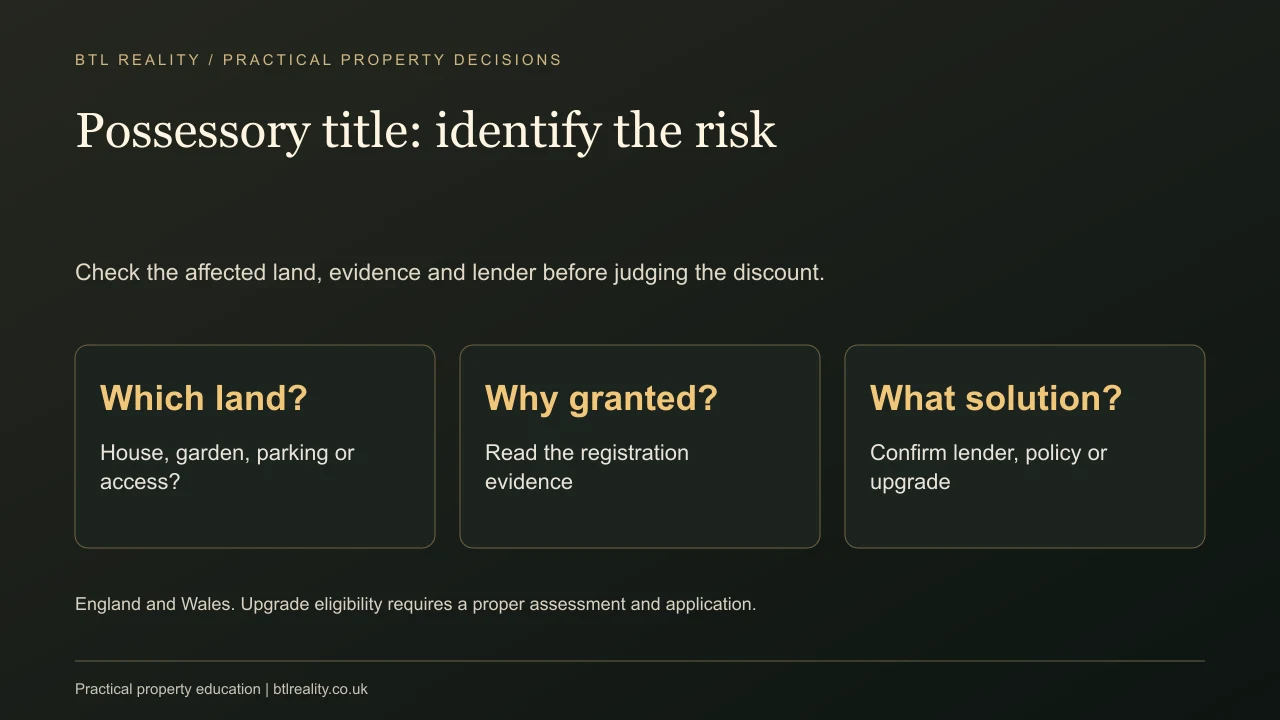
The price looks attractive, but the conveyancer reports possessory title. It is an unfamiliar phrase for many buyers, and it can prompt two equally unhelpful reactions: assuming the property cannot be bought, or assuming a small insurance premium makes everything harmless.
Start with the reason for that class of title and the exact land affected. A narrow garden strip raises different practical questions from the whole house or its only access. This guide concerns England and Wales and was checked on 19 October 2026. It is a buying framework, not a substitute for a report on a particular title.
What is possessory title?
HM Land Registry’s practice guide 42 explains the different classes of registered title. Possessory title may be granted where ownership is claimed through adverse possession or where documentary title cannot be produced. It is not the same as absolute title.
Do not translate that into a claim that the seller has no registered ownership or that every case involves squatting. Lost deeds and an adverse-possession claim have different histories and evidence. Ask the conveyancer why this title was granted and which qualifications and risks matter to your transaction.
The title register and supporting documents should guide that explanation. You need to understand what is established, what is not established and which earlier rights or claims could remain relevant. An estate agent’s statement that it is just a paperwork issue is not enough to price the risk.
Identify the affected land on a plan
Ask the conveyancer to show the possessory title against the house, garden, parking, outbuildings and access. A property can involve several title numbers and different classes of title. Do not assume a reference to possessory title applies to the entire holding, or only to a harmless corner.
Check the plan on site with the surveyor where appropriate. Does the affected area contain the route to the front door, part of the building, a drain or a parking space you intend to advertise? Even a small area can be important if the property depends on it.
If the purchase comprises more than one title, make sure the broker and lender see the complete arrangement. A valuation based on the whole marketed property may not answer whether the proposed security and legal rights are acceptable. Missing land cannot be treated as immaterial solely because it is a small percentage of the plot.
The viewing checklist helps record physical boundaries and how the property is used. Give those observations to the conveyancer so they can investigate any difference between the marketed property, occupation and title documents.
Lost deeds do not remove the need for evidence
Land Registry’s lost-deeds guidance describes the evidence needed when first registering land without the original deeds. It explains why possessory title is often granted in those circumstances and why reconstructing the title matters.
For a buyer, request the evidence supporting registration, relevant declarations or statements of truth and any available copies of older documents. Ask whether there have been adverse claims, disputes or newly discovered papers. The conveyancer should identify material gaps rather than simply record the registration date.
Missing documents can also leave questions about historic covenants or other rights. Ask what the register says and what further investigation is appropriate. A title issue is not necessarily limited to the possibility of someone claiming the whole property; the rights affecting its use can matter to a rental strategy too.
Do not prepare or sign a statement about historic ownership from guesswork. The people with direct knowledge need to provide appropriate evidence, and the solicitor should advise on its form and relevance. A confident story is not a replacement for a properly supported account.
The twelve-year point is not a simple countdown from purchase
Practice guide 42 explains that an application to upgrade a possessory title can be made after it has been registered for twelve years, subject to the requirements described there. That is not necessarily twelve years after you buy, and an eligible title does not simply rewrite itself without the proper process.
For example, assume a possessory freehold title was first registered on 1 June 2017 and you buy on 1 December 2026. The twelve-year anniversary is 1 June 2029. That is two and a half years after the assumed purchase date, not December 2038.
The date calculation alone does not prove that an application will succeed or that the risks disappear on that anniversary. Ask the conveyancer to assess the eligibility, possession evidence, any adverse claims and the appropriate application. A lender may still need an acceptable position now, before any future upgrade.
There may also be a route using further evidence that remedies the reason for the inferior title. Ask whether the seller can obtain an upgrade before you commit, what evidence is available and what timetable is realistic. Do not price an uncertain future upgrade as a completed result.
Check mortgage acceptance before spending heavily
Tell the broker about the class of title and affected land early. The conveyancer must assess the legal position and report relevant issues to the lender. Acceptance depends on the particular lender, property and proposed solution; a general agreement in principle is not confirmation about the title.
If the seller offers indemnity insurance, ask to see the proposed cover and the conveyancer’s explanation. Who is insured, what claim is covered, what is the limit and what exclusions apply? The lender may have requirements different from the protection you want for your own investment.
Insurance does not upgrade the register or guarantee that a future buyer’s lender will accept the same arrangement. Get advice before contacting potential claimants about a defect because that can affect proposed insurance. Disclose the full history to the advisers and lender handling the purchase.
For a cash purchase, consider your exit and any later refinance. The cash purchase followed by a mortgage guide explains why later borrowing must be tested rather than assumed. Cash changes how you fund completion; it does not repair the title.
A worked example: a discount is not all available cash
Assume two otherwise identical rental opportunities are being compared at £150,000 and £140,000. The cheaper one has the title issue under investigation. Assume a lender will advance 75% of the actual price in each case. That acceptance is an illustration only, not a lending prediction.
| Illustrative item | £150,000 purchase | £140,000 purchase |
|---|---|---|
| Loan at 75% | £112,500 | £105,000 |
| Deposit at 25% | £37,500 | £35,000 |
| Annual interest at 5.5% | £6,187.50 | £5,775 |
| Deposit difference | Comparison baseline | £2,500 less |
The £10,000 price difference reduces the assumed deposit by £2,500 and the debt by £7,500. It does not leave an extra £10,000 of cash in the buyer’s account. If additional legal and policy costs are £1,000, the deposit-and-extra-cost cash difference is £1,500 before other costs.
Annual interest is £412.50 lower in this illustration, but those savings do not quantify the title risk. Do not turn them into an expected loss estimate or use them to declare the defect acceptable. The legal evidence and lender position need their own assessment.
Use the Buy-to-Let Deal Analyser to compare verified finance and additional costs. Keep acquisition tax, standard fees and other differences in the complete model. A neat yield calculation cannot answer whether the land you need is securely usable.
Build a decision you can explain
Before exchange, ask for a written summary identifying the affected title, reason for registration, evidence available, relevant risk, lender response and any proposed insurance or upgrade. Separate facts already established from steps that depend on the seller or a future application.
Consider whether the uncertainty fits your cash reserve, experience and intended holding period. A property may still be purchasable where the issue is understood and appropriately addressed. It may also be the wrong fit if essential access or the dwelling itself remains subject to unacceptable risk.
The purpose is not to reject a class of title by name. It is to understand exactly what you are acquiring, how it can be financed and how a future buyer could assess it. Price is one part of that decision, with evidence doing the heavier work.
Frequently asked questions
Does possessory title mean the seller does not own the property?
It is a class of registered title rather than a statement that there is no registered owner. It carries qualifications compared with absolute title. Ask why it was granted and which risks, earlier interests or claims affect this particular purchase.
Is possessory title always caused by adverse possession?
No. Land Registry guidance also describes cases involving missing documentary title, including lost deeds. Those histories require different evidence. Your conveyancer should investigate the actual reason rather than assume every possessory title has the same background.
Does the title automatically become absolute after twelve years?
Do not assume that. Land Registry guidance describes an application to upgrade after the required registration period and subject to the relevant requirements. The calculation and supporting evidence need checking; simply waiting for an anniversary is not the same as completing an upgrade.
Does buying the property restart the twelve-year period?
The guidance refers to the period since registration of the possessory title, not simply your personal ownership period. Have the conveyancer confirm the correct original date and eligibility. The worked date example does not establish that any individual application will succeed.
Will title insurance make the property mortgageable?
It may form part of an acceptable proposal, but that is for the particular lender and conveyancer to confirm. Review the insured risks and exclusions. A premium payment does not change the registered class of title or guarantee a future lender’s acceptance.
Should I ignore a possessory garden strip if the house has absolute title?
No. Identify what the strip is used for and whether the rental depends on it for access, parking, services or other rights. Area alone does not determine significance. The conveyancer should explain the practical consequence of the affected land.