Buying a Rental With Missing Building Regulations Approval: What Next?
October 19, 2026
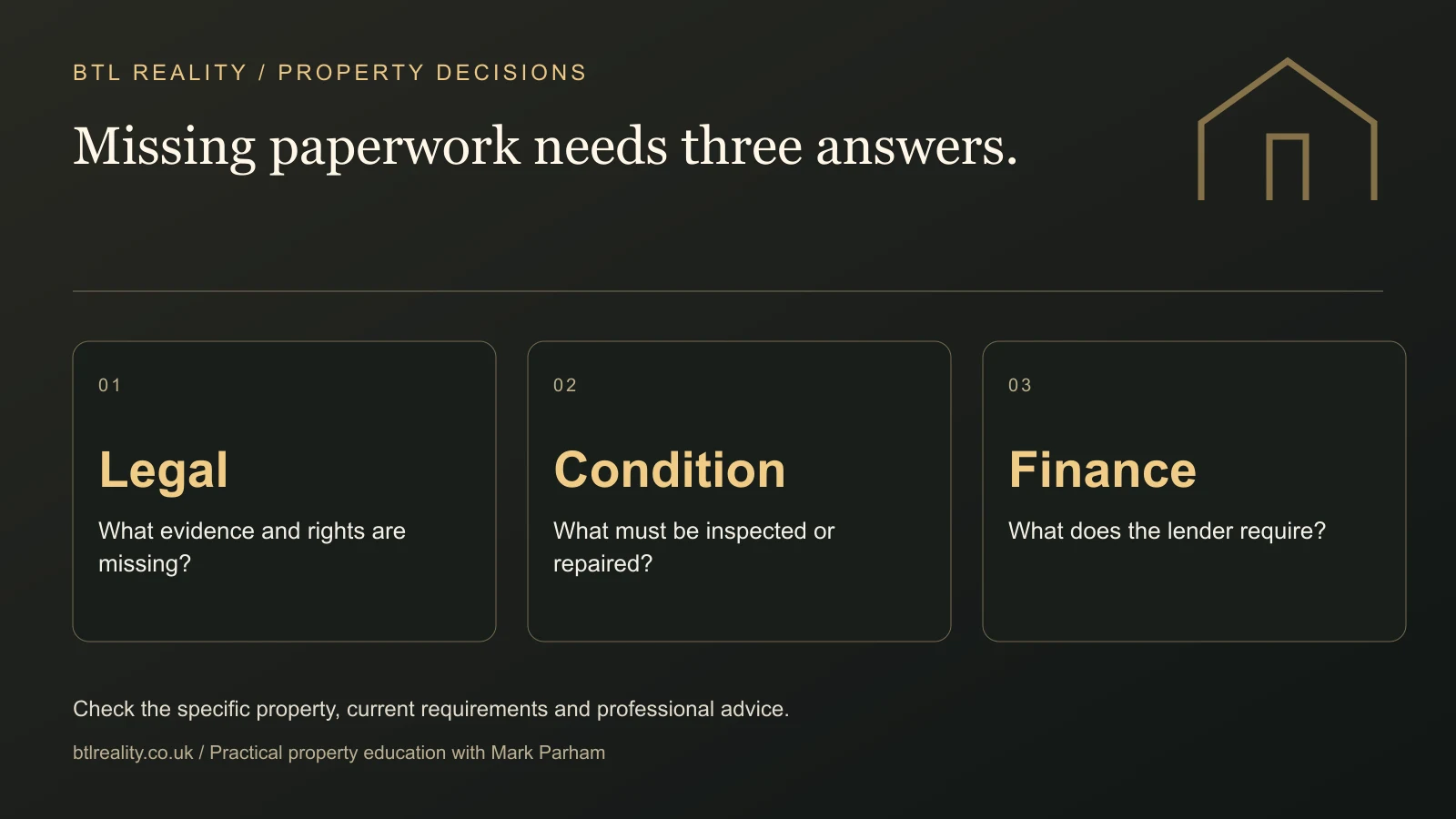
Missing building regulations approval is a reason to investigate before buying a rental property. It does not, by itself, prove that the work is unsafe. Equally, a tidy finish, an old alteration or an indemnity policy does not prove that the work is safe or acceptable to your lender.
The decision needs three separate answers: what legal evidence is missing, what condition and safety investigations are necessary, and whether the property can be financed and operated as intended. This guide focuses on England and Wales and helps you organise those questions with your solicitor, surveyor and broker.
Identify the exact work and missing evidence
Start by describing what changed: an extension, loft conversion, removed wall, drainage alteration, electrical work or another project. Record when it was reportedly done and who carried it out, while distinguishing documents from recollections.
Ask what approval, inspection or completion evidence should exist for that work and date. “No paperwork” is too broad a conclusion. The seller may have some documents but not the particular evidence your advisers need, or records may need to be checked with the appropriate body.
Create a simple evidence schedule. List the work, documents supplied, documents missing, professional reviewing it and next action. This prevents a reassuring answer about one alteration being applied to a different, unresolved project elsewhere in the house.
Planning permission and building regulations are different
Planning concerns and building regulations approval serve different purposes. A planning decision is not confirmation that construction satisfies the applicable building standards. Work may also need other consents depending on the property and circumstances.
The government's building regulations overview explains the distinction and why the relevant approval process matters. Ask your adviser which requirements applied to the specific work rather than assuming every alteration needed the same documents.
Where the work also changes occupation or use, add that to the investigation. The HMO planning guide explains why planning, licensing and technical requirements should be tracked separately. A house with extra rooms is not automatically an authorised higher-income rental.
Make the example your own
Have you separated the missing-approval questions?
Record the evidence and professional advice rather than treating insurance or a valuation as a complete answer.
0 of 6 checks reviewed
This is an organiser, not approval to invest. Selections stay in this page and are not saved or sent.
Completing this evidence checklist does not certify the building. It helps you keep legal, technical and lending questions separate so an answer to one cannot accidentally stand in for all three.
A mortgage valuation is not your condition survey
A lender may arrange a valuation for its own lending decision. That is not the same as a detailed investigation of alterations or a guarantee that missing approvals do not matter.
Tell your surveyor exactly what you know and what documents are missing before agreeing the inspection scope. Ask whether a structural engineer, electrician or other specialist needs to examine particular work. Some defects cannot be assessed from visible finishes alone.
The RICS guide to home surveys helps explain different survey levels. Our valuation versus buy-to-let survey guide shows why you should not confuse a lending assessment with your own purchase investigation.
Understand what an indemnity policy does and does not establish
Your solicitor may discuss indemnity insurance as one possible response to a legal title or approval issue. If so, ask what risk the actual policy covers, which parties benefit, what exclusions apply and what conditions must be met.
Do not treat the existence of a policy as a structural report or a certificate that building work is safe. Financial cover for a defined legal risk and the physical condition of an alteration are different questions. Ask your solicitor and surveyor to explain the remaining gaps between them. The GCS building regulations insurance summary is one provider example showing why the defined cover and exclusions need careful reading.
Before contacting the council about a historic issue, discuss the appropriate sequence with your solicitor because enquiries can affect the availability or terms of some insurance options. This is not a reason to conceal defects, avoid required compliance or disregard safety. Urgent hazards and lawful obligations still need proper action.
Regularisation is a process, not a guaranteed certificate
In some circumstances, retrospective building regulations approval may be considered through the relevant process. The government's application guidance explains that regularisation is handled through local authority building control and that alterations may be required before a certificate can be issued.
Ask a suitable professional whether this route applies to the work, what evidence and inspection are likely to be needed and what the possible outcomes mean. Avoid pricing the matter as a small administration fee before understanding whether opening up or remedial work may be necessary.
The seller may be willing to resolve the issue before completion, or the transaction may need a different approach. Your solicitor should explain the contractual implications. A promise that somebody will “sort the paperwork later” is not equivalent to an agreed and funded solution.
Model the cost of uncertainty properly
Consider an illustrative rental offered at £140,000 where a comparable property with satisfactory evidence and condition is £150,000. The apparent £10,000 saving is only a starting point.
Suppose professional investigation costs £1,200, remedial work is estimated at £8,000, further contingency is £2,000 and delay creates £1,500 of extra holding costs. Those entered amounts total £12,700, exceeding the apparent saving by £2,700 before any other differences.
These are made-up appraisal figures, not a quotation or prediction. The lesson is to compare the whole position. If the work turns out to need only minor resolution, the calculation changes. If inspection reveals a larger defect or lending restriction, the downside can be greater. Get evidence before selecting the convenient scenario.
Keep safety and price in the right order
Some issues can be evaluated through a realistic cost allowance. Others need resolution before the property can safely be occupied or before a lender will proceed. A discount does not turn an unresolved safety concern into a manageable maintenance item.
Ask the surveyor to distinguish urgent matters, further investigations and routine improvements. Ask the solicitor which evidence is essential for the transaction. Then establish who will carry out and verify any necessary work.
If tenants are already present, understand the current condition and responsibilities rather than assuming occupation demonstrates compliance. The urgency and appropriate response should be assessed by relevant professionals using the facts, not by the attractiveness of the quoted yield.
Tell the broker the actual position
Give the broker accurate information about the alteration, evidence available and any professional findings. Ask what the lender requires and when it must be supplied. Do not wait until the final days before completion to reveal a known issue.
A different lender is not automatically a solution. Even if finance is available, your own safety, cost and resale concerns remain. Conversely, a lender's request for further evidence may reveal something useful rather than merely slowing the transaction.
Update the funding plan if investigation changes the timetable or cash requirement. The buy-to-let deal calculator can help compare revised costs and cashflow, while the mortgage stress calculator tests a separate borrowing-cost scenario.
Decide what must happen before commitment
Agree the next steps with your solicitor before exchange or another binding commitment. This may include additional evidence, inspections, agreed work, lender confirmation or a revised commercial decision. The appropriate approach depends on the transaction and jurisdiction.
Be especially careful with auctions and accelerated purchases. Investigation deadlines can be short, and legal commitments may arise before the normal sequence of enquiries is complete. A bidder should understand the unresolved position and the funds needed before taking that step.
Set a review point rather than allowing the process to drift. If essential evidence remains unavailable, decide whether the uncertainty fits your budget and risk tolerance with professional advice. Time and money already spent should not force you to accept a purchase you would reject if seeing it for the first time.
Use the findings to improve the next search
Record which issues mattered and how they changed the appraisal. This turns one awkward transaction into a clearer brief for the next property: acceptable work, evidence requirements, cash reserve and finance route.
Done For You sourcing is designed around an agreed property brief. It should help focus the search, while conveyancing, condition investigations and lending checks remain necessary for each purchase. The aim is a property you can operate with a documented plan, not simply one with an attractive asking-price discount.
Frequently asked questions
Is planning permission the same as building regulations approval?
No. They address different aspects of development and construction. A planning approval does not certify the technical quality or compliance of the finished work. Ask your solicitor and surveyor which documents apply to the particular alteration and whether additional evidence, inspection or consent is needed for the intended rental use.
Does an indemnity policy prove the work is safe?
No. Ask what the specific policy covers and which conditions apply, but keep the physical investigation separate. A legal-risk insurance product is not a substitute for a survey or specialist assessment. You need to understand both the financial protection offered and any unresolved condition or safety concerns.
Can missing approval affect my mortgage?
It can affect a lender's requirements or willingness to proceed. Give your broker the relevant facts and professional findings early. The lender may need additional evidence or another agreed response. Even where finance is available, independently assess the cost, safety and future saleability implications for your own investment.
Should I contact the council before speaking to my solicitor?
For a historic approval issue in a purchase, discuss the sequence with your solicitor first because contact can affect some proposed insurance options. That does not justify hiding hazards or ignoring compliance duties. The solicitor and relevant technical professionals should help establish a lawful, safe route appropriate to the facts.
What is retrospective approval or regularisation?
It is a possible process for addressing certain work carried out without the required building regulations approval. It is not an automatic certificate for a fee. Eligibility, inspections and necessary changes depend on the circumstances, so obtain advice and a realistic scope before assuming it will resolve the purchase issue.
When should I pause a purchase until the evidence is clearer?
Pause for professional review when unresolved matters could materially affect safety, lawful operation, finance or the cash required. Agree what evidence would change the decision and who must provide it. A strong headline yield does not remove the need to understand a structural alteration, approval gap or substantial remedial cost.
Put the next step into practice
Use the free tools to test your numbers, then choose the level of support that fits your next decision.