Can I Put My Buy-to-Let on Airbnb?
October 15, 2026
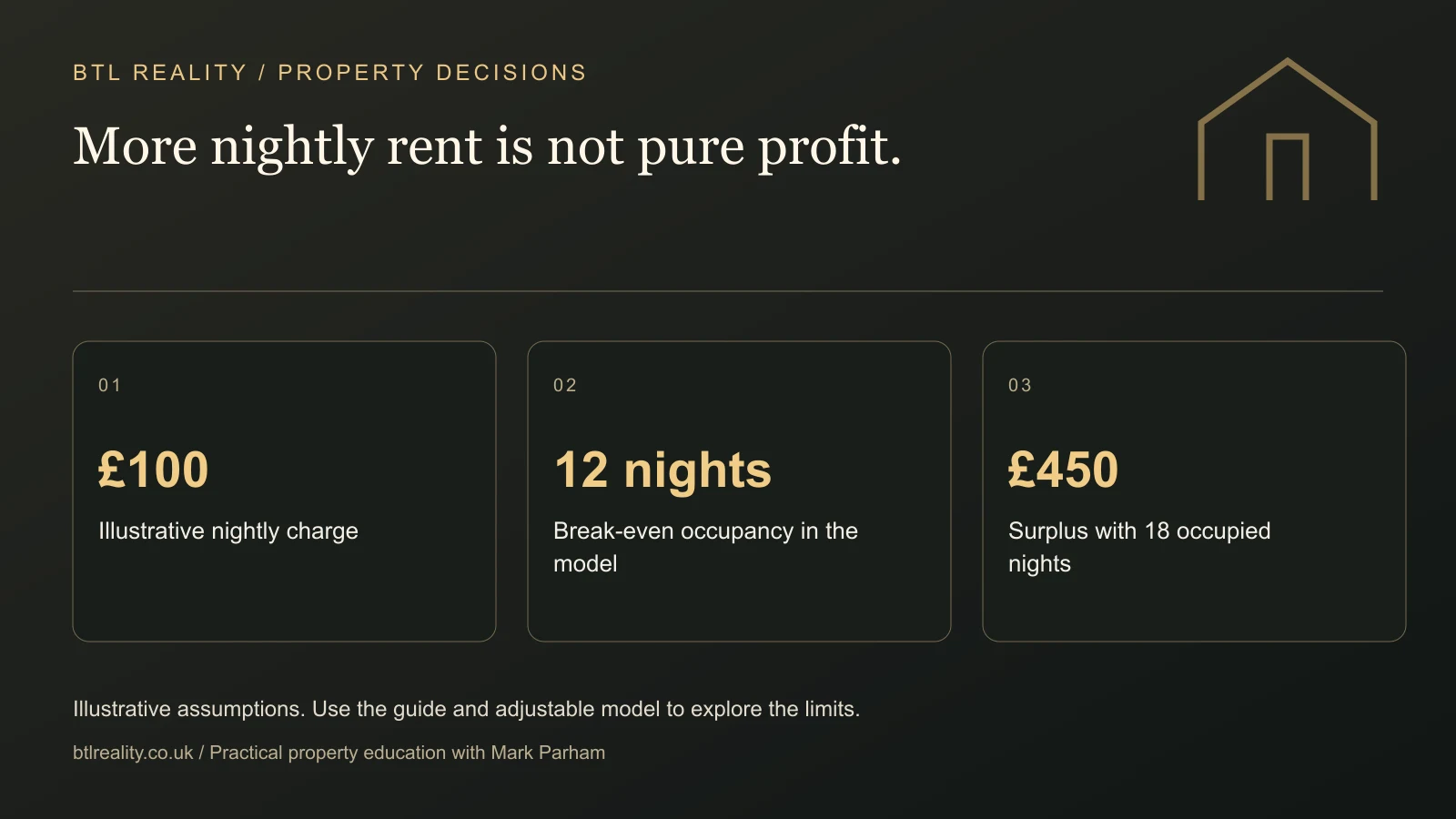
You should not put a buy-to-let on Airbnb until the finance, lease, planning position, insurance and safety requirements fit short-term letting. A property that works as a conventional rental is not automatically authorised or suitable for paying guests who stay a few nights at a time.
Once those checks are clear, compare the money you keep with the additional work and uncertainty. A £100 nightly rate sounds impressive beside £1,000 monthly rent, but empty nights, cleaning, platform charges, utilities, management and replacement costs all change the result.
Airbnb is a booking platform. It does not decide whether your particular property can legally or contractually operate as a short let. Establish that first, then build a realistic operating model.
Check the mortgage before changing the use
Tell your broker or lender exactly what you propose: occasional stays, a dedicated holiday let, contractor accommodation or another arrangement. Those descriptions are not necessarily interchangeable for underwriting. Obtain confirmation for the actual use rather than assuming the phrase “buy-to-let” covers every form of letting.
As one example, The Mortgage Works' general criteria state that its buy-to-let mortgages do not accept holiday lets. Other routes have their own terms. A property generating enough money to cover the payment can still be used contrary to the mortgage conditions.
If a new product is required, include its costs and lending requirements in the decision. Check whether a change affects the amount borrowed, interest, early repayment charges or timing. Do not start taking bookings while the financing question is unresolved.
Read the lease and building arrangements
For a leasehold flat, ask your conveyancer to review the relevant restrictions, permitted use and consent provisions. Short-term occupation may create different issues from a conventional tenancy. A building where another owner advertises on a platform does not prove your own lease permits it.
Consider the practical operation too. How will guests enter? Where can keys be stored? Are shared entrances, neighbours and waste arrangements suitable for frequent changeovers? These details affect guest experience and the people who live in the building full time.
Keep any required consent in writing and understand its conditions. An agent saying that holiday letting “should be fine” is not the same as a legal review of the lease or formal permission from the relevant party.
Planning and licensing depend on location
In England, government guidance on self-catering holiday accommodation directs operators to the local planning authority to confirm whether the proposed use requires permission. It also covers safety, insurance and other operating requirements. Check the address and intended pattern of use, not only a general national summary.
Scotland has a short-term let licensing system. Wales has specific planning use classes, including short-term lets, with local controls relevant to changes of use. Northern Ireland has its own requirements, so obtain the applicable guidance before planning to operate there.
Do not treat a proposed future rule as though it is already in force. Equally, do not assume the absence of one national registration requirement removes existing local, safety or contractual obligations. Confirm the current position with the responsible authority when making the decision.
Model the nightly rate after the variable costs
Suppose a property achieves an illustrative £100 per occupied night and sells 18 nights in a month. Gross accommodation revenue is £1,800. Assume platform costs equal 15% of that revenue and net cleaning and linen costs average £10 per occupied night. Those deductions are £270 and £180 respectively.
That leaves £1,350 before the month's fixed operating and finance costs. If utilities and internet are £250, other ongoing costs and allowances are £150, and finance costs £500, the simplified result is £450 before tax and exceptional expenses.
The 15% fee is a modelling assumption, not a statement that every host pays it. Airbnb's fee guidance explains that fee arrangements can differ and change. Use the actual structure applying to your account, including how charges on cleaning or other fees affect the payout.
Make the example your own
How many occupied nights make the short let work?
Enter nightly revenue, variable charges and all monthly fixed costs. Use costs after any cleaning charge recovered from guests.
A scenario, not an occupancy or earnings forecast. Break-even above the available nights is not achievable at these inputs. A non-positive contribution per night cannot cover fixed costs. Add setup costs, tax, major repairs and your time separately. Illustrative only. Inputs stay in this page and are not saved or sent.
Occupancy makes the same property look very different
At 12 occupied nights, the same £100 rate produces £1,200 gross revenue. The assumed platform charge is £180 and the variable cleaning allowance £120. After the same £900 fixed costs, the model breaks even before tax and exceptional expenses.
At 24 nights, revenue is £2,400, the platform deduction £360 and the cleaning allowance £240. The model leaves £900 after fixed costs. These are scenarios, not predictions. A property does not achieve high occupancy simply because the spreadsheet allows it.
Use realistic monthly patterns rather than multiplying the best month's result by twelve. Demand can vary with holidays, events, employment projects and competition. Rates and occupancy can move together: lowering the price to fill more nights may not improve the final surplus as much as expected.
Compare it with a long-term rental on equal terms
Suppose a conventional letting would achieve £1,000 monthly rent, with £500 finance and £250 ordinary operating costs and allowances. That leaves £250 before tax and exceptional work. The illustrative 18-night short-let case leaves £450, a difference of £200 a month under the selected inputs.
That extra £200 needs to compensate for any additional management effort, uncertainty and capital committed to furnishing and setup. If professional short-let management costs have not been included, the comparison is incomplete. If you manage it personally, your time still has value even though it does not appear on a supplier invoice.
Use the rental yield calculator for the conventional letting baseline. Then build the short-let model with its own costs. Keeping the two operating systems separate is more useful than borrowing the higher revenue from one and the lower costs from the other.
Budget for setup and replacement
Guests need a functioning, properly equipped place to stay. List furniture, bedding, towels, kitchen equipment, safety work, photography, access arrangements and other setup costs. Use quotes and a clear specification, including what is already present and suitable.
Set a replacement allowance for wear, breakages and items that need refreshing. Do not assume the first furnishing spend lasts indefinitely. The standard expected at the nightly rate should be supported by ongoing maintenance and reliable cleaning.
For example, £8,000 of extra setup costs compared with a conventional let would take forty months to recover from a flat £200 monthly additional surplus. That simple illustration ignores changing performance, tax, financing and the value of your time. It shows why a small monthly advantage may not justify the switch quickly.
Treat management as an operating job
Short-let management includes guest communication, changeovers, maintenance coordination, pricing, availability and responding when something fails outside convenient hours. Decide who performs each task and what happens if that person is unavailable.
Obtain a clear management quotation where you outsource. Check which charges are included and which sit outside the headline percentage. Cleaning, linen, callouts, maintenance coordination and platform administration can be treated differently between providers.
Ask how reporting works. You need to understand gross bookings, cancellations, refunds, fees, cleaning receipts and the actual payout. A dashboard showing booking revenue is not the same as the bankable profit from the property.
Insurance and safety must match guest use
Explain the intended operation to the insurer and obtain suitable cover. Do not assume a conventional landlord policy or a platform's protection arrangements replace the insurance you need. Ask how accidental damage, liability, empty periods and business interruption are treated in the actual wording.
The safety assessment should match the accommodation and its use. Use competent professionals for relevant fire, gas, electrical and other requirements. Frequent guest changes do not reduce the need for a properly maintained and safe property.
Keep a practical operating file containing permissions, inspections, insurance documents, emergency arrangements and maintenance records. This is part of running the accommodation responsibly, not paperwork to assemble only after a complaint or incident.
Tax assumptions need updating too
Avoid models that rely on old furnished holiday letting tax advantages without checking the current law. The government's England holiday-accommodation guidance notes the abolition of the former furnished holiday lettings regime. Ask your accountant how the present rules apply to your ownership and operation.
Business rates or council tax, VAT considerations where relevant, and the treatment of expenditure also belong in the professional review. A change in operating style can have consequences beyond the nightly revenue line. Do not infer your own tax position from another host's net-income screenshot.
Keep a viable alternative
Before switching, establish what happens if short letting is not permitted or produces less income than expected. Could the property still operate as a conventional rental on acceptable numbers, subject to the right permissions and tenancy arrangements? What setup costs would be unrecoverable?
The buy-to-let deal calculator can help test that fallback. If you want education and support in comparing property strategies, Starter Club provides a place to develop the plan and ask better questions.
Short letting can be a strong operation in the right property with the right systems. Choose it because verified demand, permissions and complete costs support the decision, rather than because a nightly rate looks larger than monthly rent.
Frequently asked questions
Does a standard buy-to-let mortgage allow Airbnb?
Not automatically. The lender's terms must permit the actual type of short-term occupation. Tell your broker or lender the intended use before accepting bookings. A suitable holiday-let or other finance route may be needed, and each has its own criteria and costs.
Can a lease prohibit short-term letting?
Yes, lease terms can restrict the use or occupation of the property. Ask your conveyancer to interpret the actual wording and any consent requirements. Another flat being advertised online does not establish that your lease allows the same activity.
Do I need planning permission to switch to holiday lets?
Possibly, depending on location, existing permissions, the proposed use and applicable rules. Obtain confirmation from the local planning authority for the actual address. Do not rely on a general statement that listing a property on a platform never changes its planning position.
Are the rules the same across the UK?
No. Planning, licensing and other requirements differ between UK nations and can vary locally. Check the relevant national and council guidance, then verify the property-specific position. A compliant operation in one area is not evidence that the same arrangement is permitted elsewhere.
How do I compare nightly revenue with long-term rent?
Deduct realistic platform charges, cleaning, utilities, management, maintenance, replacement allowances, finance and other costs. Model seasonal occupancy and setup spending. Compare the resulting cashflow with a conventional letting on consistent assumptions rather than comparing gross booking revenue with net rental income.
What happens if the short-let strategy is not permitted?
Do not operate it without the required permissions and suitable arrangements. Review a lawful alternative, such as conventional letting where permitted, and recalculate the costs and income. A property that only works under an unavailable strategy may not fit your investment brief.
Put the next step into practice
Use the free tools to test your numbers, then choose the level of support that fits your next decision.