What Should a Personal Property Investment Plan Include?
October 10, 2026
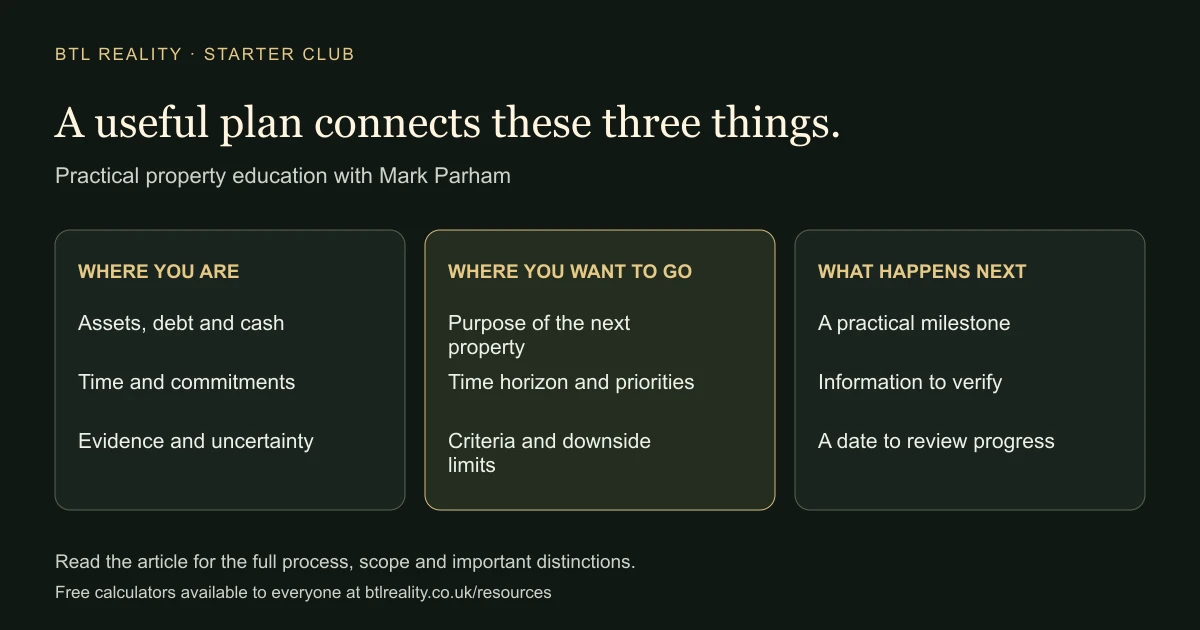
A personal property investment plan should connect your starting position, your objective and the next decisions you need to make. It should be specific enough to guide action and flexible enough to change when the evidence changes.
It is not simply a target number of houses or a forecast showing a large future value. Those may be outputs of a model, but they do not explain what you can do next, what the plan depends on or how you will respond if progress is slower than expected.
At BTL Reality, a personal roadmap is part of Starter Club. This guide sets out the elements that make a plan useful and gives a clearly hypothetical example. You can use the framework independently with our free resources, whether or not you join.
Start with your present position
List the assets, debts and cash relevant to your planning. Distinguish net worth from money available for a purchase. Equity in a home is not the same as cash in a bank account, and accessing it may involve borrowing, costs and eligibility checks.
Include your ongoing commitments and the money you need to keep available. A plan that allocates every pound to a deposit can leave little room for ordinary life or unexpected property costs.
The net worth calculator can help organise the picture. Record which figures are estimates and where you would need better evidence before making a commitment.
Your time and experience belong in the starting picture too. A refurbishment-heavy strategy may demand a different level of involvement from a property with limited initial works and professional management.
Define what the property is meant to achieve
“Build wealth” is a direction, but it is not yet a decision framework. Consider whether you are prioritising current income, a longer-term asset base, a first home or preparation for a future change in work.
Different objectives can conflict. Maximising borrowing might increase the scale of an illustrative portfolio while reducing its monthly surplus. Paying down debt may improve resilience but leave less capital for another purchase.
Write the priority in ordinary language and add a time horizon. Then identify what would count as progress before a purchase happens. That prevents the plan from treating every month without a transaction as failure.
The financial freedom calculator can help explore longer-term income goals, but its assumptions need to be read alongside the result. A scenario is not a promise.
Build a complete cash budget
A purchase budget should separate the deposit, acquisition taxes, professional fees, finance costs, works and reserves. The exact lines depend on the property and transaction.
Use the buy-to-let deal calculator to organise an illustrative appraisal. Do not use a lender’s maximum borrowing figure as a substitute for deciding what you can comfortably support.
For any uncertain cost, write down how you will confirm it. That might mean a quote, a professional discussion or further inspection. A number becomes more useful when you know where it came from.
Keep the purchase budget separate from the ongoing operating budget. The first tells you what may be needed to complete; the second asks whether ownership remains workable afterwards.
Set criteria that guide the search
Your plan should explain what types of property you will investigate and why. Location, condition, tenure, likely tenant demand and management requirements all affect whether an opportunity fits.
Use criteria as a filter, not a way to manufacture certainty. If every realistic property fails your assumptions, review the plan rather than quietly changing the numbers until one passes.
A useful criterion might be a limit on initial works because your time is constrained. Another might be evidence of rental demand for the actual property type rather than a broad statement about a city.
If you later use a sourcing service, these criteria help form the agreed brief. Our guide to having someone find an investment property for you explains how that relationship differs from planning support.
Check the structure of your property plan
Tick the preparation steps you have completed. This is an organiser, not a readiness score or investment approval.
0 of 8 preparation steps completed
Your selections stay in this page and are not saved or sent.
Example: a hypothetical first-year preparation plan
Imagine Alex, a hypothetical reader with £30,000 in accessible savings, a separate emergency reserve and capacity to save an illustrative £500 per month. These figures are not a client result, a recommendation or evidence that a purchase is affordable.
If Alex retained all of those monthly savings for twelve months, the starting £30,000 would become £36,000 before interest or any withdrawals. That is simple arithmetic, not a projection of investment growth.
The plan would still need to establish the full cash required for a suitable purchase, potential financing, operating costs and the reserve to retain afterwards. The savings total alone cannot answer those questions.
In the first stage, Alex could organise the current position and identify gaps in the budget. The next stage might involve a broker conversation, area research and practice appraisals using evidenced rent and cost assumptions. Only then would the search criteria become more useful.
A responsible twelve-month outcome might be a purchase, but it could also be a better-funded position and a decision to wait. The plan should help distinguish those outcomes rather than promise that the calendar determines readiness.
Use milestones you can influence
Some milestones depend on other people or market conditions. You cannot guarantee a lender’s decision or force a suitable property to appear. You can control preparation and the quality of your evidence.
Examples include completing a cash budget, gathering comparable rents, obtaining relevant professional input and documenting the reasons a property does or does not fit. Each should have a clear definition of completion.
Keep the next action small enough to do. “Research the entire UK market” is difficult to finish. “Compare evidence for two shortlisted areas using the same questions” is more manageable.
Review the plan regularly. If the action was not completed, ask whether the obstacle was time, missing information, an unrealistic task or a change in priorities. The response should address that obstacle rather than add another ambitious target.
Include a downside and a pause point
A plan should state what could make you slow down or reconsider. Higher borrowing costs, a lower rent estimate, larger works or reduced personal income can alter the decision.
The mortgage stress calculator helps explore rate assumptions. It does not capture every risk, so include practical issues such as delays and your capacity to manage work as well.
A pause point is a condition that requires a new review before proceeding. For example, if a key quote changes materially, update the appraisal rather than treating the original budget as fixed.
Writing that down in advance can help when enthusiasm makes a property feel difficult to walk away from. A plan is useful partly because it gives you reasons to say no.
Decide where support would improve the plan
You may be comfortable building the framework independently. The free BTL Reality resources remain available without paid membership, and every calculator shows results on the page.
If you want a personal roadmap with ongoing group support, Starter Club is designed around that need. It includes a monthly live group call and, for founding members, a private WhatsApp group where I participate weekly for your first twelve months while subscribed.
If your situation needs more intensive one-to-one discussion and bespoke modelling, Private Mentorship is a separate service with published entry criteria. Neither format replaces qualified mortgage, tax or legal advice.
The right question is not “which product is best?” in isolation. It is “which support addresses the part of my plan I cannot currently resolve well?”
What Starter Club’s roadmap does and does not mean
The roadmap is built around your circumstances and objectives, working towards a first or next property over a twelve-month planning horizon. It is not a guarantee that you will buy within that period.
The ongoing value comes from using the plan: bring questions, review progress and gather the information needed for the next decision. A document left untouched is unlikely to change what you do.
The founding offer is currently £39.99 per month for the first one hundred members, with the rate locked while continuously subscribed. The Starter Club page explains the included group access, guarantee and cancellation terms.
You can also read what to focus on in your first thirty days for a practical way to start. The aim is clarity and informed action, not a plan that sounds impressive but ignores your life.
Frequently asked questions
Can I create a property plan without joining a club?
Yes. Use this framework and the free tools independently. Membership adds planning and ongoing support; it is not required to access the calculators.
Does a plan need a target number of properties?
Not necessarily. Begin with the outcome you want and test what different approaches might require. Property count alone does not describe income, debt or workload.
Is the example a real client result?
No. Alex and the figures are hypothetical, included to demonstrate how milestones and a cash budget fit together.