Visitor Levy Bill Passes Second Reading: Holiday-Let Checks
November 17, 2026
Property News · England · Commons vote 16 November 2026
By Mark Parham · Published 17 November 2026
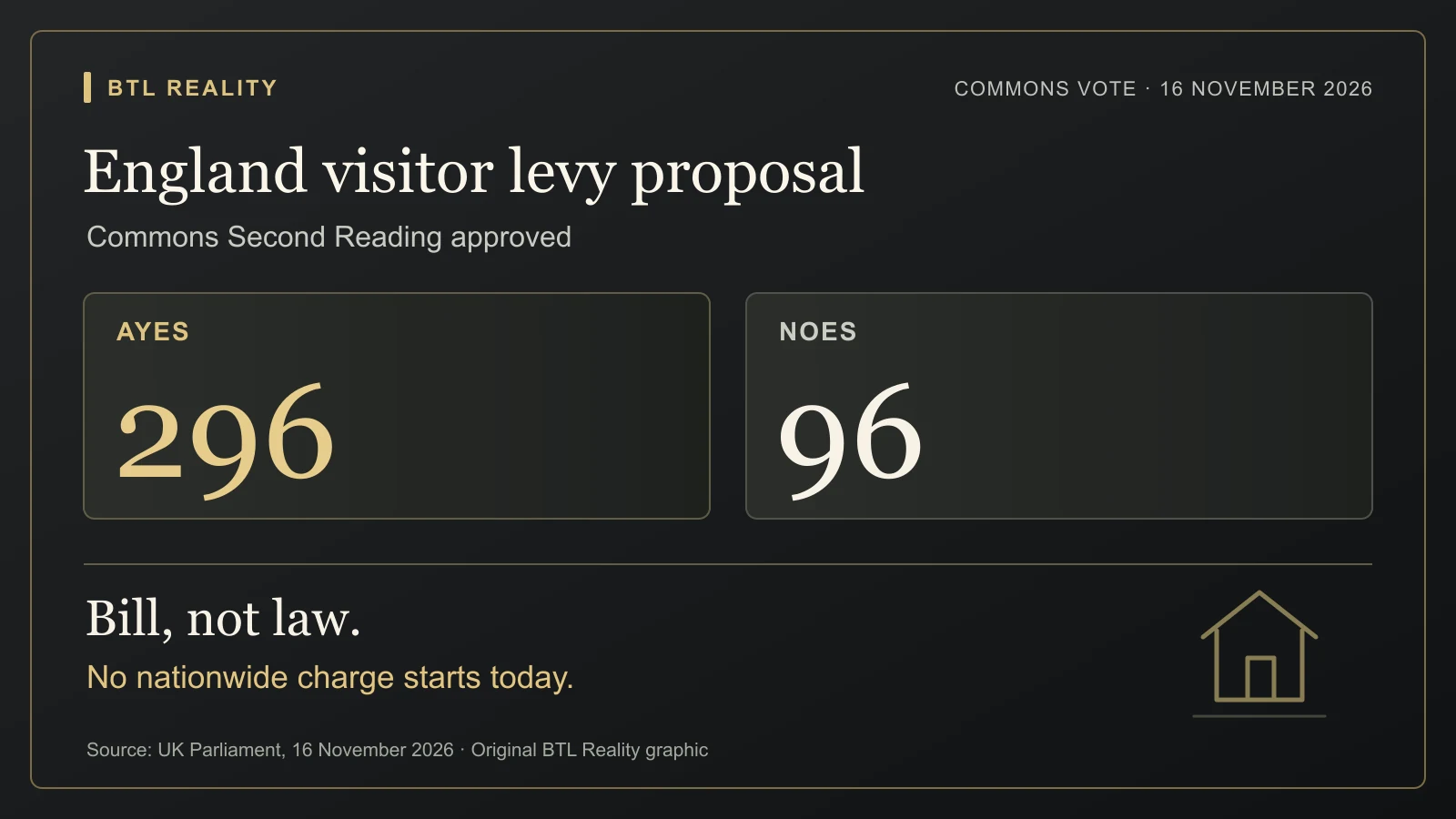
MPs have backed the Visitor Levy (England) Bill at Second Reading. The 16 November Commons debate ended with 296 Ayes and 96 Noes, allowing the proposed framework to move into detailed committee scrutiny.
For holiday-let and serviced-accommodation investors, this is a useful point to check the operating model. The proposal concerns a levy on qualifying accommodation receipts, with liability resting on the provider. It also contains a long-stay exclusion that is easy to miss if you rely on a simple “first 28 nights” summary.
What changed last night?
The Bill was introduced on 4 November. Last night’s official division is the fresh development: MPs agreed its Second Reading, and the programme motion commits it to a Public Bill Committee whose proceedings must conclude by 10 December 2026. That is a scrutiny deadline, not a date when guests or owners must start paying.
The underlying proposals were not newly inserted overnight. The current text would give English strategic authorities a choice about introducing a local levy. Further parliamentary stages, commencement arrangements and local decisions still matter. A mayor expressing support is not a completed local scheme.
The Bill extends to England and Wales, but these substantive levy powers concern England. Separate arrangements elsewhere in the UK need their own checks. An existing accommodation Business Improvement District charge should also be identified separately rather than assumed to be this proposed levy.
Who would actually be liable?
Under clauses 5 and 14 of the introduced Bill, liability sits with the accommodation provider. The definition broadly follows who brings the stay’s accommodation receipts into account for Income Tax or Corporation Tax, with specified assumptions. The actual operating agreement matters.
Using an agent or booking platform would not, by itself, remove the provider’s obligations. A manager receiving the guest’s payment is different from someone taking responsibility for the required records, returns and remittance. Before signing a management agreement, ask who does each job, who checks it and what happens when a booking changes.
The holiday-let management and agent-fees guide helps with the wider cost comparison. Check whether a quoted percentage is based on gross booking income and which deductions are included. A new administrative duty can affect the workload even when a charge is passed to the guest.
The 28-day provision needs careful reading
Clause 8 defines qualifying stays as paid residential occupation under a licence, subject to exclusions. Do not apply a tourist-tax assumption automatically to an ordinary residential tenancy. Equally, a property’s marketing label does not settle the legal character of the occupation.
There are two distinct long-stay provisions. Clause 8(2)(b) excludes occupation on a day immediately after 28 successive days of occupation. Clause 8(2)(c) also excludes occupation when the provider knows, or has reasonable grounds to believe, that the person will occupy for 28 or more successive days.
That second provision is important. A known 35-day stay should not automatically be modelled as owing a levy on its first 28 days. The provider’s knowledge or reasonable grounds at the relevant time matter. The 28-day period can include days before the provider gained that knowledge or belief. A short booking that is later extended raises different record-keeping questions; do not invent a refund or retrospective adjustment rule from a headline.
For an operator, the practical response is to keep agreed dates, extensions and supporting correspondence together. Separate known long stays from ordinary short bookings in the appraisal. Do not assume that changing a booking’s label creates an exclusion.
There is no usable national threshold figure yet
Clause 6 tests the provider’s total qualifying consideration for a three-month chargeable period against a levy threshold. The Bill leaves any positive cash threshold to regulations and, where authorised, a higher local amount. Clause 6 also includes nil as the fallback.
It also aggregates associated providers in specified circumstances, including connected providers and those acting together. That matters if a group operates through more than one entity. One property, one spare room or several companies should not be treated as proof of exemption. Keep a threshold assumption visibly separate from a confirmed rule.
Clauses 7 and 8 contain other exclusions, including specified institutional accommodation, institutional student accommodation occupied by students, authorised Gypsy and Traveller sites and qualifying statutory accommodation arrangements. Further prescribed categories are possible. Those descriptions do not mean every student flat, medical visit or contractor booking is automatically exempt.
What could it do to a holiday-let margin?
The rate would be a percentage set through the local framework. The government’s 4 November announcement reported a commitment by ten mayors to keep any levy in their areas at or below 5%. That political commitment is not a universal statutory 5% ceiling in the introduced Bill.
Here is an original sensitivity test, not a current bill or forecast. Assume one future calendar quarter has £12,000 of accommodation consideration that all qualifies and exceeds the applicable threshold. The base excludes VAT, consistent with clause 4. Assume £9,000 of operating costs, leaving £3,000 before levy, finance, tax and capital expenditure.
| Hypothetical scenario | Levy on £12,000 | Remaining operating surplus | Reduction in surplus |
|---|---|---|---|
| No levy | £0 | £3,000 | 0% |
| 3% assumed rate | £360 | £2,640 | 12% |
| 5% assumed rate | £600 | £2,400 | 20% |
At 5%, £12,000 × 0.05 gives £600. Subtracting that from £3,000 leaves £2,400, so the levy consumes 20% of the starting operating surplus. The percentage charged on receipts and the percentage reduction in surplus are different numbers.
This deliberately assumes the provider absorbs the cost with receipts, demand and operating costs unchanged. Passing a charge to guests could produce a different result, but guest acceptance, occupancy and pricing cannot be guaranteed. The illustration does not calculate VAT payable, package apportionment, platform commissions or personal tax.
Use the free buy-to-let deal analyser to compare acquisition costs, finance and running-cost assumptions. It is not a visitor-levy calculator. Keep a separate booking-level short-let schedule and check how any monthly input represents seasonal income and expenses.
What needs to happen locally?
The Bill’s Schedule 1 requires a draft prospectus and impact assessment, consultation, consideration of responses and the appropriate local approval process. A final prospectus would identify the rate, relevant threshold and exemptions, first chargeable period and transitional arrangements.
Before changing a purchase budget, identify the strategic authority covering the accommodation and monitor its actual documents. The date on a national press release does not tell you when a particular local scheme starts. Do not assume an unverified minimum notice period or treat the committee deadline as commencement.
The proposed administration normally uses quarterly returns and payments, with some annual categories possible through regulations. Keep enough detail to identify qualifying stays and consideration for the relevant period. Ask the operator how it would handle corrections, evidence of exclusions and payment deadlines.
None of this replaces planning, licensing, mortgage or insurance checks. Paying a future levy would not, on its own, establish that a short-let use is permitted. The decision remains whether the individual property works with supported income, complete costs and the right permissions.
If you want help turning an investment appraisal into a practical property plan, explore Starter Club. The current offer includes a personal 12-month roadmap and a monthly group call. Keep specialist legal and tax questions with the appropriate adviser.
Frequently asked questions
Is England’s visitor levy law after the Commons vote?
No. MPs approved Second Reading on 16 November. The Bill proceeds to committee scrutiny and further parliamentary stages. No nationwide charge begins because of that vote.
Is 5% the confirmed maximum visitor levy?
No universal statutory 5% cap appears in the introduced Bill. Ten mayors’ reported commitment is different from a legal ceiling. The examples here use hypothetical rates, not confirmed local charges.
Would a known 35-day stay pay for its first 28 days?
Do not assume so. Clause 8(2)(c) excludes occupation when the provider knows or has reasonable grounds to believe the stay will be 28 or more successive days. Apply the actual facts and final rules, including any extension or knowledge-timing issue.
Would one holiday let or a spare room be exempt?
No automatic blanket exemption is established by owning just one property. Any positive quarterly threshold depends on regulations and, where authorised, a higher local amount; the Bill includes nil as the fallback. Associated-provider aggregation can matter.
Would my agent or booking platform be responsible?
The proposed legal liability remains with the accommodation provider. Agree who keeps records, prepares returns and handles payments; a platform taking guest money does not settle all those duties.
Should I add this to my cash-flow forecast now?
Test a clearly labelled scenario for a relevant short-let business, alongside the current-cost case. Replace assumptions only when the final legislation, commencement and applicable local scheme provide verified figures.
Checked against the introduced Bill, the 16 November Commons outcome and the government’s 4 November announcement. Parliamentary and local proposals can change. All financial examples are original assumptions, not an announced rate, threshold or forecast.