Tenant EV Chargers: England Consults on Landlord Permission Rules
October 22, 2026
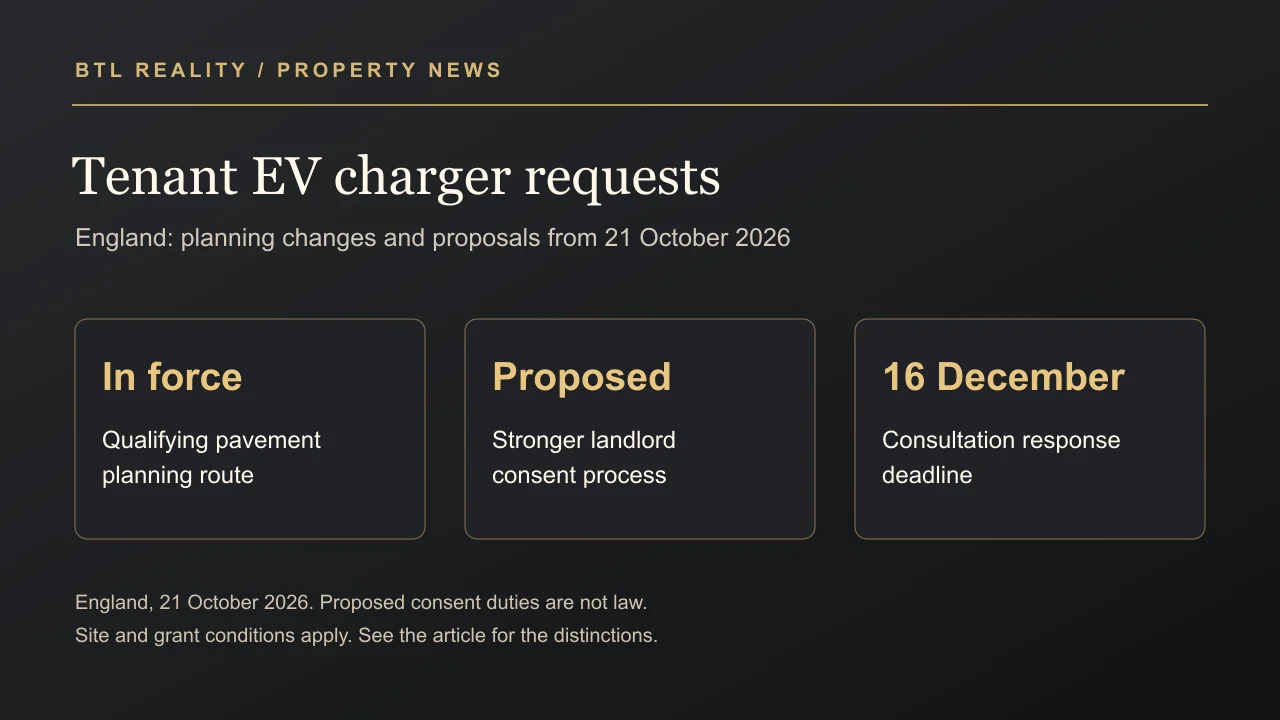
England is consulting on a stronger route for tenants and leaseholders who want an electric vehicle charger. The proposals published on 21 October 2026 include requiring landlords and freeholders to make timely decisions and not unreasonably refuse a request. Those requirements are proposed, not law already in force.
A separate planning change took effect on 21 October 2026. Qualifying cross-pavement charging installations in England can now use permitted development rights, subject to conditions and highway-authority involvement. That does not give someone permission to trail a cable across a pavement or claim the parking space outside their house.
For a landlord receiving a charger request, there are two decisions to keep separate: what the property can safely accommodate now, and what a future consent process might require. The practical checks on parking, costs, ownership and maintenance still matter.
What has changed, and what is still proposed?
| Development | Status | What it means for a rental |
|---|---|---|
| Qualifying pavement channels and associated charging equipment | Permitted development changes in force from 21 October | Check the site’s conditions and highway authorisation. Other rights and permissions remain relevant. |
| A stronger tenant or leaseholder route to request a charger | Open consultation, closing 16 December | No new universal approval duty or 28-day legal deadline has been created by the consultation. |
| Residential landlord chargepoint grant | Existing conditional scheme | Check the applicant, off-street parking and approval before assuming funding. |
The first two developments appear together in the Department for Transport’s announcement. They have different legal status and should not be treated as one new right to install anything anywhere.
The proposed landlord permission process
The England consultation focuses on off-street parking. It offers voluntary guidance or legislation requiring timely decisions and no unreasonable refusal. A legislative route needs future primary legislation and parliamentary time.
Under the legislative option, the resident would generally arrange and fund the upfront installation and alteration-permission fees. Later costs remain under discussion. A 28-calendar-day written response is an example, not a current legal deadline.
Responses close at 11:59pm on 16 December 2026. Landlords with awkward consent chains or shared parking can explain the practical obstacles. Meanwhile, ask an existing applicant for a clear installation plan and keep a written record of the questions you need answered.
What the pavement planning change actually permits
SI 2026/1056 was made on 25 September, laid on 30 September and came into force on 21 October 2026. Its changes apply to England’s permitted development system, although the instrument’s formal extent is England and Wales.
The new pavement-channel right requires installation by, on behalf of, or with authorisation from a highway authority. It excludes conservation areas, listed-building curtilage and scheduled-monument sites. Associated equipment has its own siting limits. When a pavement channel is no longer needed, the conditions require removal and reinstatement.
This is an embedded channel, not a loose cable or rubber cover. Ask the local highway authority which authorised route is available for that address. Planning changes do not by themselves settle landowner consent, lease restrictions, electrical safety or future street parking availability.
On 21 October, the government also opened a separate Part S consultation, including charging provision in covered car parks and a review of the existing connection-cost threshold. Those are proposals about building requirements, not a new order to retrofit every existing rental.
Start with the parking space and cable route
Ask the tenant for a plan showing where the car parks, where the charger sits and how the cable reaches it. Is the space included in the tenancy, allocated under a lease, shared with others or on a public road? A parking right is not necessarily permission to fix equipment to a wall or cross someone else’s land.
For a flat, identify the freeholder or management company whose approval is needed. A tenant-paid installation can still affect communal walls, another resident’s route or the building’s supply. Resolve those questions before agreeing the works.
For an on-street proposal, check the highway-authority position first. A newly available planning route is of little practical use if the relevant channel arrangement is unavailable at that address.
Get the complete installation scope
Ask an appropriately qualified installer to assess the supply, equipment and necessary works. Establish whether the quotation includes any supply upgrade, cable works, certification and making good. Compare complete projects rather than two device prices.
Ask what records and handover information will be supplied and how future maintenance will work. The landlord EICR guide explains the wider installation-check context. An existing report does not certify later work simply because it covered the property before the charger was added.
Tell the relevant insurer or broker about the proposed installation. For a flat, involve whoever deals with the building policy as well as your own cover.
Check the grant route before agreeing a budget
The residential landlord grant, checked on 21 October, covers 75% of eligible buying and installation costs, capped at £500 per socket. Funding is conditional.
The eligibility rules include a Companies House, VAT or social-housing-register condition. Personal ownership of a let property does not alone establish eligibility. The parking must be private, clearly defined and off-street, accessible to the tenant and supported by the necessary rights. That is important: the following landlord-grant examples are not a funding quotation for a public-road pavement channel.
The chargepoint must not already be installed before OZEV confirms eligibility. A separate household route exists for eligible renters or flat residents. Establish the applicant and scheme before work, and do not claim the same installation cost through two routes.
| Eligible cost | 75% calculation | Grant after £500 cap | Cost remaining |
|---|---|---|---|
| £600 | £450 | £450 | £150 |
| £1,400 | £1,050 | £500 | £900 |
At £1,400, the cap leaves £900 to fund, before any excluded costs. Ask which parts of the actual scope qualify. The grant is neither planning permission nor a substitute for the other owners’ agreement.
Agree ownership, electricity and the end of the tenancy
Record who owns the equipment, pays the balance, receives warranties and handles faults. Decide whether it stays when the tenant leaves. If removal is allowed, agree competent disconnection, reinstatement and the payer, consistently with grant and property conditions.
If it stays, arrange a proper transfer of supplier administration and maintenance records. Do not ask for the tenant’s personal passwords. The next occupier needs usable equipment without inheriting someone else’s private account.
Where charging uses the tenant’s own electricity account, understand that arrangement. A communal or landlord-paid supply needs a clear billing and metering approach. Identify subscriptions, network fees, maintenance and replacement costs before approving the work.
For illustration, 600kWh at an assumed 30p per kWh costs £180. At 20p it costs £120, a £60 difference. These are assumed tariffs, not current offers or a guaranteed saving. The bills-inclusive rent guide helps with the wider cost-allocation questions. Do not invent an EV surcharge from the car’s presence alone.
Make the property decision on checked costs
A charger may be useful to this tenant without producing a proven rent premium or valuation uplift. If the landlord funds the illustrative £900 balance over five years, that is £180 a year or £15 a month before maintenance. It is a budgeting equivalent, not evidence that rent can rise by £15 or that the device will last exactly five years.
Use the Buy-to-Let Deal Analyser beside the actual quotation to see how the expenditure affects cash committed. Count the grant once: reduce eligible expenditure, rather than also treating it as extra income.
Your written decision should identify the agreed scope, outstanding permissions, payer, ownership and completion evidence. At handover, retain the installation records, warranties and maintenance plan. The useful outcome is an authorised installation with clear responsibilities, whether the current tenant stays for one year or several.
Your questions answered
Must I install an EV charger whenever a tenant asks?
No universal installation or approval duty was created by this England consultation. Assess the actual request, tenancy and property’s constraints.
Do landlords now have 28 days to answer an EV-charger request?
No. It is an illustrative consultation period, not a deadline in force. Any legislative route requires future primary legislation.
Does every landlord qualify for the £500 grant?
No. Applicant-registration conditions, eligible existing properties, suitable off-street parking and prior approval matter. £500 is a cap per socket, not an automatic payment. Check the applicant before using it in the budget.
Can a tenant run a cable across the pavement?
The new planning route concerns qualifying embedded channels with highway-authority involvement and site conditions. It does not authorise loose cables or remove other permissions. Confirm the address-specific arrangement before agreeing any route.
Who owns a charger paid for by the tenant?
Agree ownership, maintenance, warranties and end-of-tenancy arrangements before work. The record needs to fit grant conditions and the fixed installation. Paying for a device does not resolve safe removal or building reinstatement.
Will a charger definitely increase rent or value?
No uplift is established by a request or these examples. Compare the actual cost, funding and benefit to the property without assuming a rent premium or guaranteed sale-price increase.