Tenant Will Not Sign the Inventory: What Should a Landlord Do?
October 20, 2026
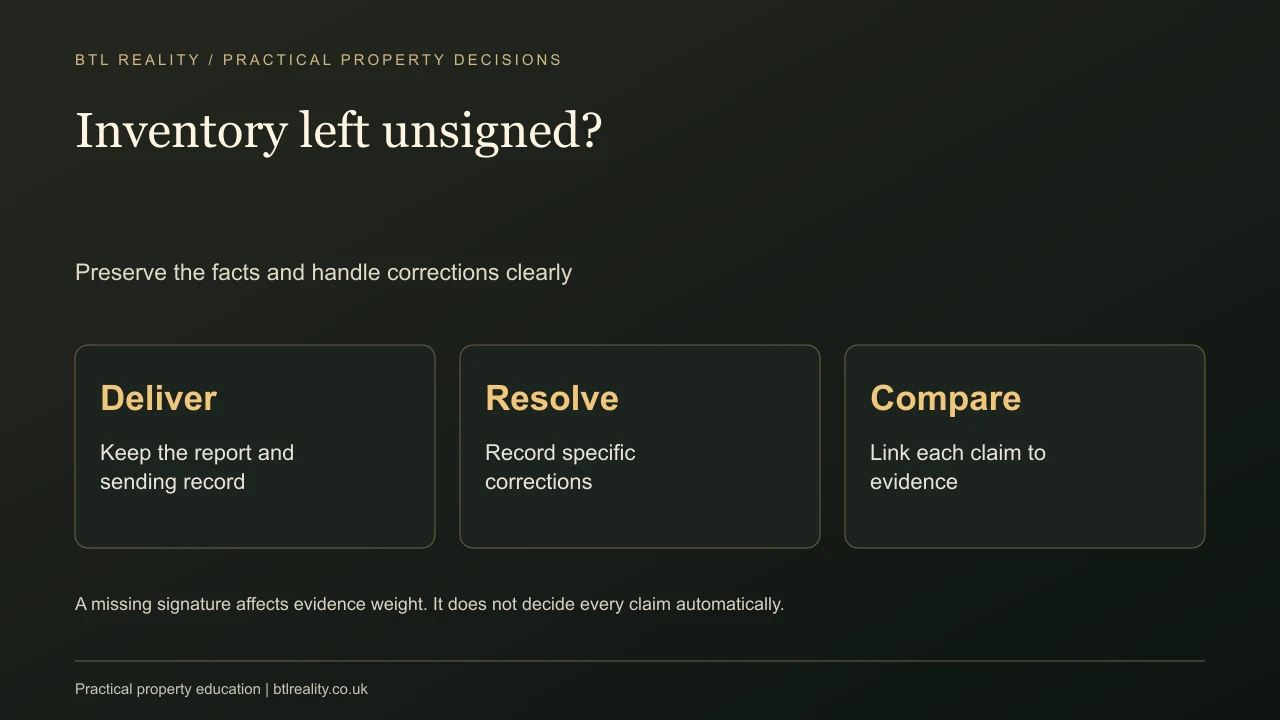
If a tenant will not sign the inventory, do not assume the report becomes worthless. Equally, do not assume a clause saying “silence means agreement” guarantees that every description will be accepted later. The strength of the evidence still matters.
Your next job is to establish why the report is unsigned, give a fair opportunity to comment and preserve the original evidence. An honest, well-organised record is more useful than weeks of increasingly irritated reminders.
This guide focuses on evidence for deposit disputes in an ordinary English private rental. It is checked against deposit-scheme guidance available on 19 October 2026. It does not decide any individual claim or replace the terms and deadlines of your actual scheme.
What do the deposit schemes say?
The DPS common dispute questions says a tenant’s signature is important, but delivery evidence and an opportunity to respond may be useful when an inventory is not returned. For an unsigned check-out, the adjudicator considers the report and supporting evidence rather than deciding solely on the missing signature.
DPS’s check-in preparation guidance explains that signed reports carry more weight and unsigned reports create uncertainty. That gives you a practical objective: strengthen the truthful evidence and resolve genuine disagreements, rather than treating signature collection as a contest.
Separate a missed email from an actual disagreement
First confirm the tenant received a readable copy of the correct report. A large attachment may have failed, an old email address may have been used or an electronic signing invitation may have expired. Ask before interpreting the absence of a signature as deliberate obstruction.
Next ask whether any descriptions need correcting. The tenant may agree with most of the inventory but dispute a stain, a missing key or a statement that an appliance is new. A specific correction is much easier to handle than a request to sign “everything”.
Keep the language neutral. “Please identify the entries you disagree with and send any supporting photographs” gives the tenant a useful action. “Sign immediately or lose your deposit” does not produce better evidence and risks an unnecessary dispute.
If the tenant simply does not want to sign, record that position accurately. Do not transform refusal into agreement in your internal notes. An evidence file should let somebody unfamiliar with the tenancy see what was said by each side.
Preserve the version the tenant actually received
Save the original report, the date it was prepared and evidence of when it was sent. Keep its photographs together with the report rather than leaving them in an unlabelled camera folder. Avoid changing a document after delivery without creating a clear revised version.
Where a correction is accepted, identify it explicitly. A version record can say “Bedroom two window-sill mark added following tenant photograph received on 4 November”. That is more credible than replacing the old file and pretending the mark was described from the beginning.
Give the tenant the revised report and ask them to check the changes. Keep the response, including any continuing disagreement. You can have a largely agreed document with a small disputed section; the choices are not limited to a perfect signature or no record at all.
| Version | What it records | Evidence to retain |
|---|---|---|
| 1: check-in day | Clerk’s original observations and photographs | Report and original image files |
| 2: tenant comments | Specific proposed corrections | Tenant message and supporting photographs |
| 3: revised report | Accepted amendments and remaining disputed items | Change list and delivery record |
| Follow-up | Agreement, refusal or no response | Actual correspondence without invented consent |
Make the descriptions capable of comparison
“Good condition” is a weak description if nobody explains what it refers to. A useful entry identifies the item, its location and observable condition. Where a mark already exists, record it rather than hoping a future photograph will make the point.
Photographs should help a reader find the same area at check-out. Use a whole-room view for orientation and closer views where condition matters. Avoid sending hundreds of close-ups that cannot be matched to a room or item.
For appliances, distinguish presence, visible condition and any actual function check. An inventory clerk may record that a washing machine is present without performing an electrical safety inspection. Do not extend the report’s conclusions beyond what was done.
The report should also distinguish a cleaner’s opinion from an observable fact. “Oven has grease on internal glass” is clearer than “tenant must pay for professional cleaning”. The possible remedy and responsibility are later questions.
What if the inventory was prepared late?
Be honest about the timing. A report made six weeks after move-in does not automatically establish the property’s condition before occupation. Record when the inspection actually took place and what earlier material exists.
Look for legitimate contemporaneous evidence, such as dated check-in photographs, the tenant’s first messages and invoices for work completed before occupation. Keep the limitations visible. An invoice proves a service or purchase was charged; it may not by itself prove the condition of every room on the start date.
Do not backdate the report or ask a clerk to state they inspected on a date they did not attend. If a later visit is agreed, it can establish a useful record of conditions then, but it should be labelled as that later inspection.
For future tenancies, book the inventory before the start date and make the review process part of the handover. Better timing is usually cheaper than reconstructing evidence when a deduction is disputed years later.
Check your agent’s process before paying twice
Ask who produces the report, sends it, follows up corrections and stores the final version. If an independent clerk is used, ask whether the fee includes dealing with tenant amendments or only issuing the first document.
For an illustrative comparison, an £85 report plus a £35 return visit costs £120. A £110 package that includes the required correction process is £10 cheaper for that assumed completed scope. These are planning figures, not quoted market prices.
A return visit should have a useful purpose. Paying somebody to repeat the same request for a signature may achieve little. Paying for a properly agreed inspection to resolve disputed observations may add information that the original file lacks.
The maintenance budget guide helps separate routine reporting from actual repair expenditure. The remote management guide is useful if you need the agent’s evidence process to work without attending yourself.
Keep the check-out fair as well
When the tenancy ends, compare the same items rather than writing an entirely different room structure. Record the check-out date and who attended. Give the tenant the factual report and a clear explanation of any proposed deductions.
If they refuse to sign the check-out, keep the refusal or absence of response and submit the other relevant material if there is a dispute. Do not assume a missing signature prevents every claim, or that it makes a claim automatically valid.
For a condition claim, the DPS dispute process places the burden on the landlord to justify the proposed share of the deposit. Organise the evidence around the particular claim rather than expecting an adjudicator to investigate a large folder unaided.
For example, a claimed damaged cupboard hinge needs the relevant before-and-after condition, the responsibility relied upon and the reasonable remedy cost. A photograph of the garden and an unrelated plumber’s invoice do not strengthen that hinge claim.
Make your file understandable in ten minutes
Before submitting evidence, imagine somebody who has never seen the property opening it. Can they identify the start condition, the end condition, the disputed change and the amount claimed without guessing?
A short index can link each proposed deduction to the relevant pages, photographs and cost evidence. Keep the tenant’s contrary evidence in context rather than leaving it out because it is inconvenient. A fair settlement can be the best outcome when the evidence does not support the original figure.
For choices about durable finishes at the next tenancy, see carpet or hard flooring for a rental. Good material choices help, but they do not remove the need for a truthful condition record and a fair allowance for ordinary use.
Your questions answered
Is an unsigned inventory completely useless?
Not automatically. DPS says delivery evidence and an opportunity to respond may help. However, a signed report carries more weight, and an unsigned report leaves greater uncertainty about agreement.
Can I say the tenant agreed because they did not reply?
Do not assume silence guarantees the descriptions will be accepted. Preserve the actual delivery and response record, and avoid presenting agreement that the tenant did not give.
Should I change the inventory when the tenant sends corrections?
Check the specific correction and supporting evidence. If accepted, issue a clearly identified revised version and retain the original, the change record and delivery evidence.
Can I backdate an inventory prepared after move-in?
No. Record when the inspection actually happened. A later report may be useful, but it must not falsely state the condition was observed before the tenant moved in.
What if the tenant will not sign the check-out report either?
Keep the factual report, supporting photographs and correspondence. DPS says an adjudicator considers the evidence rather than deciding solely on the missing check-out signature.
Does an independent inventory guarantee a deposit deduction?
No. It can provide useful objective evidence, but the landlord still needs to justify the specific claim, the responsibility and the amount. The scheme decides on the evidence submitted.