Flood Performance Certificates: What the New Pilot Means for Landlords
October 13, 2026
England is to pilot Flood Performance Certificates, giving homeowners clearer information about flood exposure and resilience. For a property investor, the useful question is straightforward: could better evidence change what you buy, what you spend protecting it, or whether the numbers still work?
A property can show an attractive rental yield and still leave you dangerously exposed to a long interruption. I would use this announcement to tighten the buying process, rather than assume that a new certificate makes a difficult property safe.
What has the government actually announced?
On 13 October, Defra and Flood Re announced plans to test Flood Performance Certificates, or FPCs, in England. Work on the pilots is due to begin during 2026 in areas exposed to flooding, with further pilots during 2027 and beyond. The certificates are intended to bring information about risk and a home’s resilience into a more consistent format.
The official announcement describes a possible rating that considers exposure, property characteristics and resistance. It also says improvements, such as flood barriers and water-resilient flooring, could be reflected in the assessment. The design is still being developed; the illustration released with the announcement is a mock-up.
The comparison with Energy Performance Certificates is about making information easier to understand. It does not mean the pilot has inherited EPC rules, letting restrictions or mandatory minimum grades. Those would be separate questions requiring their own official decisions.
There is a useful distinction here. Flood exposure asks what might reach the property. Resilience asks how well the building could resist damage or recover. A home might improve the second without removing the first. A better-looking assessment should therefore start a more informed conversation, not end your investigation.
Will a certificate make landlord insurance cheaper?
That is not something to put into your budget as a certainty. The announcement presents recognition of resilience by insurers as an aim. The practical test remains the actual policy offered for the actual address, ownership and use.
There is also an important distinction between this certificate initiative and the existing Flood Re reinsurance scheme. Flood Re’s published eligibility criteria include occupancy and policy conditions. An ordinary commercial buy-to-let should not be assumed to qualify for subsidised buildings cover. Tenant contents cover is a separate question. Ask your insurer or broker to confirm the position for your property.
When comparing quotes, put the premium beside the flood excess, exclusions, loss-of-rent cover, accommodation provisions and claim limits. Two policies with similar annual prices can leave very different amounts for you to fund. Check how any proposed resilience work affects the insurer’s assessment before assuming a saving.
A verbal assurance that a property is “insurable” is not enough to build a purchase around. You need the terms, the intended tenancy use and the lender’s requirements to agree. Make those enquiries early, while you still have choices.
An 8% yield can still produce a negative year
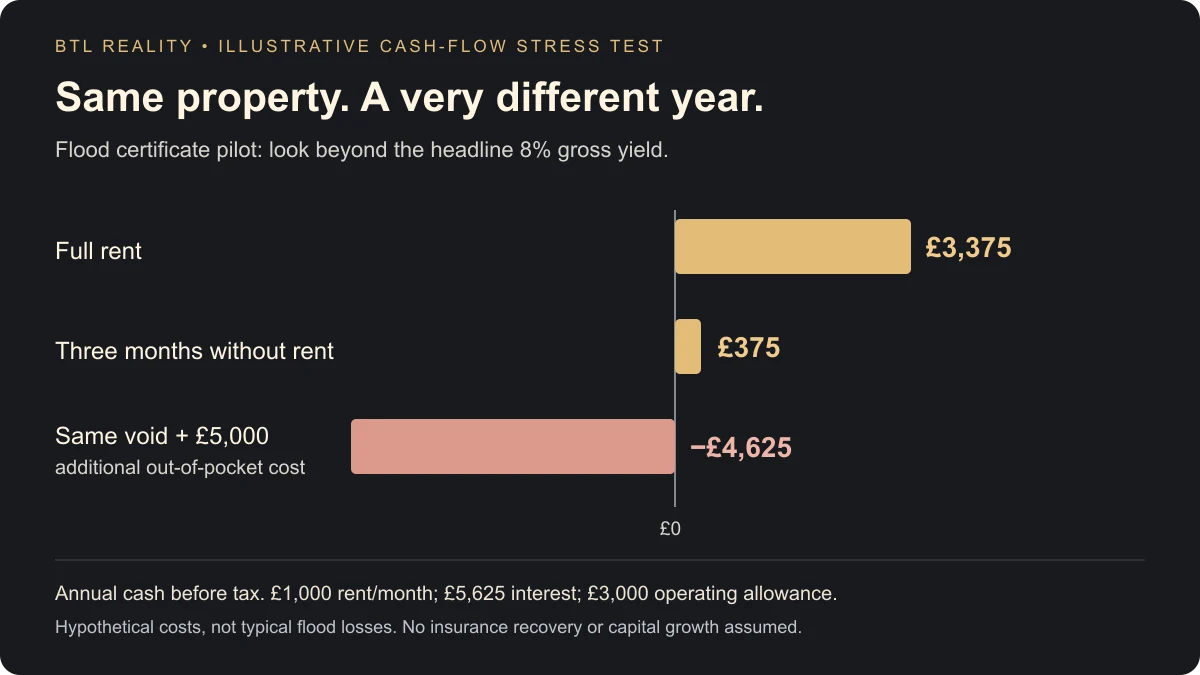
Here is a deliberately simple example. It is an illustration of interruption risk, not a forecast of flood damage or a claim about typical insurance costs.
Assume a £150,000 purchase, rent of £1,000 a month, and a £112,500 interest-only mortgage at 5%. Allow £3,000 a year for operating costs and reserves. For this comparison, that allowance stays unchanged during a void and contains no separate allowance for the interruption being tested.
| Scenario | Rent received | Cash before tax |
|---|---|---|
| 12 months collecting rent | £12,000 | £3,375 |
| Three months without rent | £9,000 | £375 |
| Same void plus £5,000 out-of-pocket cost | £9,000 | −£4,625 |
The mortgage interest is £112,500 × 5% = £5,625 a year. The first line is therefore £12,000 − £3,000 − £5,625 = £3,375. Losing three months of rent removes £3,000. An additional assumed £5,000 payment then takes the result to minus £4,625.
The advertised gross yield is 8%, calculated as £12,000 divided by £150,000. It describes the headline rent relative to price. It does not tell you whether your reserve can absorb the bad year. Nor does £3,375 represent a return on all the cash invested, because buying costs and your deposit need their own calculation.
Use the rental yield calculator for the initial comparison. Then enter the full acquisition, mortgage and running costs in the buy-to-let deal analyser. Its on-screen results are free; a personalised report is optional.
Test your interruption budget
Keep the example above and change two assumptions. This is a cash-flow stress test, not a flood-risk or insurance calculator.
Annual cash = (12 − empty months) × £1,000 − £3,000 − £5,625 − additional cost. All existing operating allowances remain. No insurance reimbursement is assumed. Costs are chosen assumptions, not typical flood losses. Actual expenses, claim timing and lost rent can differ substantially.
The table above shows the default result. Enable JavaScript to change the assumptions.
What should an investor do before buying?
Start with the Environment Agency’s long-term flood-risk service for England. It covers several sources, including rivers, sea and surface water, with groundwater information where available. Its own guidance is clear that the service does not establish the probability of an individual home flooding. Use it as the beginning of the evidence file.
Next, connect the map with the building. Ask your conveyancer about appropriate searches and seller enquiries. Discuss property-specific concerns with a suitable surveyor or flood specialist. A basement, access route, vulnerable electrical installation or previous repair can matter even when the postcode-level summary sounds reassuring.
You can also request area flood-history information from the Environment Agency. Its records are incomplete, so no recorded incident is not proof that nothing has happened. Keep the seller’s replies, survey evidence and insurance questions together rather than relying on one answer.
For any resilience work, get a property-specific scope and price. Ask what the work is expected to address, what it cannot prevent, how it must be maintained and what evidence you should retain. Avoid counting an assumed reduction in damage, insurance premiums or void time as a guaranteed financial return.
Finally, make the purchasing decision with the weaker scenario visible. Could you fund the excess and necessary work? Could you carry the mortgage while the home is unavailable? What happens if an insurance payment arrives later than the bills? An annual profit figure cannot answer those timing questions.
If you are comparing a portfolio, check concentration as well. Several homes exposed to the same event could need cash at the same time. Splitting a single reserve between properties does not make it available to each of them in full.
Where does the new certificate fit?
If the pilots produce reliable, comparable evidence, an FPC could make discussions with surveyors, insurers and lenders more useful. That is the potential value. The information would still have to be read alongside its assessment date, scope and limitations.
For now, I would keep the certificate announcement on the watchlist and do the practical checks already available. Combine those with local rental-demand evidence. Strong demand and a low asking price do not remove building-specific risks.
If you want help finding properties against an agreed investment brief, explore Done For You property sourcing. Make the acceptable risks and required evidence part of that brief. You can use the free calculators whether you work with us or not.
Frequently asked questions
What is a Flood Performance Certificate?
It is a proposed standardised assessment of a home’s flood risk and resilience. The England pilots announced on 13 October 2026 will test how that information is assessed and presented. The final certificate format remains under development.
Do landlords have to get a Flood Performance Certificate?
The announcement does not introduce a universal landlord requirement or minimum letting grade. It describes pilots. Check subsequent official decisions before treating an FPC as a new compulsory document.
When will Flood Performance Certificates be available?
Work on pilots is due to start in 2026, with more during 2027 and beyond. That is not a confirmed nationwide rollout date. Check official participation information when it becomes available.
Will an FPC guarantee cheaper landlord insurance?
No guaranteed premium reduction is announced. Recognition of resilience is an objective. An insurer must assess the address, policy and circumstances, so use a written quote rather than an assumed discount.
Can Flood Re cover a buy-to-let property?
Do not assume commercial landlord buildings cover qualifies. Flood Re has specific occupancy and policy criteria. Tenant contents insurance is separate; ask the insurer to confirm eligibility and cover for the particular arrangement.
How do I calculate the rental impact of a flood-related void?
Estimate the rent not received, continuing costs and extra out-of-pocket spending. Keep insurance recoveries separate until their scope and timing are established. Do not deduct the same void twice if it is already in your annual allowance.
General property education, not an individual insurance, mortgage or investment recommendation. The numerical example is hypothetical. Recheck the announcement and policy terms before acting.