Scotland Raises Wrongful-Termination Awards: What Landlords Face
October 7, 2026
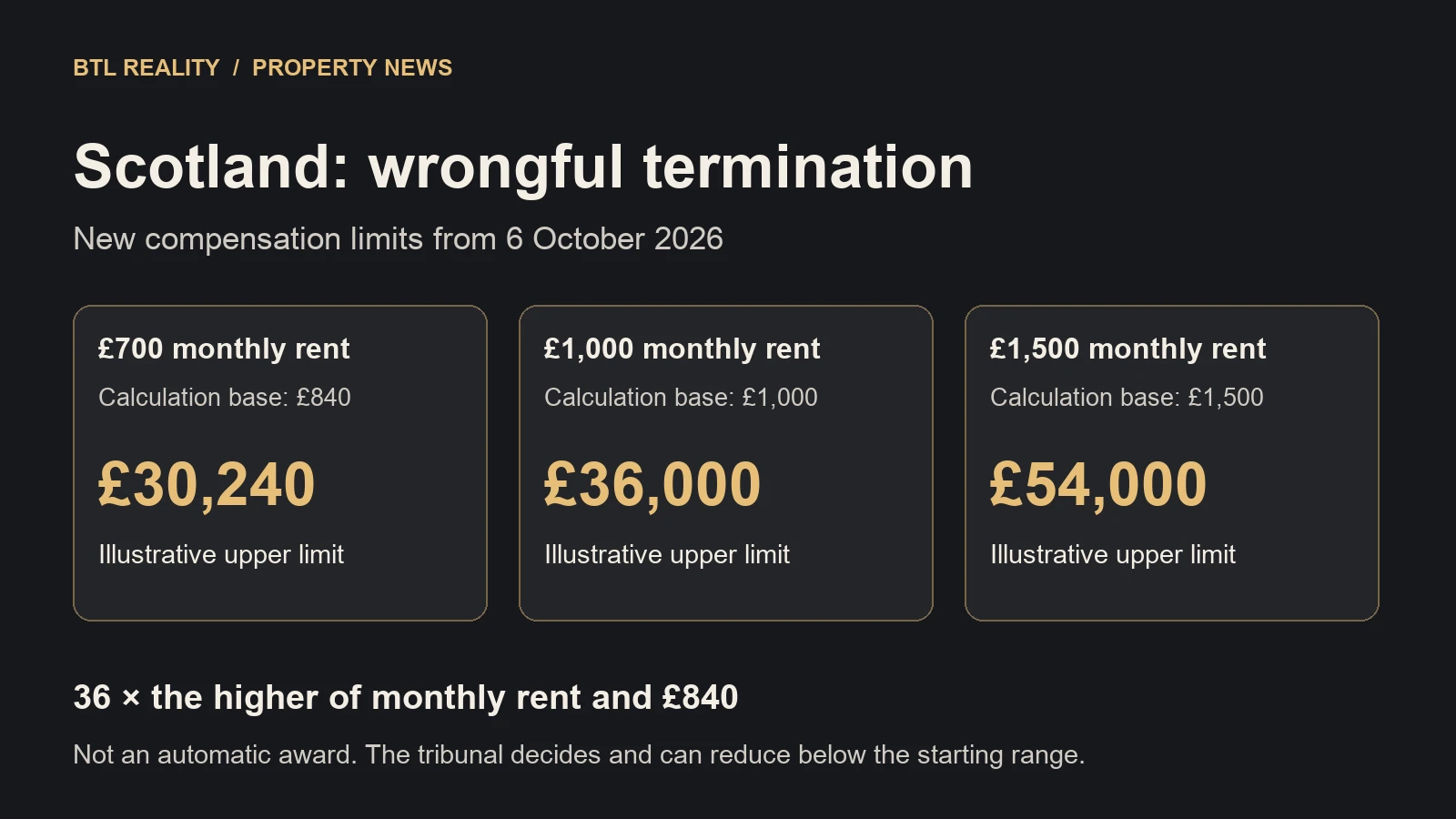
Scotland has increased the compensation a landlord can face for misleading a tenant, or the tribunal, into ending a private residential tenancy. The change took effect on 6 October 2026. It deserves more attention than a quick headline about “three years’ rent”, because the calculation includes an £840 monthly floor and the tribunal decides the award.
This is a Scottish change. It is not a new UK-wide fine for every eviction, and it does not mean that a landlord who genuinely needs to sell can no longer use the lawful process. It means the reason given for ending a tenancy must stand up to scrutiny. If your investment plan depends on obtaining vacant possession, get that part checked before relying on the sale proceeds.
What changed on 6 October 2026?
The new starting framework for a wrongful-termination award is three to 36 times the relevant monthly amount. That amount is the higher of the tenancy’s monthly rent and £840. The tribunal can reduce an award below three times that figure where it considers that appropriate in all the circumstances.
That last qualification matters. There is no automatic £2,520 minimum payment just because somebody makes an application, and the top figure is not an automatic award either. The tribunal must first decide the case and then the appropriate amount. Section 34 of the Housing (Scotland) Act 2025 sets out the new calculation and discretion.
The commencement rules apply the change to private residential tenancies brought to an end by an eviction order, or under section 50 of the 2016 Act, on or after 6 October. A notice served earlier does not by itself settle which regime applies. Check the facts and ending date with a Scottish housing solicitor. See the commencement regulations, Schedule Part 3.
What does wrongful termination mean?
The issue is misleading a tenant into leaving or misleading the First-tier Tribunal into granting an eviction order. Scotland’s updated statutory tenancy notes give a useful example: a landlord says they intend to sell, takes no action to sell and instead lets the property to another tenant.
That example should make any investor pause before treating an eviction ground as a convenient box to tick. A tenant’s home is involved, and the stated reason has consequences beyond a spreadsheet. Your agent’s wording, your instructions and what you actually do should tell a consistent, truthful story.
A genuine change of circumstances is not something an online article can classify for you. A sale can fall through. Personal plans can change. Whether the original statement was misleading, and what the later evidence shows, depends on the facts. Keep the timeline and get advice before deciding that a new letting is harmless.
The £840 floor: three worked examples
The formula begins with the higher of the actual monthly rent and £840. Multiply that figure by three and 36 to illustrate the starting range and upper limit. These are arithmetic examples, not predictions of compensation, and the tribunal’s power to reduce the award still applies.
On a narrow screen, swipe the table sideways. Keyboard users can focus it and use arrow keys.
| Monthly rent | Calculation base | 3 times base | 36 times base (upper limit) |
|---|---|---|---|
| £700 | £840 | £2,520 | £30,240 |
| £1,000 | £1,000 | £3,000 | £36,000 |
| £1,500 | £1,500 | £4,500 | £54,000 |
The tribunal decides. The upper limit is not an automatic award. The starting range is subject to discretion, including reduction below three times the calculation base.
At £700 rent, using the actual rent alone would give £25,200 at 36 months. The £840 floor instead produces an upper illustration of £30,240, a £5,040 difference. A lower-rent property is therefore not outside the reach of a substantial claim.
At £1,000 rent, £36,000 is three years of gross rent. It is not three years of profit. If an illustrative property produces £250 a month after its operating costs and mortgage interest, that upper figure equals 144 months of that cashflow, or 12 years. Neither the assumed profit nor the upper award is a forecast. The comparison simply shows why a strong gross yield does not cancel out legal risk.
Keep legal exposure separate from ordinary cashflow in your planning. Our buy-to-let deal calculator helps examine the usual purchase and rental numbers. It cannot decide whether a tenancy can lawfully end, calculate a tribunal outcome or replace legal advice.
Why this is not the same as an unlawful eviction claim
The Scottish Government’s ending-a-tenancy guidance separates wrongful-termination payments from changes to civil damages for unlawful eviction. At the time of this update, it says no commencement date has been set for the latter calculation change.
Do not read that as permission to change locks, cut off access or pressure a household out. It means different legal routes have different provisions and commencement dates. This article covers the wrongful-termination award change that took effect on 6 October. It is not a complete guide to eviction offences, damages or possession procedure.
The same distinction matters when reading social-media summaries. “Landlords can face 36 months” is not enough information. Ask which country, which tenancy, which conduct, which remedy and which effective date the person is talking about. Without those details, a dramatic number can send you towards the wrong decision.
A practical check before you seek possession
Start with the actual objective. Are you selling the property, moving into it, dealing with a breach or simply reviewing whether the investment works? Record that objective privately and accurately, then ask a qualified adviser which lawful route, if any, fits it. Do not choose a ground because it sounds quicker.
For a sale, assemble the evidence you genuinely have: instructions to an estate agent, valuation advice, your intended timetable and communications with your solicitor. These are sensible records, not a universal statutory checklist or a guarantee that a tribunal will accept your case. Do not create misleading evidence to support a decision already made.
If an agent handles the tenancy, get a copy of the proposed notice and the factual explanation before it goes out. Agree who records service, who handles the tenant’s response and when a solicitor gets involved. Paying for management does not make it sensible to stop reading what is being said in your name.
Keep dated communications together. Store the tenancy, notices, correspondence and relevant transaction records securely, with access limited to the people who need them. If the plan changes, record when and why, and seek advice before taking the next step. A tidy folder cannot cure misleading conduct, but a confused record makes an honest sequence harder to explain.
Finally, give the financial plan room to breathe. Avoid promising vacant possession or spending anticipated equity before your solicitor has checked the position. Model delays, continuing mortgage interest and realistic selling costs. A rushed exit because the next purchase depends on it is a poor starting point for careful decisions.
What should a buyer of a tenanted property check?
Ask your conveyancer to establish the tenancy type and the basis on which you are buying. If the sales particulars say “vacant on completion”, find out what evidence supports that statement and what happens if the property remains occupied. A marketing description is not proof that possession will be available on the required date.
For an investment bought with the tenant staying, review the records rather than assuming the rent schedule tells the whole story. Ask about notices, disputes and representations already made to the tenant. Your solicitor should advise which matters affect the transaction and what protection is appropriate. Do not assume buying the property either transfers every historical liability or removes every existing problem.
If you are comparing a hold with a sale, use the guide to selling a buy-to-let only for the costs relevant to your situation. Scottish conveyancing and tenancy procedure need their own checks. Getting the purchase price right is useful; understanding the legal position is essential.
Other Scottish changes to keep separate
The 6 October changes also include damp-and-mould duties and a reduction in the qualifying residence period for certain tenancy succession rights. Fife Council’s explanation distinguishes the three changes. We cover the repair deadlines in our updated Awaab’s Law guide.
There is no advantage in bundling every housing reform into one alarmist message. Check the issue that actually applies to the property. England’s tenancy reforms, Scotland’s wrongful-termination awards and damp-and-mould duties are connected by the need for proper management, but they are not interchangeable rules.
For investors building their wider knowledge, Starter Club provides property education and group support. Use that to improve your planning and questions. An active tenancy dispute still belongs with a suitably qualified Scottish legal adviser.
Questions landlords are asking
Can a Scottish landlord now be ordered to pay 36 months’ rent?
Yes, an upper limit of 36 times the relevant monthly amount applies under the new wrongful-termination framework. The amount used is the higher of one month’s rent and £840. A tribunal decision is required; it is not an automatic payment whenever a tenancy ends.
Does the change apply to landlords in England or Wales?
No. This article concerns Scottish private residential tenancies and Scottish legislation. Do not apply its payment formula to an English or Welsh property. Check the rules for the country and tenancy concerned, particularly before serving a notice.
Is three months’ compensation guaranteed to the tenant?
No. The Act’s starting range is subject to the tribunal’s power to reduce the amount, including below three times the relevant sum, where appropriate in all the circumstances. Liability and the award depend on the case, not simply on a complaint being made.
Can I still sell a rented property in Scotland?
The compensation change does not itself ban a sale. How you sell, whether the tenant stays, and whether lawful vacant possession is achievable are separate questions. Take Scottish legal advice before serving notices or committing to a completion arrangement you may not be able to deliver.
What if my property rents for less than £840 a month?
The new calculation uses £840 instead of the lower rent. For example, £700 actual monthly rent produces an illustrative upper limit of £30,240, not £25,200. Those figures show the formula only; the tribunal decides the actual award.
Where should I start if my plans to sell have changed?
Keep the original instructions, the dates and the evidence of the change. Contact a Scottish housing solicitor before re-letting or making further representations. Do not assume a failed sale automatically proves wrongdoing, or automatically rules it out. The facts need proper assessment.
This update was checked on 7 October 2026. It provides general information, not advice on a particular notice, claim or tenancy. For an active dispute or proposed eviction, use a Scottish housing solicitor.