Can You Lose Money on a Buy-to-Let and Still Pay Tax?
October 4, 2026
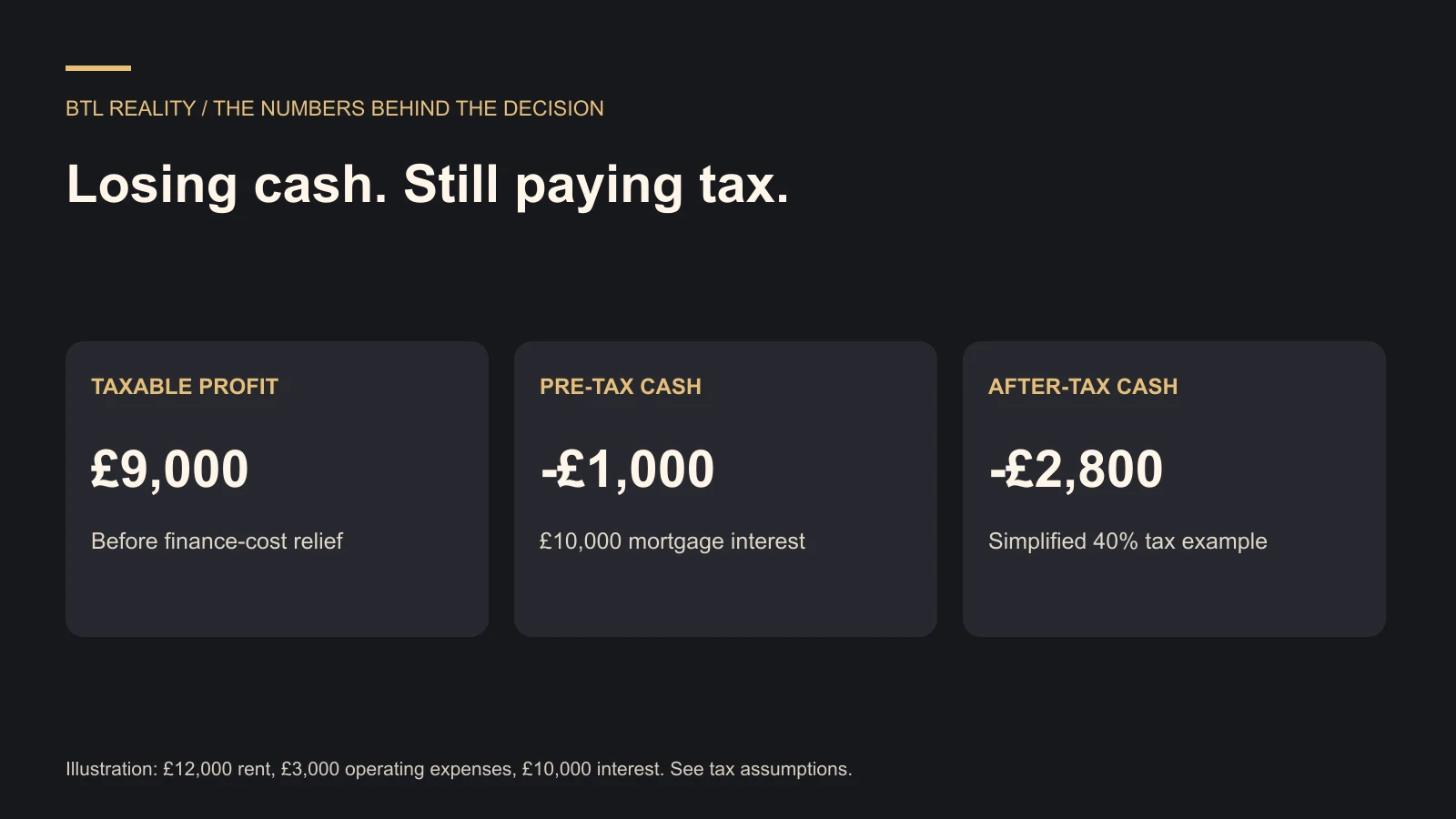
Yes, an individually owned residential buy-to-let can lose cash and still create an Income Tax bill. The money left in your bank account and the profit used for tax are not always the same number. Mortgage interest restrictions, capital repayments and expenditure that is not immediately deductible can all create a gap.
This is one reason I would never assess a rental using only rent minus mortgage payment. You need to see operating performance, financing, tax and cash separately. The worked example below makes the distinction visible. It is an educational illustration, not a calculation of your personal tax liability or a recommendation to change ownership structure.
Four numbers that landlords should keep separate
Gross rent is the income before costs. Operating surplus is what remains after the operating costs included in your budget. Taxable property profit follows tax rules about deductible expenditure and reliefs. Cash after tax reflects the money received and paid, including items that may not reduce taxable profit immediately.
A spreadsheet can use any of those numbers and label it “profit”. That is where confusion begins. If you are comparing investments or discussing a property with a mentor, accountant or broker, state which figure you mean. A £300 monthly operating surplus is not automatically £300 available for your lifestyle.
Property value growth is another separate number. A valuation increase does not pay this month's mortgage or tax bill unless you sell or obtain suitable borrowing, both of which involve conditions and costs. Adding hoped-for growth to a negative cash result can hide the need for an actual cash reserve.
Why mortgage interest can produce a tax surprise
For individuals subject to the residential finance-cost restriction, mortgage finance costs are not deducted in the usual way when arriving at taxable rental profit. A basic-rate tax reduction is considered instead. HMRC's finance-cost relief guidance explains that the reduction is capped by the lowest relevant amount: eligible finance costs, property profits or adjusted total income above the personal allowance, with further conditions and carry-forward rules.
That structure matters particularly when the tax charged on rental profit is at a higher marginal rate than the reduction. It also means you cannot simply multiply every mortgage payment by your tax rate and call the result a tax saving. The example here assumes the adjusted-income cap does not further restrict relief.
Do not treat this as a company calculation. Company taxation, finance deductions, extracting money personally and changing ownership involve different considerations. Our personal ownership versus limited company guide sets out the questions to take to an adviser before buying or restructuring.
A worked example: £1,000 cash loss and tax still due
Assume annual rent is £12,000 and allowable non-finance operating expenses are £3,000. Eligible mortgage interest is £10,000. There are no capital repayments in this first example. The property therefore loses £1,000 of cash before tax: £12,000 minus £3,000 minus £10,000.
For the simplified tax illustration, taxable property profit before the finance-cost reduction is £9,000. Assume all of it is taxed at 40%, with allowances used elsewhere and no band crossing. Tax before the reduction is £3,600. The finance-cost amount used is capped here at £9,000, giving a £1,800 basic-rate reduction.
Tax remaining is £1,800. Combined with the £1,000 cash shortfall, the after-tax cash result is negative £2,800, or approximately £233 a month. In this example, £1,000 of finance costs is unused because of the property-profit cap and may be carried forward subject to the rules. It is not an immediate £1,000 refund.
See cash flow and tax separately
Educational individual-landlord model. One rate applies to all positive profit; sufficient adjusted total income is assumed. No allowances, band crossings, Scottish bands, prior losses, carried-forward finance costs, benefit effects or other income interactions are modelled. Not your tax bill.
JavaScript is required to change the results. The figures above show the default worked example.
The tool isolates this mechanism. It assumes one marginal rate applies to all positive property profit, sufficient adjusted total income, no brought-forward losses or finance costs and no allowance or benefit interactions. It does not model Scottish tax bands, jointly owned properties, non-resident arrangements or your whole tax return. Use your accountant for an actual liability.
What changes at a different tax rate?
Keep the same £12,000 rent, £3,000 operating expenses and £10,000 eligible interest. At an illustrative 20% marginal rate, tax before the reduction is £1,800 and the modelled reduction is £1,800. The tax result in this simplified case is zero, but the property still loses £1,000 of cash.
At an illustrative 45% rate, tax before reduction is £4,050. Deduct the same £1,800 reduction and the modelled tax is £2,250. The resulting cash loss is £3,250. These are arithmetic comparisons under the stated assumptions, not a claim that every landlord in those bands will have those results.
Now lower interest to £6,000 while keeping the 40% assumption. Pre-tax cash becomes £3,000. The modelled reduction is £1,200, leaving £2,400 tax and £600 annual cash after tax. A property that appears to generate £250 a month before tax now leaves £50 a month in this illustration.
Capital repayments make cash and profit diverge again
Suppose the last example also requires £2,000 a year of mortgage principal repayments. The modelled tax calculation stays the same, but cash after tax falls from positive £600 to negative £1,400. Principal repayment reduces the loan balance; it is not simply another deductible operating expense.
That distinction does not mean repaying debt is bad. It means you need to understand the trade-off between liquidity and building equity. A repayment mortgage may suit a plan even when monthly spendable cash is limited. What would be misleading is describing debt repayment as both cash available to spend and a separate increase in wealth.
The interest-only versus repayment guide explains the broader choice. When assessing financial freedom, use the cash you can actually retain after the selected financing and tax assumptions. A portfolio with substantial equity can still struggle to meet regular bills.
Repairs, improvements and the timing problem
HMRC's rental-income guidance distinguishes allowable expenses from capital expenditure and explains property-business losses. Not every cash payment receives the same tax treatment. The nature and purpose of the work matter, so keep detailed invoices and ask your accountant to classify uncertain items.
For planning, create separate columns for routine operating costs, finance interest, principal repayments and capital projects. If you pay for an extension, a deposit on another purchase or significant improvements, the money leaves your account even when the tax treatment is different from that of a routine repair.
Timing matters too. Rent, contractor bills, mortgage payments and tax deadlines do not necessarily align. An annual result that looks manageable can contain a difficult month. Build a monthly cash forecast and keep tax money distinguishable from the cash earmarked for maintenance or the next deposit.
What to send your accountant
A useful pack lets the accountant trace the numbers without guessing. Include rental statements, bank records, mortgage statements splitting interest and principal, invoices describing work and details of ownership. Flag unusual items rather than deciding that a transaction is deductible because the spreadsheet has an expense column.
- Rent received and any outstanding or refunded amounts.
- Management fees, insurance and relevant operating invoices.
- Mortgage interest, fees and capital repayments shown separately.
- Repairs and improvement work with descriptions and dates.
- Ownership shares and changes during the period.
- Previous losses or finance-cost information where applicable.
Ask for both an estimated tax position and a cash planning figure. Those answers serve different purposes. You want enough reserved for the tax obligation without confusing retained capital, loan principal or unrealised growth with income you can safely withdraw.
What should you do if the numbers look poor?
First, check the inputs. An inaccurate fee, duplicated repair allowance or missing interest split can distort the result. Then assess the genuine choices: different financing when suitable, justified operating improvements, a different purchase price before buying, or a review of whether the property fits the wider plan.
Do not assume that a rent increase is available on demand, or that incorporating an existing property is a free fix. Both need their own commercial and legal checks. Use the buy-to-let deal calculator for the whole deal and the mortgage stress calculator to explore financing pressure.
If your main need is learning to assess these decisions consistently, Starter Club is a practical next step. The aim is to ask better questions before committing money, while leaving personalised tax advice with a suitably qualified adviser.
Frequently asked questions
Can I pay tax even if rent does not cover the mortgage?
Yes, depending on your circumstances. Interest restrictions and capital repayments can separate the tax result from your bank balance. Obtain a calculation based on the interest component, allowable expenses and your wider income rather than treating the whole mortgage payment as deductible.
Is a negative bank balance the same as a property tax loss?
No. A cash shortfall can include principal repayments, capital expenditure or tax payments. A tax loss is calculated under the applicable rules. Keep the categories separate so that you do not assume a cash loss automatically creates relief against salary or other income.
Does the calculator show my exact Section 24 tax bill?
No. It demonstrates a simplified finance-cost restriction scenario with explicit assumptions. Your allowances, income bands, losses, ownership, residence and other circumstances can change the answer. Take the underlying figures to an accountant before deciding how much tax to reserve.
Can unused mortgage-interest relief be carried forward?
Unused eligible finance costs can be carried forward in specified circumstances, subject to the rules and future limits. That is different from receiving cash back now. Keep the relevant records and have your adviser confirm the amount available rather than assuming every unused pound becomes a refund.
Would buying through a company remove every tax problem?
No. A company has a different tax framework, financing costs, administration and potential tax when money is extracted. Transferring an existing property may create significant costs. Compare the complete structure with professional advice rather than choosing from one isolated interest-deduction rule.
Which figure should I use for financial freedom planning?
Use a realistic estimate of sustainable cash available after costs, financing and tax, with reserves retained for the property. Show equity and debt separately. A high property value or gross rent figure does not establish the monthly amount you can spend without weakening the plan.