How to Check Rental Demand Before Buying a Buy-to-Let
October 4, 2026
A strong rental market is useful only if people want the particular property you are buying, at a rent that makes your numbers work. To check rental demand before buying a buy-to-let, combine comparable listings, evidence from local letting agents, practical location checks and a realistic allowance for empty weeks. A national shortage of homes is not a substitute for those checks.
The question I would start with is simple: who will choose this home, and why would they choose it over the alternatives? If the answer is just “it is cheap”, the research is not finished. This guide gives you a repeatable way to investigate demand without pretending that any postcode comes with guaranteed tenants.
Start with the tenant's decision, not the investor's spreadsheet
A two-bedroom terrace near a hospital and a two-bedroom flat beside a railway station might have similar asking rents. They can still serve very different households. Parking, stairs, storage, outside space, public transport and the journey to work all affect whether a viewing turns into an application.
Write a short description of the household the property would practically suit. This is a way to assess the accommodation, not permission to discriminate against applicants. Consider bedroom sizes, accessibility, local amenities and total living costs. A nominal third bedroom that barely accommodates furniture does not automatically create a stronger letting proposition.
Next, identify the nearest realistic substitutes. A property across a busy road may have a different school journey. A flat with a lift may appeal to people who cannot use stairs. A house without parking may be less convenient in a location with weak public transport. These differences deserve more attention than an impressive regional growth forecast.
Build a small evidence file
Create a comparison sheet with around eight to twelve genuinely similar homes, where the market provides enough examples. Record the address or listing reference, property type, bedroom count, condition, parking, advertised rent and date observed. Add the date of any rent reduction or change to “let agreed”. Keep duplicates out of your count.
This is a research sample, not a statistically reliable survey. In a small village there may be only three useful comparisons. In a city there may be dozens, but mixing studios, family houses and bills-inclusive rooms would make the bigger sample less useful. Comparable means a tenant could reasonably choose one instead of the other.
Check the same listings again after a week or two if your buying timetable allows. A disappearing advert is a clue, not proof that a tenancy began at the asking price. It may have expired, been withdrawn or moved to another agent. Record what you know and label what remains unconfirmed.
Ask letting agents questions that require evidence
Speak with at least two agents who actually manage the type of property you are considering. An agent selling the house has a different commercial role from an agent responsible for finding its tenant. Both can contribute, but their rent estimates should not be treated as independent if they are based on the same listing.
- Which comparable homes have you let recently, and what rent was agreed?
- How long did they take to let, and were there price reductions?
- What features made the slowest comparable difficult to let?
- What work would you require before marketing this particular home?
- Is demand consistent through the year or concentrated around particular dates?
- What rent would you use if the aim were a sensible letting period rather than the highest advertised figure?
Ask agents to explain a range rather than promise an exact outcome. “Probably £900 to £950 depending on presentation” is more useful when accompanied by examples than “easy £1,050” without evidence. Note the date and assumptions behind each opinion, then revisit them if the purchase takes several months.
Separate rental demand from rental price inflation
The ONS explanation of rental price statistics distinguishes data sources across the UK. Its England and Wales inputs include achieved rents from new and existing tenancies. Scotland relies mainly on advertised new lets. Those measures are useful context, but they do not establish today's achievable rent for one property.
A rising local average also does not tell you how quickly your home will let. Existing tenants may be paying less than new arrivals, and an area's mix of property types can differ from your purchase. Use national and local statistics to challenge your assumptions, then return to comparable accommodation and current letting evidence.
October 2026 market context: Our September RICS survey update explains why weaker buyer enquiries can coexist with stronger tenant demand. It includes a price, rent and mortgage-rate calculator, while keeping survey sentiment separate from evidence for one property.
For the latest official context, the October 2026 ONS rent and house-price update separates the different data periods and shows why rising rents do not automatically improve cash flow. Use the national figures to challenge your assumptions, then return to current comparable listings and local letting evidence.
Work through the cost of being optimistic
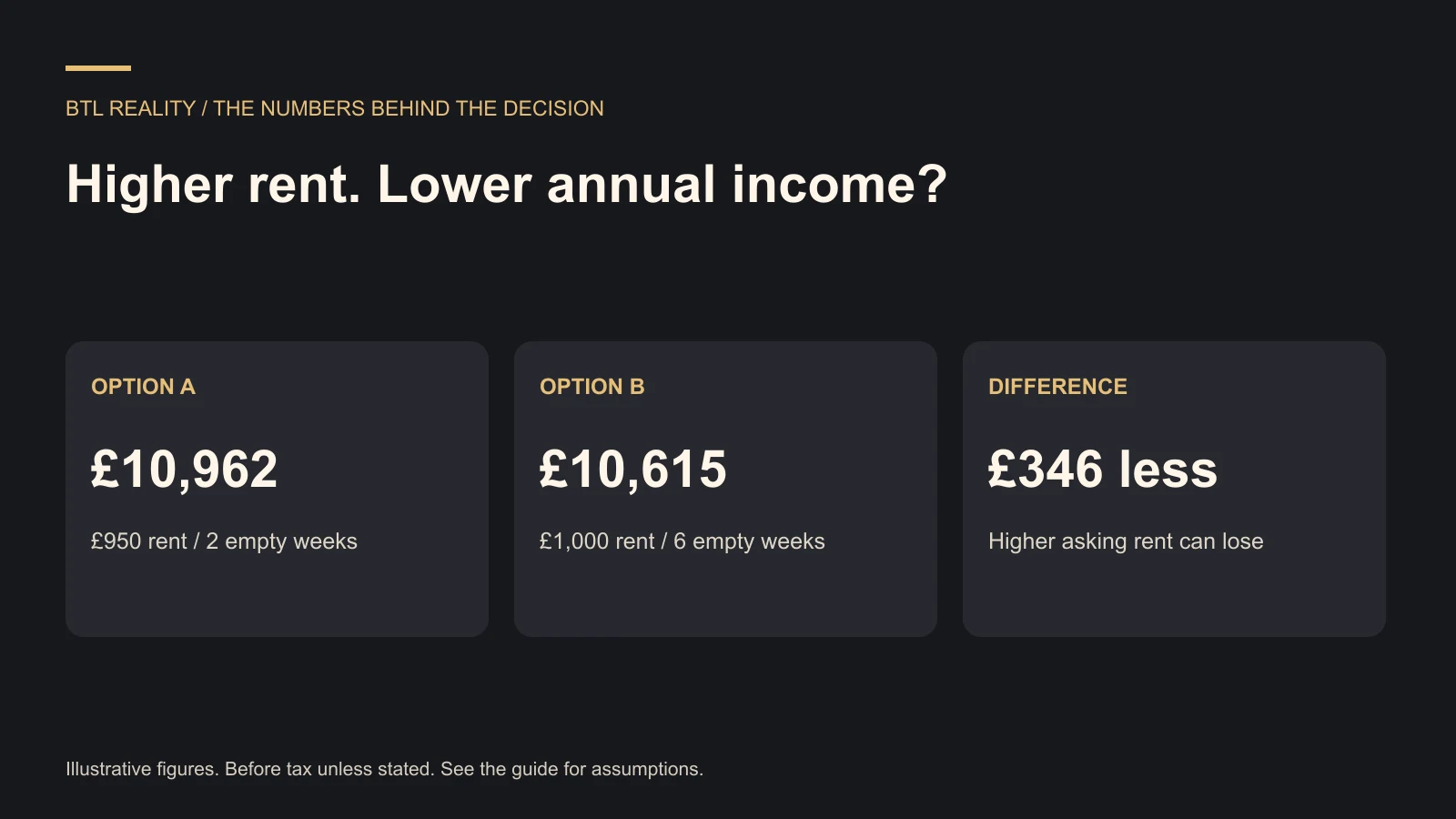
Consider two illustrative first-year outcomes for the same house. At £950 a month with two empty weeks, approximate rent collected is £10,962. At £1,000 a month with six empty weeks, it is approximately £10,615. The higher advertised rent produces about £346 less income in that year.
The calculation uses monthly rent multiplied by twelve, then multiplied by occupied weeks divided by 52. It is a budgeting convention rather than a tenancy accounting method. Actual rent dates, arrears and partial periods may differ. Management costs, repairs, mortgage payments and tax have not yet been deducted.
This example does not mean you should automatically discount the rent. It shows why testing a realistic letting period matters. If both prices achieve the same occupancy, the higher rent wins on gross receipts. If the ambitious price creates a long gap, the result can reverse. The right answer comes from the property and evidence.
Does the higher asking rent win?
Approximate first-year receipts: monthly rent × 12 × occupied weeks ÷ 52. Before all costs and tax. Assumed weeks, not a letting forecast.
JavaScript is required to change the results. The figures above show the default worked example.
Turn the evidence into three underwriting cases
Your base case should use a rent supported by comparable homes and a void allowance you can explain. Your cautious case might use lower rent and more empty weeks. A stronger case can show what happens if presentation and local demand produce a better outcome, but it should not be the only version that supports the purchase.
For example, test £900 with six empty weeks, £950 with four and £1,000 with two. Approximate annual receipts are £9,554, £10,523 and £11,538 respectively. That £1,984 spread can absorb a surprising amount of the profit on a heavily financed property. It is worth discovering before you commit to the purchase.
Put the selected rent and void allowance into the buy-to-let deal calculator. Keep the method consistent: if you reduce annual rent for empty weeks here, do not also deduct the same void loss somewhere else. Then stress the mortgage separately using the mortgage stress calculator.
Check the street at the times a tenant would use it
Visit, or arrange an independent inspection, beyond the convenient midday viewing slot. Look at evening parking, actual walking routes, public transport frequency and nearby noise. A station shown on a map may involve an unpleasant walk or an infrequent service. A promising employer may be difficult to reach without a car.
These observations should be factual. Record journey times and features, rather than broad assumptions about who lives in an area. Ask what is being built nearby: additional homes can bring amenities and demand, but competing rental supply can also affect pricing. Neither development nor a large employer guarantees the performance of your purchase.
Inspect the product itself with equal care. Damp, poor heating, awkward layouts or unreliable appliances can make a supposedly cheap home expensive for occupants. A good photograph might win the viewing; a comfortable, well-maintained home is more likely to justify the rent and support a stable tenancy.
Decide what would make you walk away
Before negotiating, write three conditions that would stop the deal. Examples include the rent needing to exceed all credible comparisons, essential work exceeding your reserve, or the property relying on a single unverified assumption about future demand. This makes it harder to explain away weak evidence after becoming emotionally attached.
There is no universal minimum number of enquiries that makes a property safe. An agent's waiting list may contain people with different budgets or requirements. A count of ten adverts may indicate weak demand, a large market or a sudden seasonal release. The purpose of your evidence file is to interpret the detail, not produce a misleading score out of ten.
My approach is to make the buying decision earn its place in the plan. Start with the first buy-to-let guide if you are building that process. If you want properties sourced against an agreed brief, Done For You property sourcing is the relevant service. The calculators remain free whether you work with BTL Reality or not.
Frequently asked questions
How do I check rental demand in a postcode?
Compare similar advertised homes over time, speak to local managing agents and check actual location convenience. Use postcode statistics as context. A postcode can contain very different streets and property types, so narrow the comparison before deciding what rent and void allowance to use.
Does a property marked let agreed prove its advertised rent?
No. It indicates progress in the letting process, not necessarily the final rent or a completed tenancy. Ask the agent what can be confirmed. Keep an achieved figure separate from an advertised figure in your comparison sheet so the distinction survives into your spreadsheet.
Is a high rental yield proof of strong tenant demand?
No. A high advertised yield might reflect a low purchase price, an optimistic rent estimate or costs that have been left out. Demand, condition, financing, compliance and resale prospects need separate checks. Calculate the cash result after realistic operating costs rather than selecting a property from gross yield alone.
How many empty weeks should I allow for a buy-to-let?
There is no single reliable allowance for every property. Use local evidence, the condition of the home and your letting timetable. Test several scenarios rather than treating a small allowance as guaranteed. Keep a cash reserve for a worse result than the base case.
Can I research rental demand without visiting the area?
You can do much of the initial research remotely, including comparisons and agent interviews. You still need dependable inspection and local evidence before committing. Photos and maps do not reliably reveal every condition issue, noise source or practical problem with the journey to nearby amenities.
Should I choose the agent promising the highest rent?
Choose an evidence-based service you can assess, not simply the biggest number. Ask for comparable lettings, a marketing plan, a clear fee schedule and an explanation of what happens if the initial price does not attract suitable interest. A promise without supporting detail should not determine your investment budget.