Student Let or Professional Let: How Should You Compare the Numbers?
October 19, 2026
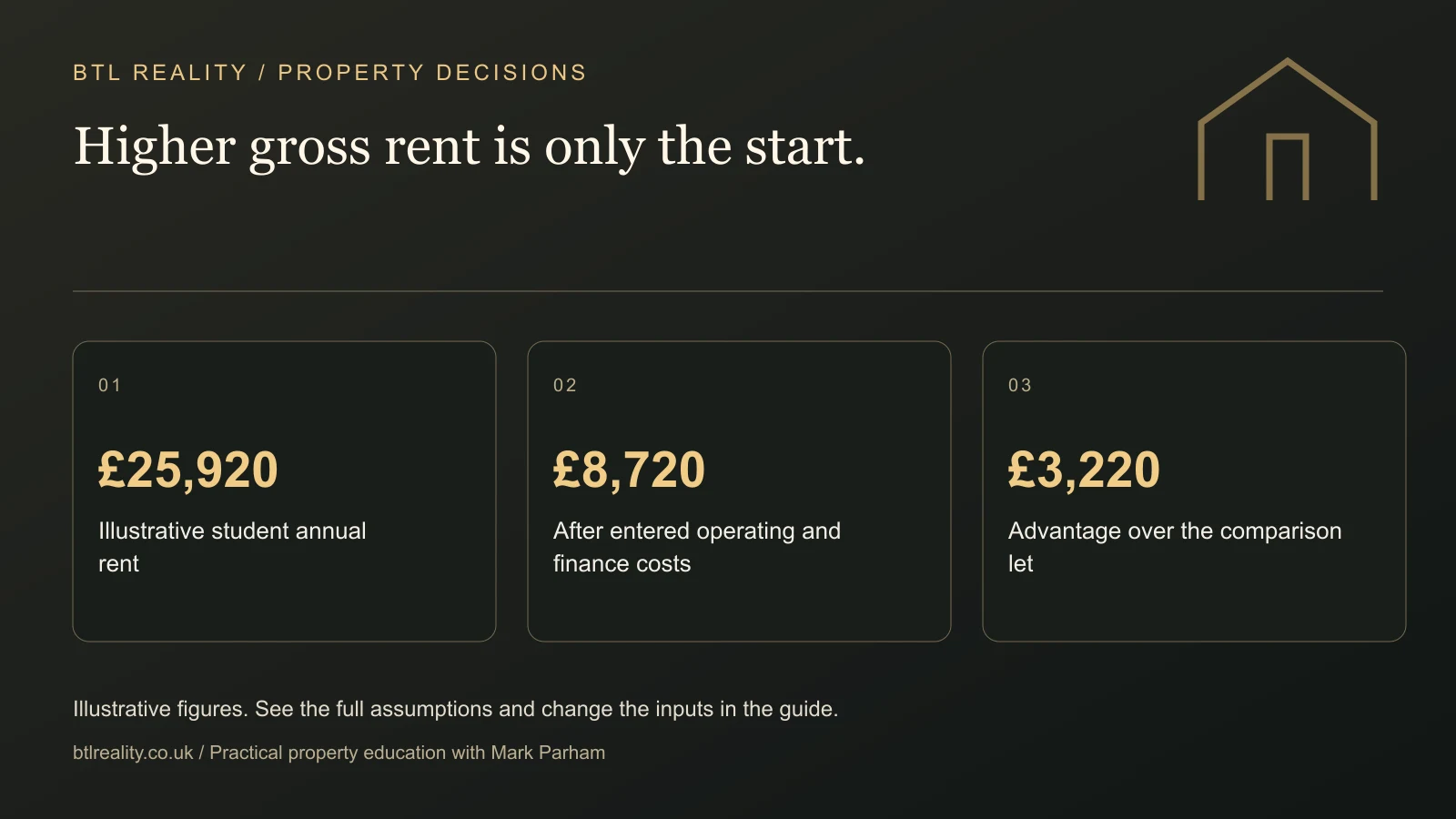
A student let can produce more gross rent than a conventional professional let, but the higher income may come with additional bills, furnishing, management and compliance costs. The useful comparison is annual cashflow after realistic paid periods and expenses, alongside the extra capital and work required.
There is no need to make assumptions about a tenant's character based on whether they study or work. Assess the property, the local market and the actual tenancy arrangements fairly. This guide provides a financial comparison and a checklist of the operating differences that can change the result.
Compare annual income, not weekly headlines
A room advertised at £135 a week can look attractive beside a whole-property monthly rent, but the units are different. Multiply by the number of rooms and the weeks you realistically expect to receive rent, then compare annual totals.
For an illustrative four-room student property at £135 per room for 48 paid weeks, gross annual rent is £25,920. A conventional let at £1,500 a month produces £18,000 over twelve fully paid months. The student model shows £7,920 more gross income.
Neither figure is guaranteed. The paid-week assumption should reflect the lawful tenancy arrangements, local market and realistic occupancy. Do not copy a historic fixed-term student template without checking the current rules. Private student houses and purpose-built student accommodation can be treated differently.
Start with the local university and housing market
Investigate the specific sources of demand. How many suitable applicants seek private housing in the location, what competing supply exists and how do transport and campus access affect preferences? A university somewhere in the city is not enough evidence that any nearby house will let well.
Speak to agents who manage comparable properties and ask about achieved rents, rooms left unlet, marketing timing and the features applicants value. Check whether the advertised prices include bills or furnishing and whether they reflect the same occupancy arrangements.
For a professional let, investigate the relevant employment and household market with equal care. Apply the same standard of evidence to both options rather than giving the preferred strategy stronger rent and perfect occupancy by default.
Build separate operating budgets
A student-house model may include utilities, broadband, furniture, more intensive management, licensing and a particular changeover programme. A conventional let may allocate some bills differently but still needs maintenance, safety, insurance, management and vacancy allowances.
Record the actual service being offered and what the agent will charge. A percentage management fee applied to a larger gross rent can be materially higher in pounds. Check minimum charges, setup fees and what work is outside the standard service.
Do not assume every student let includes bills or every professional let excludes them. The comparison should reflect your proposed agreements. Our bills-inclusive rent guide shows how a higher rent can be consumed by services and why charging rules matter.
Annual student-let cashflow under three scenarios
Make the example your own
Which letting model leaves more annual cash?
Enter realistic paid weeks and all operating and finance costs for each alternative.
Professional input assumes 12 paid months; adjust annual costs or use a realistic average monthly receipt for voids. No tax, capital growth or setup costs. Paid weeks are a scenario, not a guaranteed tenancy term. Check licensing, planning and current tenancy rules separately. Illustrative only. Inputs stay in this page and are not saved or sent.
The calculator compares annual figures before tax and capital changes. It is not a tenancy-law or licensing assessment. Input realistic paid weeks and all relevant annual costs, then compare the result with the cash and effort each option requires.
A worked example after costs
Take the four-room student model producing £25,920 gross annually. Assume £8,200 of annual operating costs and £9,000 finance costs. The remaining cashflow is £8,720 before tax and exceptional expenditure.
For the professional model at £18,000 annual rent, assume £3,500 operating costs and the same £9,000 finance cost. That leaves £5,500. The student model is £3,220 ahead, rather than the £7,920 difference suggested by gross rent alone.
Now reduce the student model to 44 paid weeks. Gross income falls to £23,760 and cashflow to £6,560 with costs unchanged. The advantage shrinks to £1,060. If operating costs are also £2,000 higher than first estimated, student cashflow falls to £4,560, which is £940 below the professional example.
These are invented scenarios, not typical local returns. They demonstrate that paid periods and costs can reverse the result without changing the advertised weekly room rate.
Include the extra setup capital
If adapting and furnishing the student property needs an extra £15,000, that cash belongs in the comparison. The initial £3,220 annual advantage would represent about 21.5% of that extra capital before tax, replacement spending and other differences.
Under the weaker 44-week case, the £1,060 advantage represents about 7.1%. Under the higher-cost case, there is no positive incremental return. The extra capital still remains committed even if the operating advantage disappears.
The setup figure could be very different for a real property. Obtain quotations and professional advice on the works, safety and suitability before budgeting. A house with four rooms on a floor plan is not automatically ready for a four-person letting strategy.
Licensing and planning are separate checks
In England and Wales, GOV.UK's HMO licensing guidance explains the relevant licensing framework and directs landlords to their council. Occupation by several unrelated people can raise HMO questions, and local schemes can apply beyond the national mandatory licensing threshold.
Check the actual address, number of occupants, households and facilities with the council. Planning permission is a separate matter from licensing, so an HMO licence or a lack of mandatory licensing does not automatically establish lawful planning use.
Scotland and Northern Ireland have their own systems. If your comparison depends on a shared-house arrangement, obtain location-specific advice before committing to the purchase or conversion. Compliance costs and occupancy limits belong in the financial model from the beginning.
Use current tenancy rules in the forecast
England's tenancy framework changed in 2026. The government's assured-periodic-tenancy guide for landlords should be checked alongside advice relevant to your proposed student letting arrangement.
Do not assume you can guarantee possession on a chosen summer date simply because the budget has a new group arriving then. Notices, grounds and tenancy requirements need a lawful process. Similarly, a model with twelve paid months is not a promise that every tenant will remain and pay throughout that period.
Have the agent or legal adviser explain how the actual tenancy arrangement fits the operational calendar. The spreadsheet should follow the lawful process, not invent one to suit a desired annual return.
Model turnover and maintenance without stereotypes
A changeover can involve inspection, repairs, cleaning, replacement items and marketing. Estimate the work from the property and actual occupancy pattern rather than assuming that all students cause damage or all working tenants stay for years.
Keep a reserve for ordinary wear and exceptional work. Furniture replacement is not necessarily an annual cost at the same level, so separate regular allowances from known one-off purchases. Do not treat tenant deposits as money available to finance routine maintenance.
A competent managing agent can explain the practical workload for comparable properties. Ask who handles enquiries, contractor access, utility accounts and changeovers, and what support is included if several tasks occur at once.
Compare the exit and alternative use
Consider what happens if the local student market weakens or your preferred management arrangement is no longer available. Could the property reasonably serve another tenant market, and what changes or permissions would be needed?
Do not assume conversion back to a conventional let is free or immediate. Layout, facilities, furniture, mortgage terms and planning history can affect the options. The future buyer pool may also differ between a standard home and a specialised shared-house investment.
Run the alternative-use numbers before relying on them as a fallback. An exit plan is more credible when supported by achievable rent and known work rather than the phrase “we can always rent it another way”.
Choose the business you can operate well
A higher-income model can be worthwhile when its costs, compliance and management are understood. A simpler let can also be the stronger choice where it leaves more time, liquidity or flexibility for your wider plan.
Use the rental yield calculator and buy-to-let deal calculator to compare full cash requirements and realistic operating assumptions. Record the evidence for each rent and cost line.
BTL Reality's Done For You sourcing service works against an agreed brief. That brief should explain the type of operation you want and the complexity you can manage. A larger gross rent is only valuable when the resulting investment and workload fit the plan.
Frequently asked questions
Are student lets always more profitable?
No. Higher gross rent can be offset by bills, furnishing, management, licensing, vacancy and changeover costs. Compare annual cashflow and total capital committed using local evidence. Do not assume one tenant group automatically creates better returns or worse behaviour than another.
Should I model rent over 12 months or paid weeks?
Use the period you realistically expect to collect under the actual lawful arrangement. Convert both strategies into annual totals for comparison. A weekly room rate multiplied by 52 without evidence can overstate income, while assuming every summer is empty can also misrepresent the market.
Can a student house require an HMO licence?
Yes, depending on the occupation, property and local licensing rules. Student status alone does not remove HMO obligations. Check the address with the relevant council and assess planning separately. The rules differ across the UK, so use guidance for the property's location.
How do inclusive bills change the comparison?
They increase both the rent collected and the costs and uncertainty the landlord carries. List every included service and stress-test usage and prices. Apply the relevant charging rules, and compare the net effect rather than treating a bills-inclusive headline rent as pure additional income.
Should I assume the property is empty every summer?
No blanket assumption is reliable. Investigate local demand and the actual tenancy arrangements, then model a range of paid periods and turnover costs. Current tenancy law and possession processes also matter. Do not make the financial forecast depend on an unsupported fixed changeover date.
Which local demand evidence should I check?
Check achieved rents, competing supply, letting times, rooms left unlet, transport, campus or employment access and the expected specification. Use comparable properties and ask experienced local agents for evidence. Apply the same scrutiny to the professional-let alternative so the comparison remains fair.
Put the next step into practice
Use the free tools to test your numbers, then choose the level of support that fits your next decision.