Should a Landlord Include Bills in the Rent?
October 19, 2026
Including bills in the rent can make a property easier for tenants to budget for, but it transfers cost uncertainty to the landlord. The larger advertised rent is not automatically a larger profit. You need to compare the rent premium with the bills, administration and risk you are taking on.
For a straightforward single let, excluding bills may be simpler. In other markets, a clearly defined inclusive package may match tenant expectations. The right answer depends on the property, occupancy, local demand and the legal arrangements. This guide helps you compare the economics without assuming that a fair-usage clause can solve every problem.
Compare like with like before changing the offer
A property advertised at £1,200 including some bills is not directly comparable with a £950 property where the tenant pays everything separately. List exactly what each package includes: energy, water, broadband, council tax or other services. Do not use “all bills” if important items or usage limits are excluded.
Ask local agents whether your target tenants actually value the package and what premium comparable properties achieve. A premium that appears on a listing is not evidence that someone signed at that price. Also check whether those examples have the same occupancy and property condition.
The goal is to improve the proposition while keeping a sustainable margin. If the premium merely reimburses expected costs, any extra administration or cost increase can leave you worse off than a bills-exclusive arrangement.
A simple bills-inclusive comparison
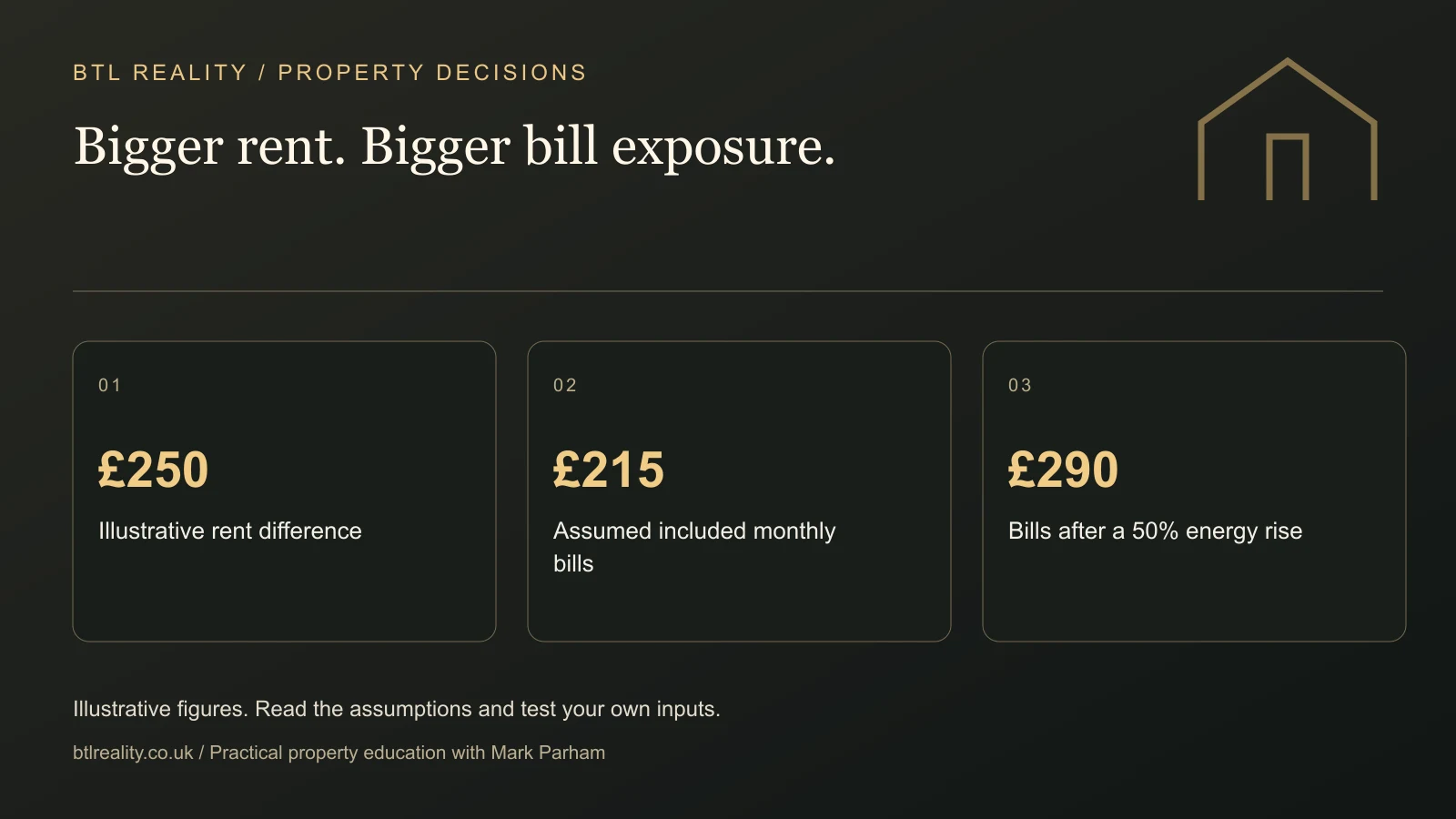
Suppose the achievable rent excluding bills is £950 a month. An inclusive offer might achieve £1,200, creating a £250 monthly premium. Assume the included costs are £150 for energy, £35 for water and £30 for broadband, totalling £215.
On those illustrative figures, the cash comparison leaves £35 a month before any additional management time, tax differences or unexpected usage. This is arithmetic, not permission to mark up utilities: any utility element must comply with the applicable charging rules. That is £420 a year. The headline rent is £3,000 higher annually, but most of that increase pays suppliers.
Now increase the £150 energy assumption by 50% to £225, leaving the other two costs unchanged. Total included costs become £290 and the package loses £40 a month against the exclusive alternative. That is a £480 annual disadvantage.
These are invented modelling inputs, not current tariff estimates. The example shows why a small apparent premium can be sensitive to energy costs and usage. Use the actual property, tariffs and realistic occupancy when budgeting.
Make the example your own
What is the cash difference after included bills?
Compare the rent difference with actual costs, then stress the energy line. The result is not permission to mark up utilities.
Illustrative costs, not tariff quotes. Utility charges must comply with applicable cost and resale rules. Excludes extra administration, tax, vacancy and ordinary property costs. Negative results mean the package is behind the exclusive alternative. Illustrative only. Inputs stay in this page and are not saved or sent.
The model compares the incremental effect of including bills. It does not calculate the full property's profit. Mortgage, maintenance, insurance and other costs still need to be included in the overall appraisal, even if they are identical under both options.
Identify which bills you can estimate properly
Energy spending depends on the building, heating system, tariff, weather and how the property is occupied. A previous owner's bill may not represent a fully occupied rental. An annual average can also hide expensive winter months that need funding before lower-cost months arrive.
Water charging can depend on the supply and metering arrangements. Broadband may involve a fixed contract, installation costs, price changes or early termination charges. Council tax has its own liability rules and should not be assumed to follow whichever name you prefer to put in the tenancy agreement.
Make a separate line for each included service and record the evidence behind the estimate. A rounded “£200 for bills” is difficult to review when actual spending is £350. Individual lines make it possible to see whether the issue is tariff, usage, occupancy or an omitted cost.
Council tax needs its own check
Responsibility can depend on the occupation and property arrangements. Do not assume that wording in the tenancy agreement overrides statutory liability. HMOs and other particular situations can require different treatment from an ordinary single-household letting.
GOV.UK advises contacting the local council if responsibility is unclear. Confirm the position for the actual property, including relevant discounts, exemptions and any changes during vacancy. Northern Ireland uses domestic rates rather than council tax, so a UK-wide financial model should not quietly assume the systems are identical.
If you include council tax in a package, explain exactly what is included and obtain advice on the appropriate agreement. Do not treat a tenant's personal eligibility for a reduction as a guaranteed saving in your investment appraisal.
Get the agreement and charges right
For England, GOV.UK's guidance on permitted tenancy charges explains that utilities and communication services can be included in rent, that included utilities must accurately reflect costs, and that reselling utilities cannot generate a profit. The position should be checked for the applicable tenancy and nation rather than copied from an unrelated template.
Where gas or electricity is resold, Ofgem's maximum resale price guidance is relevant. Do not assume that a separately labelled energy charge is an unrestricted profit opportunity. The structure of the arrangement matters, and you should take advice on compliance.
Have an appropriately qualified adviser or competent agent review the proposed terms. They should be clear about included services, responsibility for accounts, any lawful limits and how issues are handled. Clear marketing and clear contractual terms should tell the same story.
A fair-usage clause is not a complete risk strategy
A phrase such as “subject to fair use” can create more questions than it answers if the tenant cannot understand what it means. Any limits, measurement and potential charges need to be transparent, lawful and suitable for the tenancy. Do not assume an arbitrary extra fee becomes enforceable because it appears in a clause.
Even a properly drafted arrangement does not eliminate collection risk or disputes. You still need a workable way to identify usage, communicate concerns and maintain the service. A spreadsheet that assumes every excess amount will be recovered immediately is too optimistic.
Treat the primary protection as lawful rent and cost arrangements, efficient property systems, accurate estimates and clear administration. Contract wording supports that process; it does not replace it.
Budget for timing as well as annual totals
Imagine the annual included-bill budget is £2,580, equivalent to £215 a month. The supplier payments may not arrive evenly, especially if estimates are corrected or seasonal use is high. A package that breaks even over a full year can still require extra cash in particular months.
Keep a buffer and review actual consumption against the budget. If a meter reading or statement looks wrong, investigate through the appropriate supplier process rather than waiting until year-end. Record opening and closing readings where relevant and use actual figures when available.
Vacancy also deserves separate treatment. Some standing charges or contracts continue when the property is empty, while usage may fall. Do not assume every bill stops at the same moment rent stops. Include those costs in the property's void reserve.
Consider incentives and tenant experience
An inclusive package may appeal to people who want predictable costs and fewer accounts to arrange. That convenience is a real feature when the package is honest and reliable. It can be particularly relevant to a market where competing properties already offer it.
However, a landlord-controlled service also creates expectations. If broadband fails or a supplier problem occurs, tenants may reasonably turn to you or the managing agent. Ask whether the agent's service includes this administration and whether there are additional charges.
Provide practical information about heating controls, ventilation and reporting faults. Efficient use is easier when systems are understandable. Avoid building a business model around restricting reasonable heating or ignoring maintenance issues that increase consumption.
Test the package against three scenarios
Build an expected case using current evidence, a higher-cost case and a vacancy case. In the example, the expected premium after bills is only £35 monthly. A higher-cost scenario quickly shows that the margin is thin.
Then test the rent itself. If the market only accepts £1,150 inclusive, the premium over £950 falls to £200. With £215 bills, the package is already £15 a month behind before any shock. You cannot solve that by assuming the advertised rent is automatically achievable.
Use our rental yield calculator and buy-to-let deal calculator to carry the chosen assumptions into the overall return. Record rent and bill costs consistently so the same expense is not deducted twice or missed entirely.
Decide whether the extra work earns its place
The final question is whether the package improves your investment after costs, effort and uncertainty. It may make sense if it supports evidenced demand and supports the overall letting economics without an unlawful utility markup. It may be unnecessary complexity if tenants prefer arranging their own services and the achievable premium is weak.
Review the proposition before advertising and keep it consistent across the listing, conversations and agreement. If you later want to change the arrangement, obtain advice about the lawful process rather than assuming you can rewrite an existing tenancy unilaterally.
Starter Club helps investors build practical plans and test assumptions like these. The free calculators are available without membership. Start by understanding the actual margin, then decide whether the package supports the tenant and the business you want to run.
Frequently asked questions
Is bills-included rent better for a single let?
Not automatically. It can offer convenience, but the premium must cover the included costs, administration and uncertainty. Compare local demand and actual achievable rent with a bills-exclusive alternative. A larger advertised monthly payment is not the same as a larger landlord profit.
Which costs should I include in a bills-inclusive model?
List every service promised, including relevant energy, water, broadband and council-tax costs where applicable. Include standing charges, seasonal changes, setup or contract costs and additional management work. Keep ordinary property expenses separate but present in the full investment calculation.
Who is responsible for council tax?
Liability depends on the legal and occupancy arrangements, not just the tenancy's wording. Confirm the position with the local authority for the particular property and tenancy, especially for HMOs or unusual arrangements. Check vacancy, exemption and discount assumptions separately rather than treating them as guaranteed savings.
What happens when energy prices rise?
If you have committed to an inclusive package, higher costs can reduce the landlord's margin. The agreement and applicable law determine what changes or charges are possible. Stress-test the budget beforehand and obtain advice rather than assuming costs can immediately be passed to the tenant.
Can a fair-usage clause solve every cost risk?
No. Terms must be clear, lawful and workable, and disputes or collection delays can still occur. A vague phrase is not a substitute for proper pricing and administration. Review the proposed arrangement professionally and do not assume every unexpected cost becomes recoverable.
How should I compare inclusive and exclusive advertised rents?
Remove the value of the included services and compare the underlying accommodation, condition, occupancy and location. Use achieved rents where available. For the landlord calculation, subtract the actual expected bills from the premium and test higher costs before deciding the inclusive offer performs better.
Put the next step into practice
Use the free tools to test your numbers, then choose the level of support that fits your next decision.