What Changes When You Buy Your Fourth Mortgaged Rental Property?
October 17, 2026
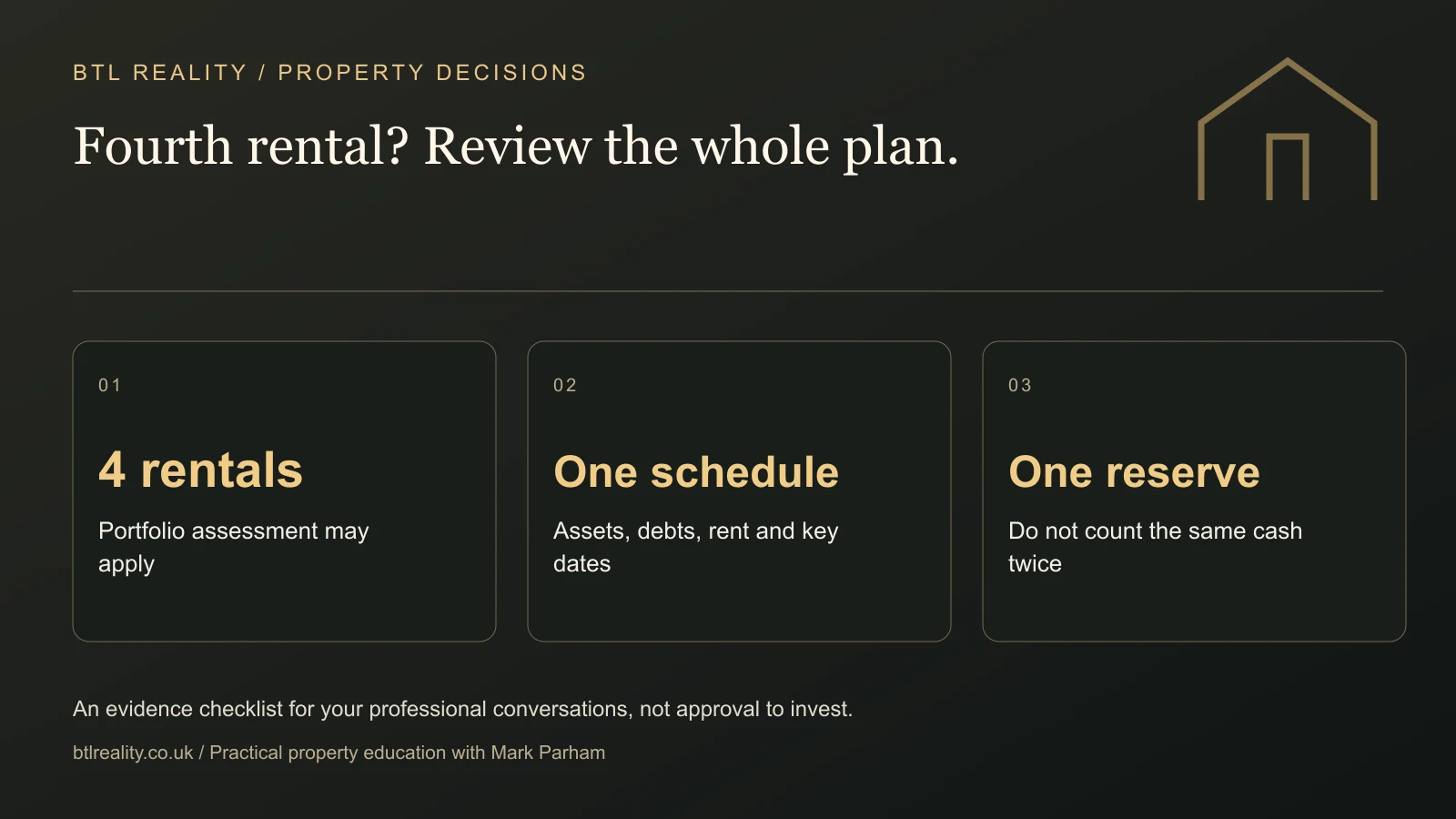
Buying your fourth mortgaged rental can change the mortgage assessment from a single-property exercise into a wider portfolio review. The new deal still needs to work, but the lender may also examine the properties, borrowing and rental income you already have. Preparing that information before offering on the next purchase makes the process much easier to manage.
Four properties is not a magic point at which investing becomes safe, difficult or automatically profitable. It is an important underwriting threshold, and individual lenders apply their own processes within the wider framework. This guide explains what to prepare and how to spot a weak portfolio assumption before it disrupts the next acquisition.
What makes you a portfolio landlord?
The Prudential Regulation Authority's buy-to-let underwriting standards identify portfolio landlords as borrowers with four or more distinct mortgaged buy-to-let properties, considered in aggregate. The framework expects a specialist approach reflecting the greater complexity of their position.
That does not mean every lender asks for identical documents or offers identical products. The type of transaction can also affect the process. For example, The Mortgage Works' published portfolio criteria distinguish some remortgages without capital raising from other applications. Check the criteria relevant to your actual application rather than relying on a remembered threshold.
Give your broker the complete ownership picture, including jointly owned rentals, company interests and properties with consent to let. Let the broker establish how the chosen lender counts and assesses them. Leaving something out because you do not personally consider it part of the portfolio can produce an inaccurate application.
Count properties, not mortgages or bedrooms
The usual reference is distinct mortgaged rental properties, not the number of tenants or individual bedrooms. A jointly owned property should not simply be counted twice because two applicants own it together. Conversely, a property does not disappear from the assessment because another person owns a share or a company holds the title.
Mortgage-free rentals do not themselves create the four-mortgaged-property threshold. They may still be relevant to the wider financial picture and a lender's portfolio assessment. List them accurately rather than assuming that “not counted for the threshold” means “not disclosed”.
Where the structure is more complicated, such as multiple units, several titles or borrowing secured across properties, ask for a specific classification. A tidy spreadsheet is only useful if each row represents the correct asset and liability.
Build a property schedule you can maintain
For each property, record its address, ownership, current estimated value, outstanding mortgage, monthly rent, mortgage payment, lender, product expiry and final term. Add lease and service-charge details where relevant, tenancy information and any known works.
Keep evidence beside the figures. A rent figure should be distinguishable as current contracted rent, current actual receipts or a future market-rent estimate. A property valuation should have a date and basis, rather than being the highest number an agent once mentioned.
The same applies to debt. Use current statements and identify whether fees have been added or capital repaid since the last review. A £5,000 error on several balances can materially change the apparent loan-to-value and cash available for the next deposit.
Maintain this schedule for your own decisions as well as the application. Updating it when a product renews or a tenancy changes is easier than reconstructing the entire portfolio under a purchase deadline.
Make the example your own
Is the portfolio file ready for your broker?
Tick after reviewing the actual evidence. Ask the broker for the chosen lender's exact requirements.
0 of 6 checks reviewed
This is an organiser, not approval to invest. Selections stay in this page and are not saved or sent.
The checklist helps you assemble an application file. It does not calculate a lender pass or replace the lender's requested format. Submit the information your broker asks for, with explanations where figures need context.
Portfolio averages can conceal a weak property
Consider three illustrative rentals with combined values of £450,000 and mortgages totalling £300,000. The aggregate loan-to-value is approximately 66.7%. Adding a £150,000 property with a £112,500 loan creates a £600,000 portfolio carrying £412,500 of debt, or 68.75% loan-to-value.
Those averages look comfortable compared with a hypothetical 75% ceiling. But they do not tell you whether each property earns sufficient rent, whether an expensive leasehold works bill is coming or whether all mortgages renew in the same month.
Suppose monthly rents across the four properties total £3,800. At an illustrative 6% interest stress rate on £412,500, monthly interest is £2,062.50. Gross rent divided by that interest is approximately 184.2%. That is an arithmetic ratio, not a lending decision or an operating profit margin.
Deducting £1,000 of ordinary monthly property costs leaves £737.50 before tax in this simple interest-only scenario. Add a vacancy, repayment mortgage or substantial repair and the cash outcome changes again. A lender's rental-cover test and your spendable income are different measures.
Use our mortgage stress calculator for financing scenarios and the property portfolio calculator for the wider plan. Neither should be treated as confirmation of an actual lender's assessment.
Test a shared shock, not just one empty property
A portfolio can diversify some risks while concentrating others. Four properties in one building might share a roof problem. Four similar lets in one small employment market may face the same demand shock. Four loans on similar fixed-rate dates can expose you to a simultaneous financing change.
List the events that could affect several properties together. Then decide how the cash reserve and purchase pace should respond. Counting each property's contingency as though it were separate cash can create a false sense of protection if all the money sits in one limited pot.
For example, £12,000 in the bank is not a £12,000 reserve for each of four properties. If you reserve £3,000 against each, a single £8,000 bill already consumes more than two allocations. The right buffer depends on the buildings and obligations, not a rule that every door needs the same amount.
Does buying the fourth property improve the portfolio?
Look beyond the fact that you can obtain a mortgage. Compare the next property's contribution with the cash and attention it requires. A fourth rental that adds £100 a month but uses the entire reserve can weaken the plan, even if it increases the total asset value.
Write a short purchase case: who will rent it, what evidence supports the rent, what cash remains after completion, how it behaves at a higher interest rate and what could force an early sale. Then explain why this purchase is better than reducing risk, improving an existing property or waiting.
A purchase can still be worthwhile with modest initial income if the wider assumptions are sensible, but label those assumptions. Forecast growth is different from contracted rent, and a hoped-for refinance is different from money already available.
Our guide to negative equity and refinance pressure shows why a portfolio can encounter lending constraints before the assets become worth less than the debt. Carry that stress case into any expansion plan.
Organise the professional conversations
Ask your broker which assets will be included, what evidence is required, how the new borrowing is assessed and whether any existing property could constrain the application. Be clear about intended ownership and the source of the deposit.
Ask your accountant to check the tax and cash consequences of the structure you propose. Ask your solicitor about guarantees, security and any transaction-specific obligations. Keep advice within each professional's remit rather than assuming that one approval covers the whole investment.
If a lender asks for a business plan, explain the actual strategy in plain language. Include the current position, proposed purchase, funding, management, reserves and plausible downside responses. A page of realistic numbers is more useful than a promise to become financially free through uninterrupted appreciation.
Build a repeatable review before scaling further
Set a routine for reviewing mortgage expiry dates, rent receipts, maintenance and reserves. A portfolio does not need elaborate software to begin with, but it does need records that match the real cash position. Reconcile the bank account with the forecast and investigate differences.
This is where the conversation can move from “Can I buy another one?” to “Which next decision improves the plan?” BTL Reality's Private Mentorship supports strategic discussion, modelling and planning around your objectives. It complements the work of your broker, accountant and solicitor rather than replacing their advice.
The strongest fourth purchase is not necessarily the cheapest property or the highest advertised yield. It is a purchase that works on its own and leaves the combined business able to cope when one of the assumptions fails.
Frequently asked questions
When am I classed as a portfolio landlord?
The PRA framework uses four or more distinct mortgaged buy-to-let properties considered in aggregate. A lender's application route and evidence requirements can depend on the transaction. Give your broker the full ownership and borrowing schedule before assuming the fourth purchase will be processed like the first.
Do mortgage-free properties count towards the four-property threshold?
The threshold refers to mortgaged buy-to-let properties. Mortgage-free rentals can nevertheless form part of a lender's wider assessment and your financial disclosure. Record them accurately, with rent and value evidence, and ask the broker how the relevant lender treats them.
Do jointly owned or company-owned rentals count?
They can be relevant, and you should disclose them rather than making your own exclusions. Lenders have specific rules for joint applicants and company ownership. Avoid double-counting the same distinct property, but provide enough detail for the broker to establish the correct portfolio position.
Do all lenders apply identical portfolio criteria?
No. Documentation, stress assumptions, concentration limits, acceptable property types and product availability can differ. Published criteria also change. Compare the routes that fit your actual portfolio instead of assuming one lender's response proves that every other lender will reach the same decision.
Why does a lender ask about my other rental properties?
Existing assets and borrowing affect the overall financial position supporting the application. A strong new property does not remove risks from expensive debt, weak rents or concentrated exposure elsewhere. The information helps the lender assess the combined position rather than the new purchase in isolation.
What should I prepare before applying for the fourth mortgage?
Prepare an up-to-date property schedule, ownership details, mortgage statements, rent evidence, relevant accounts or income documents, deposit evidence and an explanation of the proposed purchase. Ask your broker for the lender-specific list. Keep assumptions clearly separate from documented current figures so questions can be resolved quickly.
Put the next step into practice
Use the free tools to test your numbers, then choose the level of support that fits your next decision.