What Happens If My Buy-to-Let Falls Into Negative Equity?
October 16, 2026
Negative equity means your buy-to-let is worth less than the mortgage secured against it. It does not automatically mean the rent has stopped or that you must sell immediately. It does mean refinancing and selling can become much harder, because the property's value no longer covers the debt.
The useful response is to separate three numbers: asset value, monthly cashflow and the cash required at your next decision point. A landlord with stable income and time has a different problem from one facing an imminent mortgage maturity, expensive repairs or a forced sale. This guide helps you see those differences without assuming property prices always recover on your timetable.
How negative equity happens
If a property is worth £150,000 and its mortgage balance is £112,500, the gross equity is £37,500. A 10% fall in value reduces the property to £135,000 and equity to £22,500, assuming the debt stays unchanged. A 25% fall reduces the value to £112,500, leaving no gross equity. A 30% fall takes the value to £105,000, creating £7,500 of negative equity.
These are balance-sheet calculations, not sale proceeds. Estate-agent fees, legal costs, redemption charges and any tax due are separate. You can still need cash to complete a sale even when the headline equity is slightly positive.
MoneyHelper explains negative equity and its effect on mortgage options. Its general guidance is useful background, but your buy-to-let mortgage terms and available assistance need checking with your own lender. Do not assume every residential homeowner arrangement applies to a rental mortgage.
A modest price fall can remove refinance flexibility
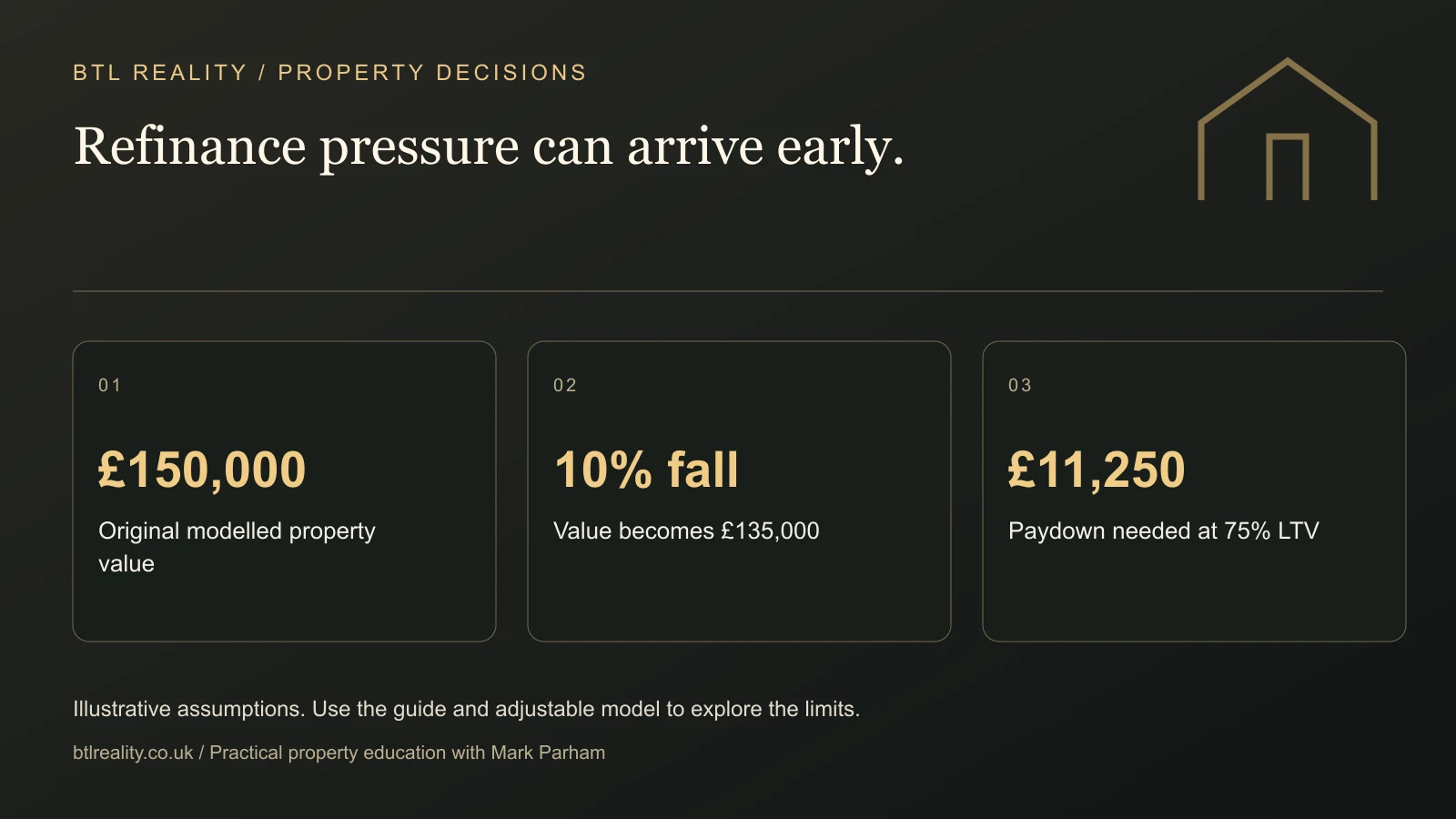
You do not need to enter negative equity to encounter a refinancing problem. Suppose that £150,000 property falls just 10% to £135,000. With £112,500 outstanding, its loan-to-value rises from 75% to approximately 83.3%.
If a replacement lender's maximum loan is 75% of the accepted value, the new loan would be no more than £101,250 on that basis. You would need £11,250 to bridge the old balance, before fees and any other restrictions. The property still has £22,500 of gross equity, yet it cannot support the previous debt at the modelled lending limit.
Rental coverage, your circumstances and the property's suitability can reduce borrowing further. Conversely, a different eligible product may offer a different limit. The point is to model the actual borrowing test rather than treating “positive equity” as a guarantee of an easy remortgage.
Our property refinance calculator can help you compare potential borrowing and cash released. For a falling market, the most useful output may be the money you need to put in, not money you can take out.
Paydown required to refinance at 75% LTV
Make the example your own
How does a price fall affect the refinance?
Move the price-fall slider while keeping debt fixed. The lending limit is illustrative and may be reduced by other criteria.
No fees, tax, repayments or extra borrowing. Equity can be negative. Paydown is before refinancing costs and assumes the chosen limit is available; rent coverage and other criteria can reduce the loan. Illustrative only. Inputs stay in this page and are not saved or sent.
The slider keeps debt constant so you can see the effect of changing property value alone. It is a stress test, not a prediction of a particular market fall. A repayment mortgage, additional borrowing or overpayments would change the debt separately.
Negative equity and negative cashflow are different
Take the same £112,500 interest-only mortgage at an illustrative 5% interest rate. Its monthly interest is £468.75. With £1,000 rent and £250 operating costs, the property produces £281.25 a month before tax and exceptional expenditure.
A lower valuation alone does not change that arithmetic. If the property falls to £105,000 but rent, costs and interest remain identical, the model still produces £281.25. You have a balance-sheet problem with positive operating cashflow.
Now increase the interest rate to 7%. Monthly interest becomes £656.25, reducing the surplus to £93.75. Add a £2,000 repair and that single bill exceeds 21 months of the smaller surplus. The combination of limited refinance options and a weaker cash buffer is much more uncomfortable.
That distinction prevents two opposite mistakes. One is panic-selling solely because an estimated valuation changed. The other is dismissing the valuation because rent currently arrives. You need to understand both the ability to hold and the eventual ability to repay or refinance.
Build a twelve-month holding budget
List the actual mortgage payments, insurance, management, service charges where applicable, maintenance allowance and compliance costs. Include a realistic period without rent and any known work. Keep your household commitments outside the property calculation so neither budget quietly subsidises the other without acknowledgement.
Then separate dependable receipts from hoped-for receipts. Contracted rent is still exposed to non-payment and vacancy. A planned refinance is not cash until an acceptable loan completes. A possible sale is not a liquid emergency reserve.
For example, a property costing £750 a month to hold without rent requires £4,500 for a six-month empty period. Add a £3,000 repair and the required funding becomes £7,500. If your accessible reserve is £5,000, the immediate issue is a £2,500 liquidity gap, regardless of the long-term price forecast.
Use the free mortgage stress calculator alongside this guide. Test the finance rate you might actually face at the next product change, not just the rate you enjoyed when you purchased.
Check the dates that could force a decision
Find the end of the fixed-rate period, the final mortgage maturity, any repayment requirements and the timing of major property expenditure. These dates are different. A fixed-rate deal ending does not necessarily mean the entire mortgage balance is due that day, but the final term normally requires a repayment solution.
Ask your lender or broker about the routes available before the deadline becomes urgent. A product transfer with the existing lender may be worth discussing, but it is not an entitlement or permission to borrow more. Eligibility and pricing need confirmation for your account.
If repayment is approaching, our guide to the end of an interest-only buy-to-let mortgage explains why a property valuation and a repayment plan are separate matters. Waiting for an assumed rebound is not a substitute for a funded plan.
Should you use savings to reduce the mortgage?
Paying down debt can improve loan-to-value and reduce interest, but the money generally stops being readily accessible. Ask about overpayment allowances, charges and how the payment affects the loan. Do not assume a lump sum will automatically produce the mortgage product you want.
Compare two uses of the same £10,000: reducing borrowing or keeping a reserve against vacancy and repairs. The preferred balance depends on the refinance shortfall, mortgage terms and wider finances. Emptying the reserve to reach a lending threshold can leave a property vulnerable immediately afterwards.
A structured decision records the benefit you expect, the cost of acting and the risk created elsewhere. If your proposed payment improves an indicative LTV but does not solve rental coverage or property eligibility, it may not deliver the intended refinancing result.
Selling needs a redemption calculation
Before deciding to sell, request the relevant mortgage redemption figures and estimate sale costs. If the agreed price cannot cover the secured debt and costs, speak to the lender and your conveyancer about the position before committing to a transaction.
Using the £105,000 value and £112,500 debt example, a sale at that price starts with a £7,500 debt shortfall. An illustrative £4,000 of selling and redemption costs increases the cash needed to £11,500, before any other liabilities. This is why the gross equity number is not enough.
A sale at a loss may still be the least damaging route in some circumstances, but it should be assessed alongside realistic holding costs and alternatives. Do not keep a failing investment simply because crystallising a loss feels worse than watching it on paper. Equally, do not assume a quick-sale offer represents normal market value.
Plan across the portfolio without hiding the weak property
If you own several rentals, examine each one and the combined position. Surpluses elsewhere may provide time, but they also have their own maintenance and borrowing needs. A cross-portfolio cash reserve should not be counted in full against every property simultaneously.
The property portfolio calculator is useful for comparing wider scenarios. For strategic modelling and decision support, Private Mentorship provides a setting to examine your objectives and assumptions. Mortgage recommendations, debt advice and legal decisions still belong with appropriately qualified professionals.
If payments are becoming difficult, contact the lender promptly and seek suitable debt advice. An educational calculator can clarify numbers; it cannot negotiate your mortgage or determine which protections apply to your situation.
Frequently asked questions
What is negative equity on a buy-to-let?
It is the amount by which the mortgage debt exceeds the property's current value. A £120,000 mortgage against a £110,000 property creates £10,000 of negative equity before selling costs. It describes the asset and debt position, not whether the monthly rent currently covers expenditure.
How far can prices fall before my deposit is wiped out?
With debt unchanged, a purchase at 75% loan-to-value reaches zero gross equity after a 25% fall from the original value. Added borrowing, repayments and buying below the independently supported market value change that calculation. Purchase and sale costs are not protected by the deposit percentage.
Can I remortgage while in negative equity?
Moving to a new lender is likely to be difficult because the value does not support the existing debt. Discuss your exact circumstances with a broker and current lender. A possible product transfer is different from a new capital-raising mortgage, and neither route should be assumed available.
Can I keep renting a property that has negative equity?
A lower valuation does not by itself end the tenancy or stop rent. You still need to meet the mortgage conditions, payments, legal obligations and property costs. Check the contract and take advice if a term expiry, covenant issue or payment difficulty could change the position.
Does negative equity mean the rent stops covering the mortgage?
No. Property value, rent and financing costs are separate variables. However, restricted refinancing options can leave you exposed to more expensive borrowing, which may reduce cashflow later. Model the monthly budget and the next financing decision alongside the equity figure.
Who should I contact if repayments become difficult?
Speak to your mortgage lender early, explain the situation accurately and ask about the options relevant to your account. Seek appropriate independent debt advice and involve a qualified broker or legal adviser where needed. Do not wait for an assumed price recovery before addressing missed or unaffordable payments.
Put the next step into practice
Use the free tools to test your numbers, then choose the level of support that fits your next decision.