Is a Flat Above a Shop a Good Buy-to-Let Investment?
October 15, 2026
A flat above a shop can be a good buy-to-let when the price, tenant demand, building arrangements and financing work together. It can also be cheap for reasons that reduce its appeal to tenants, lenders and future buyers. The commercial unit below deserves as much attention as the kitchen inside the flat.
Central locations can offer useful transport links, shops and employment nearby. A lower purchase price may improve the rental yield. But the type of business, its hours, ventilation, deliveries, security and access can make two apparently similar flats very different investments.
The aim is to identify a property that works well as someone's home and produces a sensible return at the price you pay. Start with the actual building and street, rather than a rule that every flat above commercial premises is either a bargain or a mistake.
Understand what is beneath and beside the flat
A quiet office operating during ordinary working hours creates a different environment from a late-night takeaway, bar or premises with frequent early-morning deliveries. Look at the whole arrangement, including neighbouring units and rear access, rather than only the shop directly below.
Visit when the businesses are operating. A viewing at 11am may reveal little about noise at closing time. Check odours, extraction equipment, refrigeration units, bins, loading areas and where staff or customers gather. Observe rather than assume: the presence of a restaurant does not by itself tell you the actual impact inside the flat.
Ask what the commercial premises are permitted to do and whether any proposed changes are known. Your conveyancer can investigate the relevant legal documents, while the planning authority can clarify planning matters. The tenant will experience the use that actually occurs, not the reassuring description in the sales advert.
Check that the entrance works as a residential entrance
A separate, secure and well-maintained entrance can make a significant difference to daily use. Check lighting, locks, post, refuse arrangements and the route from the street to the flat. Consider whether tenants must pass a service yard, share access with commercial staff or navigate poorly maintained common parts.
Think about an ordinary evening arrival. Is the route clear after the shop closes? Can deliveries block it? Is emergency access appropriate? A short viewing should include the shared areas and outside route, not just the rooms being marketed.
Ask who maintains each part and pays for it. Responsibility for the stairs, roof, external walls, drainage and services should be established from the documents. An attractive interior cannot compensate indefinitely for a neglected entrance or uncertain building-management arrangement.
Mortgage acceptance depends on the actual circumstances
Some lenders will consider flats near commercial premises under their criteria; others restrict particular uses or building arrangements. A broker needs the exact address, business types, access, tenure and other relevant details before identifying a suitable route.
For example, The Mortgage Works' property criteria discuss commercial proximity that could affect demand or marketability through noise, smells or disturbance. That is a specific lender's approach, not a universal ban or approval for all flats above shops.
Get the financing discussion started before committing to expensive legal or survey work where a fundamental eligibility concern is obvious. Also think beyond today's mortgage. A restricted future lending market can affect refinancing and the pool of buyers when you eventually sell.
Compare the lower price using complete cashflow
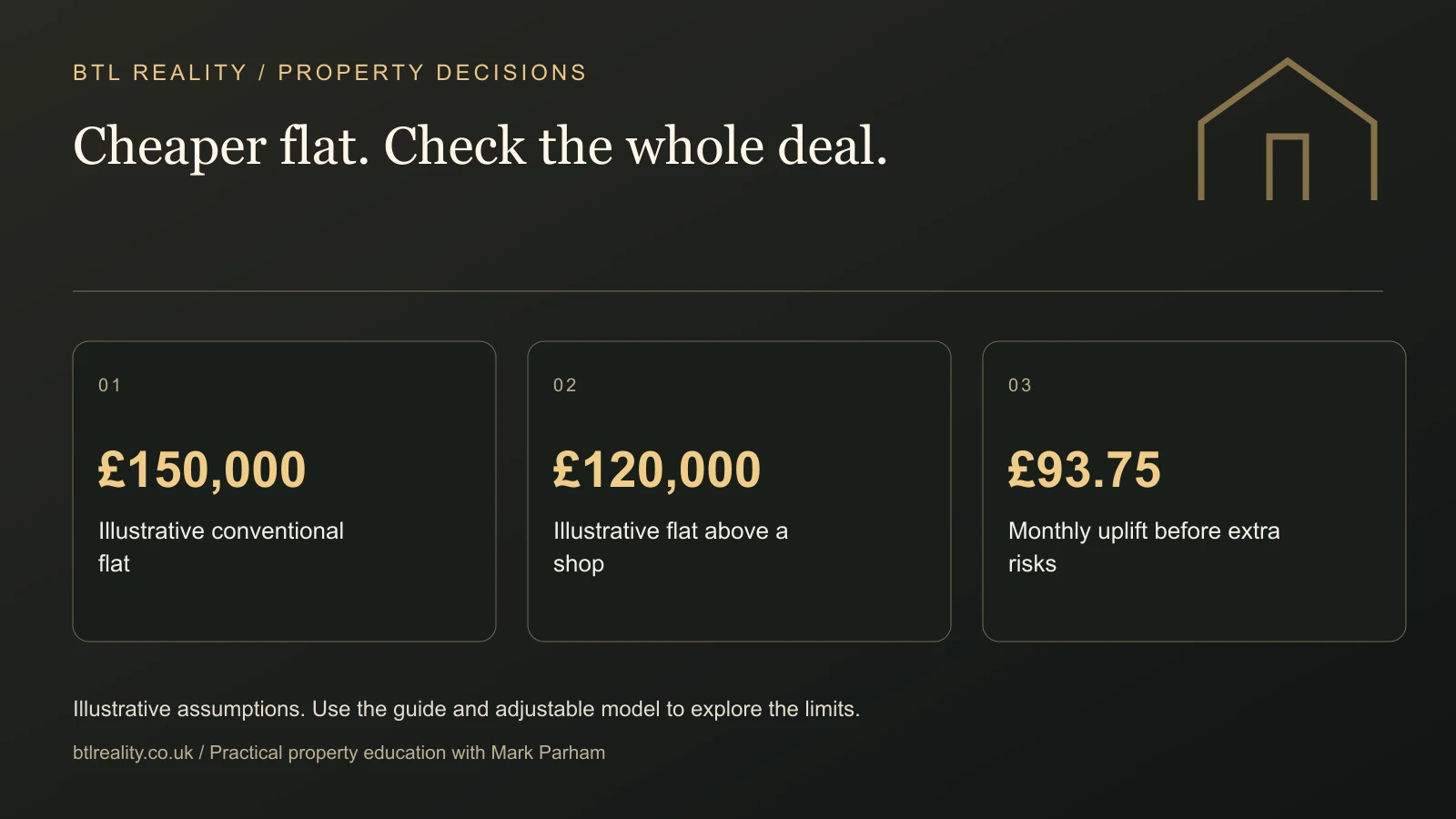
Imagine two flats each expected to achieve £1,000 monthly rent, with £300 of monthly operating costs and allowances. One costs £150,000 and the other £120,000. At an illustrative 75% interest-only mortgage and 5% interest, the finance costs are £468.75 and £375 respectively.
The simplified monthly cashflow is therefore £231.25 for the £150,000 flat and £325 for the £120,000 flat, before tax and exceptional costs. The lower price creates a £93.75 monthly difference under these assumptions. This is the attraction worth investigating rather than dismissing the cheaper property immediately.
But equal rents and costs are assumptions to prove. If the cheaper flat attracts £900 rent and has another £75 monthly service or insurance cost, its cashflow falls to £150. The price discount has not prevented the weaker operating result.
Make the example your own
Does the lower price improve the monthly cashflow?
Compare two interest-only purchases with the same loan-to-value and rate. Adjust the rent and running costs independently.
Excludes tax, buying costs, exceptional work, price changes and unentered voids. Finance terms may differ between properties. A positive deposit saving means B needs less deposit, not less total cash in every case. Illustrative only. Inputs stay in this page and are not saved or sent.
Use the buy-to-let deal calculator for a complete acquisition budget, including tax, legal fees, works and reserve. The comparison above isolates the price and operating figures; it does not establish that either property qualifies for finance or that the rents are achievable.
Prove tenant demand at the realistic rent
Ask local letting agents about comparable flats above similar businesses, not just ordinary flats nearby. Find out who tends to rent them, how long they take to let and which objections appear during viewings. A large number of advertised properties may represent choice for tenants rather than strong demand for yours.
Compare achieved or well-supported rents with the asking figures. Note differences in floor area, condition, heating costs, parking, access and distance from transport. A central location can be a strength, but the specific flat must still offer a comfortable and practical home.
Ask how the likely tenant profile affects the management plan. A small flat aimed at people working nearby may have a different turnover pattern from a larger family rental. Avoid making assumptions about tenant quality from occupation or location; focus on lawful, consistent referencing and the property's suitability.
Review the lease and whole-building costs
For a leasehold flat, the conveyancer should review lease length, use restrictions, repair obligations, service charges, insurance arrangements and any consent requirements. Mixed residential and commercial buildings can have cost allocations that are not obvious from a simple percentage in the advert.
Ask how major works are planned and funded. Who pays if the roof needs replacing or shared drainage fails? Are accounts and budgets available? Our guide to buying a flat with major works planned explains why an approaching contribution belongs in the purchase appraisal.
Check whether the commercial owner and residential owners have different obligations or interests. That does not automatically make management difficult, but the mechanism for decisions and payments should be understandable. Do not assume a low service charge means the building has low future maintenance needs.
Get the right condition and insurance checks
Choose a survey appropriate to the property and ask about the aspects that deserve specialist follow-up. Sound transmission, damp, extraction, fire separation, roof condition and alterations may be relevant, but their assessment requires the right expertise and scope.
A lender's valuation is not a complete investigation of those matters. The valuation-versus-survey guide helps identify the separate roles. Explain the commercial use when obtaining survey and insurance advice so the professionals are assessing the building you are actually buying.
Check the insurance arrangements before exchange. In a leasehold block the building may be insured collectively, but you still need to understand the cover, allocation, exclusions and any additional landlord cover required. Obtain the documents rather than relying on a statement that the building is insured.
Think about the buyer after you
You do not need to sell soon to care about resale. A future buyer may need a mortgage, prefer a different type of home or price the commercial proximity differently. A smaller buyer pool can affect sale time and the price required to achieve a sale.
Look for evidence of actual transactions in the same type of building. A claimed discount against a conventional flat may simply reflect a persistent difference in the market. It is still possible to earn an acceptable income at that lower price, but you should not assume the gap will close.
Separate the income case from the appreciation case. If the investment meets your target through realistic rent at the current price, that is a coherent argument. If it only works because a future buyer is expected to ignore the very feature that made it cheap, the growth assumption needs stronger evidence.
Set a brief that allows opportunity without ignoring constraints
A useful brief might specify acceptable business types, independent access, evidence of rental demand, manageable building costs and a confirmed finance route. It can also identify features that are outside your experience or risk tolerance.
That is more productive than asking for “the highest yield available”. A high gross yield might reward careful selection, or it might reflect costs and restrictions missing from the advert. The job is to find out which before committing.
BTL Reality's Done For You service sources property against an agreed brief. If flats above commercial premises are included, the brief should state the evidence and professional checks required. The result should be a property whose lower price improves the investment after the real costs and tenant experience have been considered.
Frequently asked questions
Can I get a buy-to-let mortgage on a flat above a shop?
Potentially, depending on the lender, business use, access, construction, tenure and other criteria. Give the broker the exact property details early. A general statement that a lender accepts flats does not confirm it will accept this particular building or commercial arrangement.
Does the type of business below the flat matter?
Yes, because actual use can affect noise, smells, access, insurance, tenant demand and lending. Investigate operating hours, deliveries, extraction and common areas. Visit while the business is active rather than judging the environment from a quiet daytime viewing alone.
Is a flat above a restaurant different from one above an office?
It can be. The operating hours, equipment, ventilation and customer activity may differ considerably. Assess the actual impact and professional requirements rather than treating the category as a complete answer. A well-managed building and a poorly managed one can produce very different living conditions.
Will a lower purchase price offset a smaller resale market?
It might, but that needs a deliberate comparison of income, costs, holding period and exit assumptions. A lower price does not guarantee strong returns or future price convergence with ordinary flats. Use evidence from comparable transactions and allow for potentially longer sale times.
What insurance and lease questions should I ask?
Check permitted use, access, repairs, service charges, major works, lease length and the building's insurance arrangements. Tell the insurer about the commercial premises and intended letting. Ask the conveyancer to explain the responsibilities and cost allocations rather than assuming all flats contribute equally.
How do I check demand before making an offer?
Compare similar local lettings and ask agents about realistic rent, letting time and common viewing objections. Check the property during relevant business hours and assess access, comfort and layout from a tenant's perspective. Avoid using the highest nearby advertised rent as your only evidence.
Put the next step into practice
Use the free tools to test your numbers, then choose the level of support that fits your next decision.