Buy-to-Let Maintenance Budget: Repairs Without the Guesswork
October 19, 2026
A useful buy-to-let maintenance budget starts with the building you own, not a percentage copied from somebody else's spreadsheet. A newly refurbished flat with a service charge needs a different plan from an older house with its original roof and heating system. Both can look profitable until the next large invoice arrives.
The practical aim is to turn irregular spending into a funding plan. Separate small repairs, foreseeable replacements and genuinely unexpected work. Then compare the monthly amount you need to set aside with the rent left after other costs. If that makes the deal less exciting, the budget has done its job before your bank balance does it for you.
Why a percentage of rent is only a starting point
An allowance such as 10% of rent can be useful for a quick screen, but it does not describe the condition of your property. Two houses collecting £1,000 a month would both receive a £1,200 annual allowance. One might have new systems and a recent survey; the other might face several expensive replacements close together.
Rent also varies by area while some repair costs do not vary in the same proportion. A lower-rent property does not necessarily have a proportionally cheaper boiler, roof repair or emergency callout. Using a single percentage can therefore make a high-yield purchase look more resilient than it really is.
Start with a percentage if information is limited, label it as provisional and replace it with evidence. Ask for service records, inspect the property properly and obtain quotes for known defects. The budget should become more specific as you get closer to a purchase, rather than remaining the optimistic estimate used on your first viewing.
Divide maintenance into three separate pots
Routine repairs cover smaller recurring jobs: leaks, broken fittings, minor electrical faults and contractor callouts. Estimate these from the property's history, condition and expected usage. Keep management fees separate unless your agreement genuinely includes the repair itself, rather than arranging it.
Planned replacements cover items with a foreseeable future cost, such as flooring, decoration between tenancies or an ageing appliance. You may not know the exact replacement date, but you can make an explicit assumption and revisit it. Dividing the expected cost by the months until replacement gives a useful monthly saving target.
Emergency liquidity is accessible cash for costs arriving sooner than expected. A monthly saving plan does not pay an invoice due tomorrow if the account currently contains very little. Keep an opening reserve alongside the ongoing provision, and avoid treating the same cash as both a deposit for the next purchase and a repair buffer.
Read Mark's cash-reserve discussion for property investors for the wider liquidity issue. Its historical market commentary is separate from the practical principle: money already committed to a purchase cannot also be your emergency fund.
A worked maintenance budget
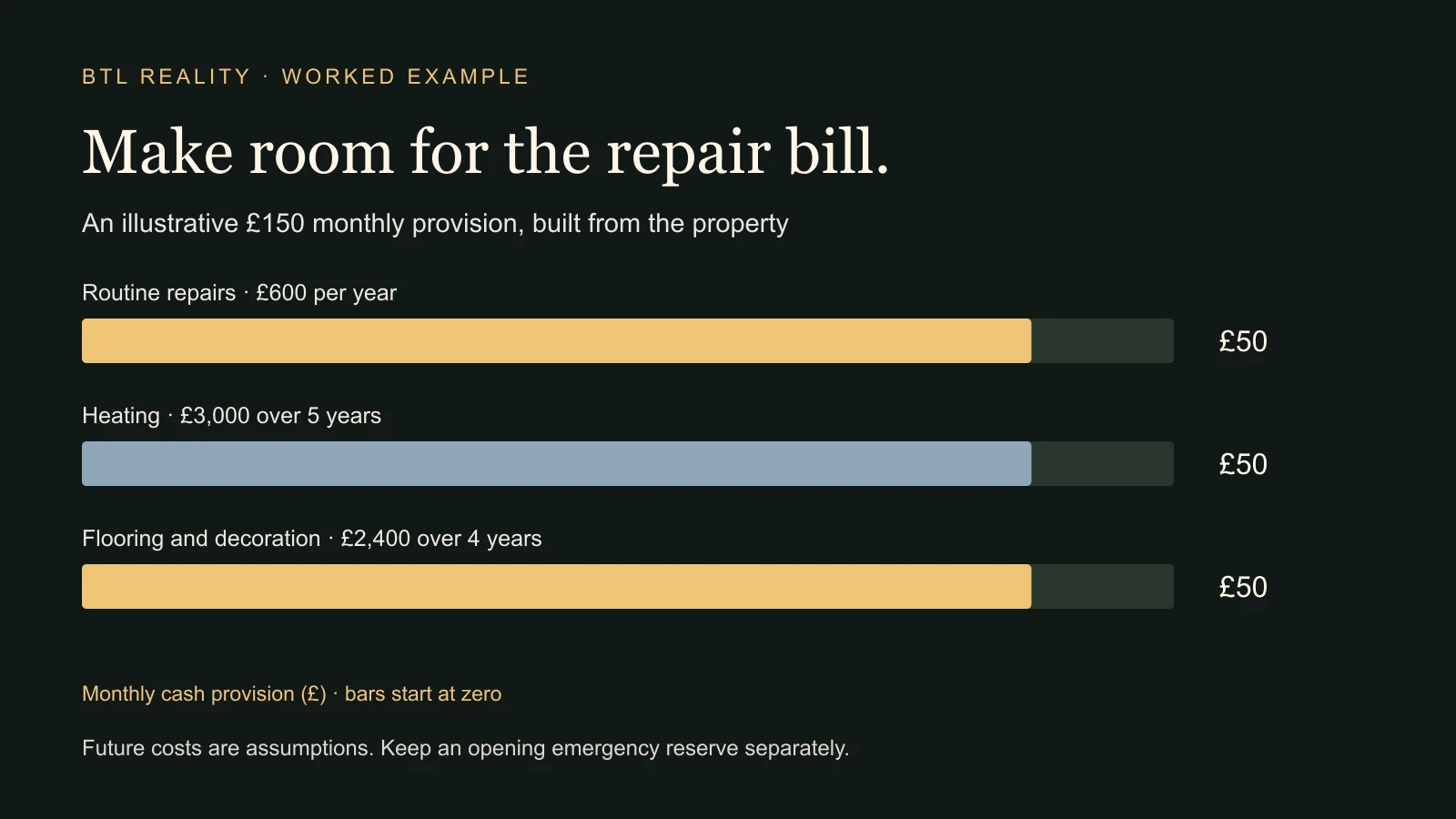
Consider an invented rental with £1,100 monthly rent. Allow £600 a year for routine small repairs, £3,000 for a heating replacement in five years and £2,400 for flooring and decoration in four years. These are illustrative figures, not contractor prices or estimates of how long particular equipment will last.
The monthly provisions are £50 for routine repairs, £50 for heating and £50 for flooring and decoration. Together that is £150 a month, or £1,800 a year. It is approximately 13.6% of the starting rent. Someone entering 5% of rent would allow only £55 a month, leaving a £95 monthly difference against this plan.
The answer is not that every landlord should reserve 13.6%. It is that the allowance should follow the expected work. If the heating system has just been replaced, its next replacement assumption may be different. If a roof issue already exists, a five-year saving plan may be entirely inappropriate.
Build your own replacement provision
Use the worksheet to separate routine spending from two planned projects. Enter costs including VAT where applicable and allow for access, removal, making good and any related work. A quote for the main item alone may not be the final bill.
Build a monthly maintenance provision
Illustrative future costs, no interest earned. Costs and timing are assumptions, not equipment-life predictions. Keep an opening emergency reserve separately.
Calculations stay in your browser. Nothing you enter is saved or sent.
The worksheet assumes level monthly contributions and no interest earned. It does not automatically increase costs for inflation. Use an expected future cost or update the budget regularly, and do not mistake the calculated provision for a survey or repair specification.
Timing matters as much as the annual total
Suppose you set aside £150 a month and need £3,000 after twelve months. The savings pot contains £1,800 before any earlier spending, leaving a £1,200 gap. An annual average can look reasonable while the actual cash timetable fails.
Put known projects into a calendar. Show the likely payment month, current funds allocated and further contributions expected before then. If you have two expensive projects within the same year, check their combined timing. Treat contractor deposits and staged payments as cash commitments rather than waiting until the final invoice to record them.
A property with work required immediately needs an acquisition or refurbishment budget, not just an ongoing maintenance allowance. Our refurbishment budget guide helps separate those initial costs from the normal running plan. Avoid deducting the same refurbishment twice when comparing returns.
Flats need a separate service-charge check
A leasehold service charge may fund some building maintenance, but it does not mean every future expense is covered. Read the lease and relevant accounts, understand what sits inside your flat's responsibility and ask about planned major works and reserve funds. Obtain professional advice on unclear obligations.
Do not add a full estimated communal repair allowance on top of a service charge without understanding what you are counting. Equally, do not assume a modest current service charge prevents a later increase or additional demand. The correct budget follows the documents and works programme.
For the wider cashflow effect, see our buy-to-let service-charge guide. The point is to keep routine charges, likely future liabilities and personal flat maintenance visible as separate lines.
Maintenance, voids and compliance are different costs
A repair can create several effects at once: the contractor's invoice, lost rent while the property cannot be occupied and additional empty-property bills. Saving for the invoice alone can leave the rest unfunded. Check the likely works programme and whether the property can lawfully and safely remain occupied.
Routine void allowance should sit in the rental cashflow model. A large planned project with a known empty period may need a separate specific allowance. Explain how the two interact so you do not count the same missing rent twice, or omit the exceptional period altogether.
Required safety checks and landlord obligations also need a budget and timetable. They should not depend on whether rent happened to exceed expectations that month. Start with the government's landlord-responsibilities guidance and confirm the requirements applicable to your property and jurisdiction.
A cash provision is not automatically a tax deduction
Putting £150 into a separate account does not itself establish a deductible expense. Actual expenditure can have different tax treatment depending on what was done and your circumstances. Repairs, improvements and replacements should not all be given the same label merely because money left the bank.
Keep invoices, descriptions and before-and-after records, and ask your accountant how expenditure should be treated. HMRC's rental-income guidance explains the distinction between allowable expenses and capital expenditure. The worksheet deliberately calculates cash provision, not taxable profit.
How to use this before making an offer
Ask what is likely to require spending in the first year, what can reasonably be planned over several years and what remains unknown. Price the immediate items into your acquisition appraisal. Put future items into the maintenance schedule and retain an emergency buffer for the uncertainty.
Then enter the resulting allowance into the buy-to-let deal calculator. If the deal works only after removing realistic maintenance, it needs a better purchase price, stronger evidence or a different decision. Reducing a spreadsheet allowance does not improve the building.
For an existing rental, review the budget after a major repair, contractor inspection or tenancy change. Record actual spending against the plan and update future costs. Several quiet months are not proof that your allowance was excessive; they may simply be the saving period before the next replacement.
Build the habit before scaling
A second property brings another roof, heating system and set of potential invoices. Maintenance planning becomes more valuable as the portfolio grows because costs can arrive together. A portfolio allowance should be built from the underlying properties rather than chosen to make the overall return look attractive.
If you are working towards your first investment, Starter Club can help you put the numbers into a practical plan. Bring the evidence you have, the questions you still need answered and the cash you can actually commit. A maintenance budget is one part of making the first purchase sustainable.
Frequently asked questions
Is 10% of rent enough for maintenance?
It may be too much or too little for a particular property and period. Use it as a clearly labelled initial allowance, then test it against condition, repair history, planned replacements and actual quotes.
Should I spend the reserve if no repairs happen?
Revisit the purpose of the money before reallocating it. A quiet year does not remove a future replacement. Separate genuinely surplus cash from money already allocated to a known project or emergency buffer.
Does landlord insurance replace a repair budget?
No. Cover depends on the policy, exclusions, excesses and circumstances. Routine wear, maintenance and foreseeable replacements should not be assumed to be insured. Read the policy and keep an appropriate cash plan alongside it.