How to Compare Refurbishment Quotes for a Rental Property
October 19, 2026
Two builders can inspect the same rental property and return quotes that differ by thousands of pounds without either quote being obviously wrong. They may have priced different work, materials, assumptions and responsibilities. The first job is to make the scope comparable. Only then does a price comparison tell you something useful.
For a buy-to-let, the question is whether the work makes the property suitable for its intended letting within a realistic total budget. A cheap headline quote that omits necessary work can be expensive by completion. An expensive quote can also include finishes or changes that the investment does not need. This guide helps you turn both into a decision you can explain.
Write one scope before asking for prices
Create a room-by-room schedule describing the outcome required. Instead of “refresh bathroom”, list the fittings to retain or replace, what happens to wall finishes, the expected flooring, ventilation work and any investigation needed before a firm price is possible. Include photographs and measurements where useful, but let contractors verify the site themselves.
Use the same schedule for each contractor. Ask them to identify exclusions and alternatives separately. If one suggests keeping a serviceable kitchen and another proposes replacing it, treat those as two options rather than comparing the totals as though they deliver the same result.
A specification need not dictate a particular brand for every item. It should be clear enough to prevent material differences being hidden in a phrase such as “standard finish”. Agree a practical quality level that fits the property and likely tenant. Our refurbishment budget guide helps distinguish essential work from optional upgrades.
Separate known work from investigation
Some issues cannot be priced properly until an investigation is complete. A damp patch, concealed pipework or suspected roof problem can have several causes. Ask which part is a fixed scope and which part remains an allowance. Do not turn an unknown into a fixed cost merely because the spreadsheet needs a number.
For each provisional item, record what would resolve the uncertainty, who is responsible and when the decision is needed. A quote might include removing a damaged ceiling but exclude repairing the cause of the leak. That distinction changes both the expected spend and the risk of paying twice.
If a purchase decision depends on a maximum repair cost, obtain the right professional investigation before relying on the budget. A general contractor's initial impression is not automatically a structural report or specialist diagnosis. It may be valuable information, but you need to understand its scope.
Compare the total payable, including exclusions
Build a table with the base quote, tax where applicable, excluded work you still require, professional or consent costs, waste removal, materials you must supply and a contingency appropriate to the remaining uncertainty. Ask every contractor whether the figures are inclusive of VAT and what assumptions their quotation uses. Do not add VAT twice to a figure already quoted inclusive.
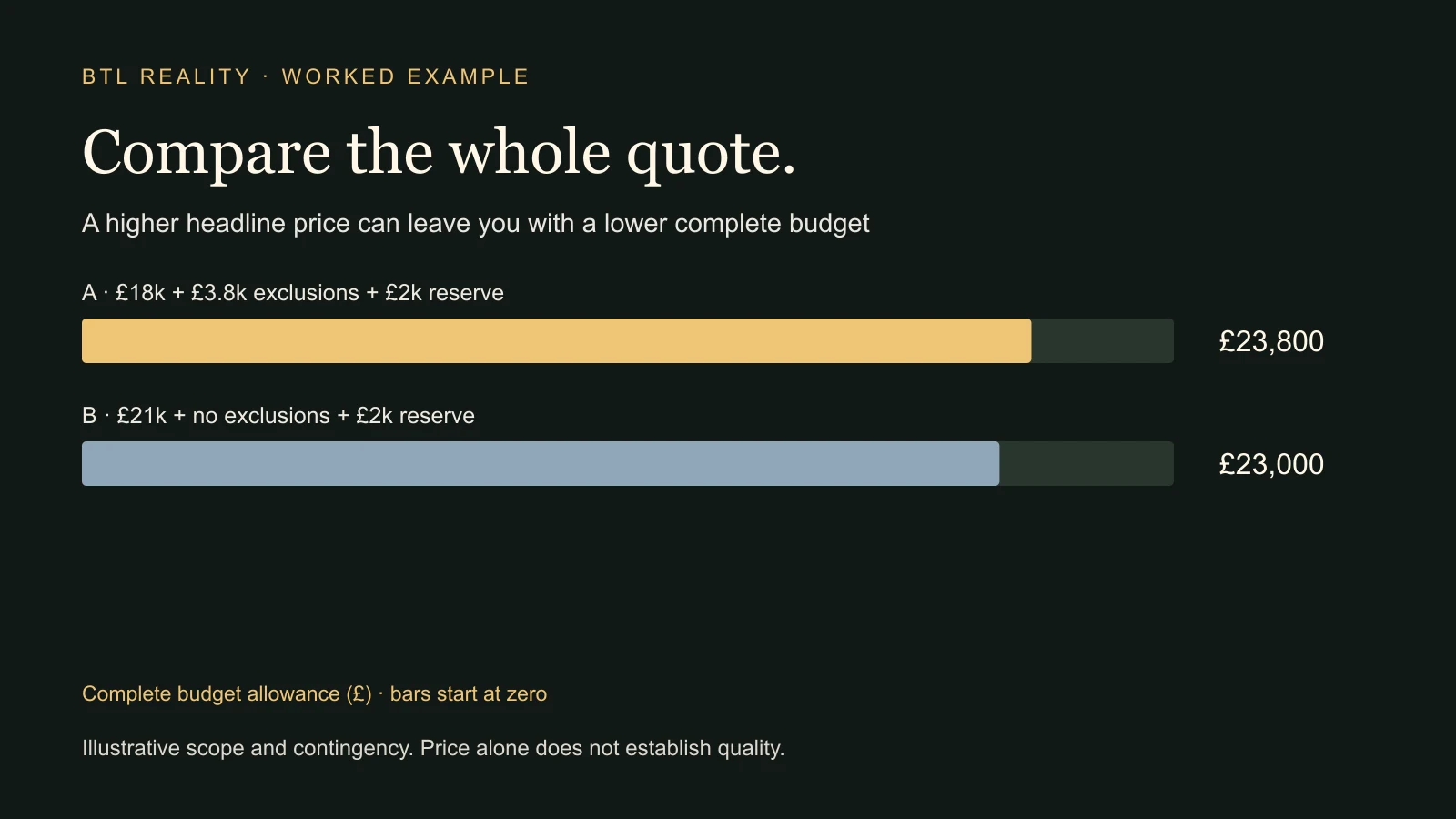
Consider two hypothetical quotes. Quote A is £18,000 including applicable VAT, but excludes £3,000 of required flooring and £800 of waste removal. Its comparable cost is £21,800 before contingency. Quote B is £21,000 including the same flooring and disposal. On the stated scope, B is £800 cheaper even though its initial headline is higher.
That does not automatically make B the better contractor. You still need to assess competence, capacity, references, insurance and how the work will be managed. It does mean the decision should not be based on the original £18,000 versus £21,000 comparison.
Use the quote normaliser
Enter the amount payable under each main quote, including VAT where applicable, then add the omitted items you would still need to buy. Add your own contingency amount separately. The tool compares complete budget allowances, not workmanship or contractual certainty.
Compare the complete quote budget
Use prices including VAT where applicable. Add excluded required work and your contingency separately; do not double-count included costs.
Calculations stay in your browser. Nothing you enter is saved or sent.
The example uses £2,000 contingency for each option purely to show the arithmetic. It is not a recommendation that £2,000 is enough for your project. A more uncertain scope may need investigation, a different allowance or a decision to postpone the work. A contingency cannot make an unknown structural problem understood.
Check who is buying and warranting materials
Clarify whether the contractor supplies materials or only labour. If you buy the items, who measures quantities, accepts deliveries, checks damage and resolves missing parts? A saving on purchase price can disappear if an incorrect fitting delays several trades. Record responsibilities before the schedule starts.
Ask how product warranties and workmanship issues will be handled. Keep invoices, specifications, certificates and relevant contact information together. A clear handover pack is useful for maintenance and future ownership decisions. It is much less useful to discover six months later that nobody knows which product was fitted or who supplied it.
Where regulated work is involved, confirm the qualifications and documentation required with the appropriate professional. Do not assume that a single general quote proves every specialist task will be carried out by a competent person. The government landlord responsibilities guide is a starting point for checking safety obligations; requirements differ across the UK and by property use.
Price the programme as well as the work
Ask for an expected start date, duration, dependencies and what could delay completion. A contractor available in six weeks may produce a different total project cost from one available next week, especially if the property is empty and financed. Likewise, an unrealistic short programme is not necessarily an advantage.
Suppose a property costs £700 a month to hold before letting. An additional six weeks represents about £1,050 using a simple one-and-a-half-month assumption. That amount belongs in the project comparison, together with any effect on rent commencement. Do not describe future rent as guaranteed merely because the works are expected to finish on a particular day.
Use the empty rental property cost guide and update the deal calculator with the complete holding period. The cheapest works quote may not produce the lowest overall cost, but be careful about choosing speed without a credible delivery plan.
Agree changes before they become bills
A refurbishment often reveals something that needs a new decision. Establish how variations will be quoted, approved and recorded before work starts. Ask for the cost and time consequences of a change in writing, including any effect on other work. An informal conversation on site can be remembered very differently by two people.
Distinguish a necessary response to a newly discovered defect from an optional upgrade. Both may be legitimate, but they should not disappear into a single unexplained extra. Keep an approved budget, committed spend and remaining allowance visible throughout the job. This makes it easier to decide whether a new request can be funded without consuming the property reserve.
Payment stages should relate to an agreed arrangement and identifiable progress. Do not assume that any particular deposit percentage or stage schedule is appropriate for every contractor. Read the terms, understand cancellation and dispute arrangements, and obtain professional advice where the commitment or scope warrants it.
Keep the rental purpose in view
Mark's discussion of refurbishment mistakes highlights the danger of spending according to personal taste rather than the investment's needs. A durable, maintainable finish can be more valuable to the owner than an impressive specification that does not attract an appropriate rent premium.
This does not justify poor standards. The property still needs to be safe, lawful and suitable for the intended tenancy. It means testing optional spending against evidence: would the improvement reduce maintenance, improve usability, support evidenced demand or solve a real defect? If the answer is mainly that you like it, label it accordingly in the budget.
For a structured approach to assessing projects, Blueprint explains the course and current access options. If the problem is finding an investment that fits an agreed brief, Done For You describes the sourcing service. Neither replaces checking the contractor and the specific agreement you are about to enter.
Frequently asked questions
How many quotes should I obtain?
Enough to understand the local pricing and available approaches for the particular scope. A small number of detailed, comparable quotes is more useful than many vague estimates. Availability, specialist work and the scale of the project will affect what is practical.
Is a fixed quote always safer than an estimate?
Read what is actually fixed and what is excluded. A fixed price for an incomplete scope can still leave substantial additional costs. The wording, assumptions and change process matter more than the label alone.
What should I do when a quote seems unusually low?
Ask the contractor to explain the scope, exclusions, materials and programme. A legitimate efficiency may explain it, or important work may be missing. Seek an answer supported by detail instead of assuming either a bargain or poor workmanship from the price alone.