How to Value a Buy-to-Let Using Sold Comparables
October 19, 2026
An asking price tells you what a seller hopes to receive. A sold comparable tells you what somebody paid for another property. Neither, on its own, tells you what your prospective buy-to-let is worth. The useful work is deciding how closely the evidence matches the property you are considering and how much uncertainty remains.
This guide shows how to build a sensible valuation range using sold comparables, then keep that range separate from your maximum investment offer. The examples are invented to explain the method. They are not local market evidence, a professional valuation or a prediction of what a lender will accept.
Start with the property you are actually valuing
Write a short description before looking for evidence: location, property type, approximate floor area, bedroom layout, tenure, condition, outside space, parking and any known restrictions. For a flat, add the remaining lease term, service charges and planned major works. For a house, note extensions, unusual construction or access arrangements that might make comparison difficult.
Be specific about the valuation basis. Are you estimating its current condition or a proposed finished condition? A refurbished three-bedroom house is weak evidence for an unmodernised two-bedroom property unless the differences are understood and allowed for. Keep a separate current-value column and proposed-finished-value column in your working notes. Mixing them can make a purchase appear discounted when the difference merely represents work still to be paid for.
Our guide to property price versus market value explains why the distinction matters. A claimed discount deserves a clear answer to a simple question: discounted against which property, condition and date?
Find completed sales, then investigate the details
For England and Wales, the government sold-price search uses HM Land Registry records. The same page points readers towards the separate arrangements for Scotland and Northern Ireland. Do not describe an England-and-Wales dataset as a complete UK transaction database.
Start with the closest genuinely similar transactions you can find. Search the same street and immediate area, but do not set a rigid radius that crosses an important boundary. A railway, school catchment, busy junction or different style of housing can matter more than a small difference in distance. Likewise, the closest house is not automatically the best comparable if it has double the floor area.
Record each property's address, completion date, paid price and evidence source. Then use available listing details, floor plans and photographs to understand what actually changed hands. A sold-price record does not explain the state of a roof or whether an attractive kitchen was fitted after that transaction. If you cannot establish an important characteristic, mark it unknown rather than filling the gap with a convenient assumption.
Build a small evidence table you can defend
Three useful comparables can be more informative than twenty loosely related addresses. For each candidate, record why it belongs in the analysis and what makes it imperfect. This makes your conclusion easier to discuss with an agent, surveyor or broker, and prevents you selecting only the transactions that support the price you want.
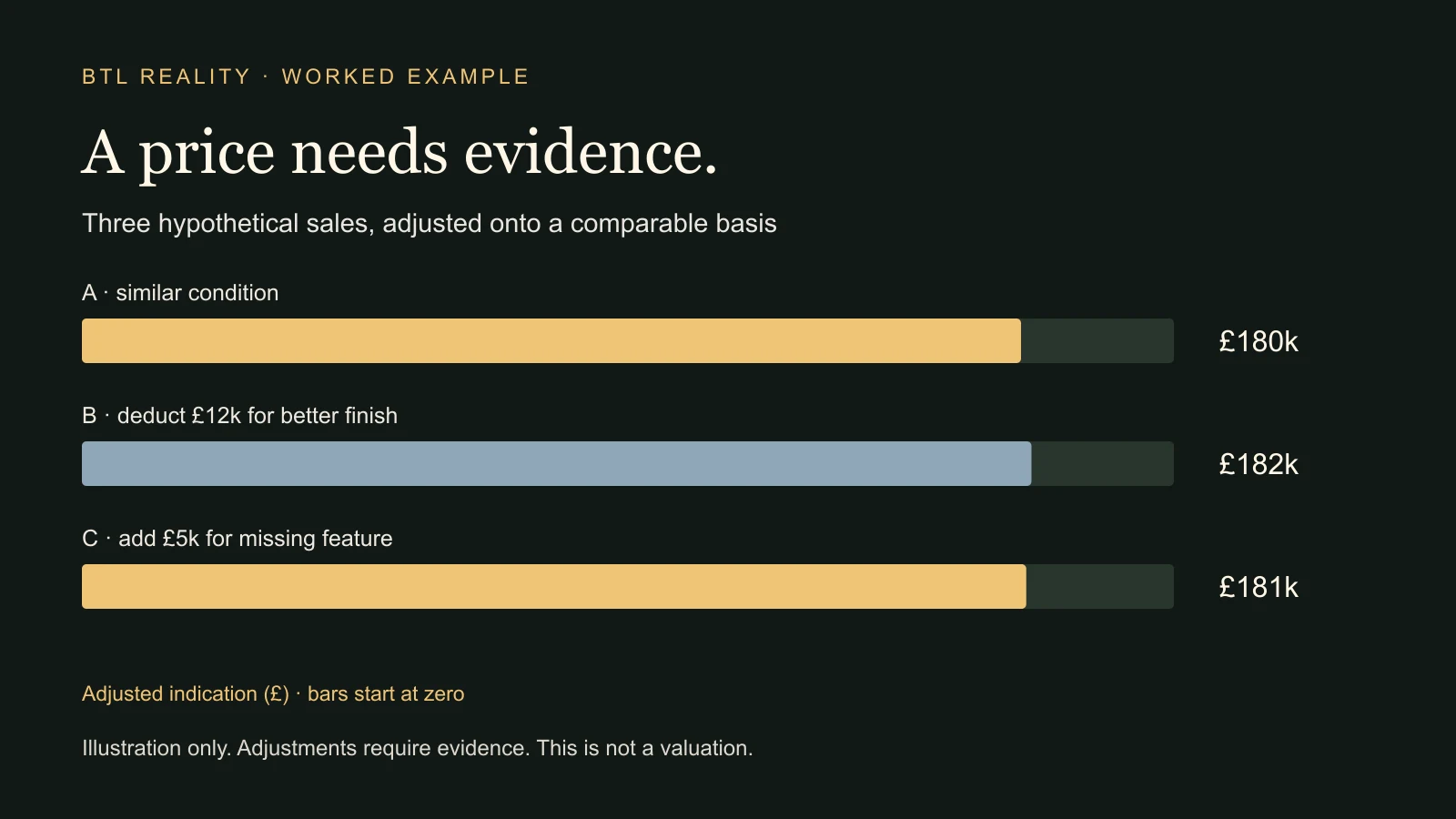
Imagine a hypothetical two-bedroom terrace. Comparable A sold for £180,000 in broadly similar condition. Comparable B sold for £194,000 but was appreciably better finished; you provisionally deduct £12,000 to compare it with your subject property. Comparable C sold for £176,000 but lacked a feature that your evidence suggests is worth around £5,000 to relevant buyers. Your adjusted indications are therefore £180,000, £182,000 and £181,000.
Those figures suggest a working centre around £181,000. They do not establish an exact value of £181,000. The adjustments themselves need evidence, and there may be characteristics you have missed. A sensible conclusion might be that the evidence supports further investigation around that level, with the range widened where the evidence is weak.
Try the comparable adjustment worksheet
Enter three sale prices and your provisional adjustments. A positive adjustment means the subject property is better on the relevant evidence; a negative adjustment means the comparable was better. The worksheet reports a simple average and the span of the adjusted figures. It does not weight evidence or produce a surveyor's valuation.
Build your comparable range
Illustrative inputs. Adjustments require evidence; the result is not a professional valuation.
Calculations stay in your browser. Nothing you enter is saved or sent.
The displayed range is only the lowest and highest adjusted input. Three identical guesses create a narrow range without creating reliable evidence. You should record the reasoning beside your numbers in your own notes, particularly where the adjustment would change whether the deal works.
Avoid turning refurbishment cost into automatic value
Spending £20,000 does not necessarily add £20,000 to market value. Some expenditure fixes defects that buyers already expected to be absent. Other expenditure reflects your preferences rather than local demand. A new layout may add value, but only if buyers want it, relevant permissions are in place and comparable evidence supports the finished result.
Use the refurbishment budget guide to estimate what the work costs. Then investigate completed properties with the intended specification to estimate what the finished property might be worth. These are separate pieces of work. Adding a contractor's quote to the purchase price is a cost calculation, not valuation evidence.
Mark's historical Rugby and Kettering case-study discussions distinguish purchase figures, work and projected finished values. Read those as examples of the questions to ask, not as confirmation that every refurbishment achieves its projected uplift. A lender's later valuation can still differ from your original estimate.
Account for timing without false precision
A transaction that completed recently may have been negotiated months earlier. An older sale may still help with layout and location, but need more caution as evidence of today's price. Record dates and ask what has changed in the local market rather than applying a national percentage automatically to every address.
Asking prices can provide context about competing stock, but unsold listings do not establish completed value. A property sitting on the market for months at £220,000 is not proof that your similar purchase is worth £220,000. Equally, one unusually low sale may have circumstances that make it unrepresentative. Investigate outliers instead of averaging them away.
If evidence is sparse, say so. The honest output is a wider range or a request for professional input. It is not a spreadsheet showing a price to the nearest pound. Decimal places are particularly unhelpful when the largest adjustment is an uncertain five-figure estimate.
Keep market value separate from your maximum offer
You might believe a property would sell for £180,000 and still decide that £165,000 is your maximum offer. That can be a rational investment decision if buying costs, works, financing, reserves and the income you require leave no room for a higher price. It does not mean the seller is obliged to accept your investment criteria.
Run the buy-to-let deal calculator using the asking price, your proposed offer and a downside case. Check the actual cash needed, not just the deposit. Read how to compare two buy-to-let deals if another property is competing for the same capital.
Before relying on a refinance, ask a broker how the proposed lender assesses value and rent. Available borrowing can be limited by rental cover even where the valuation is acceptable. A higher paper value does not automatically produce enough releasable cash to fund another purchase.
Make the evidence useful to the next professional
Prepare a short pack containing your subject-property description, the strongest comparable records, dates, source links, adjustment explanations and unresolved questions. Separate facts from assumptions. Give the surveyor or broker an opportunity to disagree with your reasoning instead of presenting the number as a conclusion they must endorse.
If you want help finding properties against an agreed investment brief, Done For You explains BTL Reality's property sourcing service. Independent legal, mortgage and survey checks still matter. The purpose of a sourcing brief is to make the search and assessment more focused, not to remove uncertainty from property investing.
Frequently asked questions
Is the average sold price for a postcode enough?
No. A postcode can contain different sizes, tenures, conditions and property types. The average may be useful background, but it can be a poor guide to the particular property you want to buy.
Should I use price per square metre?
It can help compare broadly similar properties when the floor-area evidence is consistent. It should not replace judgement about layout, condition, tenure and location. A small flat and a large house can have different pricing patterns even on the same street.
What if the lender values it lower?
Rework the deposit, cash reserves and borrowing before committing to a plan that depends on the original figure. Ask what evidence can legitimately support a review, but do not assume a challenge will succeed. A deal that requires every optimistic assumption to be accepted has little room for error.