How Much Do You Need Per Month to Be Financially Free?
October 3, 2026
FINANCIAL FREEDOM · BUILD YOUR OWN NUMBER
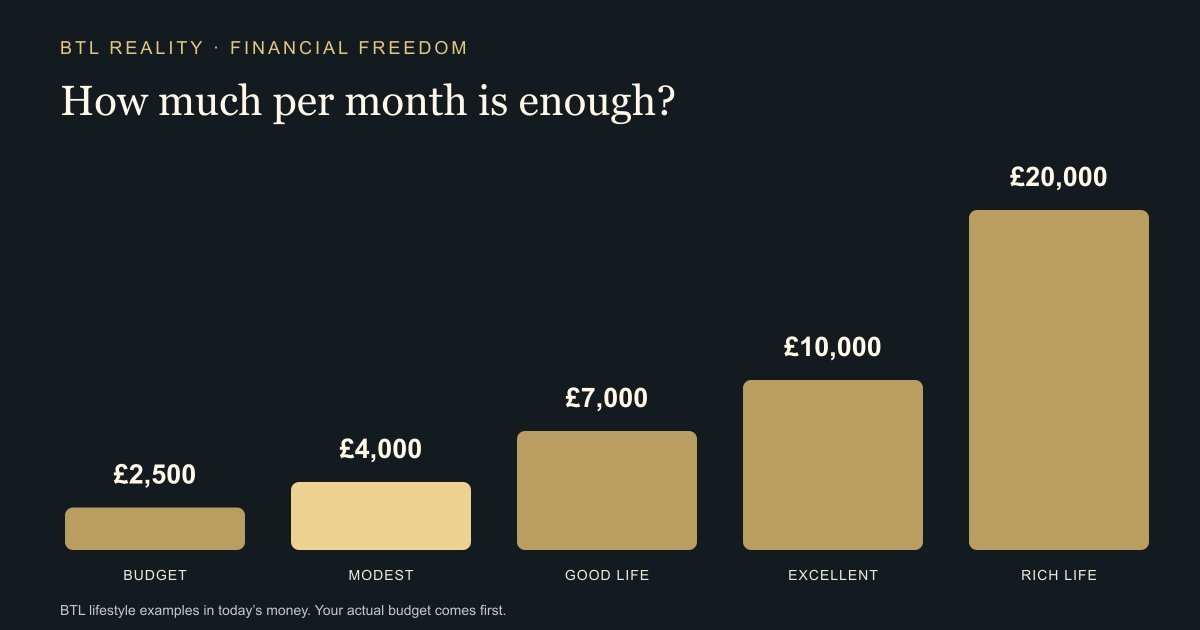
How much do you need per month to be financially free? Start with the life you want to pay for, then work backwards. A useful first target might be £2,500, £4,000, £7,000, £10,000 or £20,000 a month. The right answer depends on your housing, family, location and choices.
My starting point: financial freedom means having enough dependable resources to make work a choice. An impressive property valuation does not automatically pay the bills. The number that matters is spendable money after costs and tax, with enough resilience for a bad year.
Use the five BTL lifestyle examples below as a conversation starter. They are not official UK living standards or promises about what a particular household can afford. Then put your own figures into our free Financial Freedom Calculator to compare property, index funds and a mix of both.
Five monthly financial freedom targets
The amounts below represent a monthly spending target in today’s money. Decide whether you are modelling yourself or your whole household, then keep that definition consistent when entering assets, income and contributions.
| Lifestyle starting point | Monthly target | Annual spending | What to check first |
|---|---|---|---|
| Budget | £2,500 | £30,000 | Housing and essential bills |
| Modest | £4,000 | £48,000 | Family costs and regular leisure |
| Good life | £7,000 | £84,000 | Travel, lifestyle and flexibility |
| Excellent life | £10,000 | £120,000 | Higher discretionary spending |
| Rich life | £20,000 | £240,000 | What you genuinely value |
£2,500 a month: a budget starting point
This could be a useful first independence target for someone with controlled housing costs. It may be completely inadequate for another household paying expensive rent and childcare. Before dismissing the number or treating it as enough, write down the actual bills it must cover.
£4,000 a month: a modest lifestyle target
This adds room above the budget example, but “modest” is only a label. A mortgage-free couple and a family renting in London face very different arithmetic. Build a line for enjoyable spending as well as necessities. Freedom should describe a life you want to live.
£7,000, £10,000 or £20,000: more choice, a larger funding task
These targets may provide more travel, flexibility, generosity or expensive hobbies, depending on your circumstances. Each increase also requires more capital, income or time. Separating your minimum acceptable lifestyle from your ideal lifestyle gives you useful milestones instead of one distant finish line.
How to calculate your personal monthly number
Start with twelve months of spending rather than the most recent bank statement. Annual insurance, repairs, holidays and replacement costs disappear from a monthly snapshot but still need paying. Divide irregular annual spending by twelve.
Keep the essentials
Housing, food, utilities, transport, insurance and commitments that continue after work becomes optional.
Price the good life
Travel, hobbies, family help and the things you want more time to enjoy.
Fund the irregular bills
Annual costs, replacements and a sensible margin for things you cannot predict precisely.
For example, £2,200 of essential monthly costs, £900 of discretionary spending, £500 towards annual bills and £400 of breathing room gives a £4,000 target. These are invented planning figures. Replace every line with your own evidence.
Keep an emergency cash reserve separate from the investment pot. Also distinguish the money you want to spend from the gross income needed to provide it. Rental profits, pensions and different investment accounts can have different tax treatment. The calculator uses an editable flat allowance for exploration, not a personal tax calculation.
How much invested capital supports those targets?
At a 4% annual withdrawal assumption, the simple relationship is annual spending divided by 0.04. That is equivalent to 25 times annual spending. Before taxes and fees, a £4,000 monthly target therefore corresponds to £48,000 ÷ 0.04 = £1.2 million.
The investment-pot benchmark at 4%
Simple arithmetic before tax, fees and any other income. A withdrawal assumption is not a guaranteed return.
The 4% figure is a withdrawal planning assumption, not a guaranteed safe rate and not the same as annual investment growth. Your time horizon, charges, tax, asset mix and the order of market returns matter. MoneyHelper explains pension drawdown and the risk of running out of money.
Lowering the withdrawal assumption to 3% raises the £4,000 benchmark to £1.6 million before tax. Applying a simplified 20% tax allowance at 4% instead raises it to £1.5 million. Neither adjustment is a substitute for checking your actual accounts and tax position. Existing income can reduce the amount the portfolio needs to supply.
Age and monthly contributions can change the route
Someone starting with £50,000 and investing another £1,000 each month has a different path from someone with £250,000 who cannot make further contributions. The starting balance alone does not describe the plan. Time, contributions and spending requirements all interact.
As a simple illustration, £50,000 growing at a constant 7% effective annual rate, with £1,000 added at each month-end for ten years, reaches approximately £269,000 before tax and fees. Contributions provide £170,000 of that total. This is smooth mathematical growth, not a prediction of an actual market account.
Use the compound interest calculator to compare contribution levels and growth assumptions. Try 5%, 7% and 9% as lower, central and higher illustrations, remembering that even the lower figure is not a safe or guaranteed outcome. The FCA’s explanation of risk and returns is a useful starting point.
Pension access also matters. A large pension does not automatically fund the years before you can draw it. Keep accessible investments and pensions separate, and verify the access rules for your own scheme.
How many rental properties would you need?
Count dependable net cashflow, not front doors. At an illustrative £300 a month per property after all costs and tax, a £4,000 target needs fourteen properties. At £500 a month, it needs eight. Those examples are arithmetic, not claims about typical returns or the quality of a particular deal.
Rent received is not personal spending money. Deduct mortgage interest, management, maintenance, voids, insurance, compliance and other relevant costs before considering tax. A property with impressive gross yield can deliver disappointing cashflow. Use the Buy-to-Let Deal Calculator to investigate an actual opportunity.
Our Freedom Planner starts with editable cash-on-cash assumptions of 10% for single lets, 15% for HMOs and 20% for serviced accommodation. These are optimistic planning scenarios, not market averages. Higher-return assumptions can involve considerably more work, occupancy risk, setup expense and operational complexity.
The model keeps the underlying property’s operating income consistent when comparing borrowing levels. A lower mortgage generally means more cash tied up initially and less interest to pay. It would be misleading to give every borrowing level the same cash-on-cash return without changing anything else.
Can refinancing help you reach freedom sooner?
Potentially, if values, rental performance and lending terms support it. Refinancing can release equity to help buy another property. It can also provide borrowed cash to cover spending, but those are different uses of the same money. It cannot fund both at once.
Suppose a property is valued at £150,000 with £90,000 of mortgage debt. A new loan at 65% LTV would be £97,500, creating £7,500 of gross release before fees. At 75% it would be £112,500, creating £22,500 before fees. The larger release also leaves more debt and higher interest costs. A valuation and lender agreement are still required.
Equity release is not rental profit. Our optional lifestyle-refinancing scenario shows a finite spending period, additional borrowing and remaining equity. It also checks what happens when further refinancing is unavailable. A passed ten-year model is not evidence that a strategy lasts for life.
A 20% fall in a £100,000 property’s value reduces it to £80,000. If debt stays at £75,000, equity falls from £25,000 to £5,000 before selling costs. That is an 80% reduction in equity. Lower leverage reduces this exposure but does not eliminate investment risk.
Build an ambitious plan you can challenge
Everything is rarely perfect. The headline in the calculator is deliberately best-case: suitable deals, the entered returns and permitted borrowing all happen as modelled. The useful next step is to challenge that result with slower growth, smaller contributions, lower leverage and unavailable refinancing.
The planner compares a finite selection of property, fund and mixed routes within your chosen boundaries. It then shows milestones, cash requirements, debt, equity and a separate spending test. It does not determine investment suitability or promise the fastest possible real-world route.
Build my free Financial Freedom Plan →
You can see the calculator results without joining anything. If you want the personalised PDF, provide your name and email so we can prepare and save your report. Marketing is optional. The PDF brings your inputs, modelled route, annual numbers, borrowing assumptions and next steps together.
If property is part of your plan and you want help turning the numbers into better decisions, Starter Club is the natural place to explore our education, planning and community. Start with your actual position and a credible next step, not the most exciting screenshot.
Common questions
Is £4,000 a month enough to be financially free?
Only if it reliably covers your chosen lifestyle after costs and tax, with appropriate reserves and a sustainable funding plan. Housing and dependants can change the answer substantially.
Does financial freedom mean never working again?
It can mean having the choice. You might keep working, reduce hours or change what you do. Define the life first, then calculate what needs to fund it.
Should I choose property or index funds?
Compare the capital required, diversification, liquidity, work involved, borrowing and uncertainty. A calculator can illustrate the trade-offs but cannot establish what is suitable for you. Consider regulated advice for investment and pension decisions.
Written by Mark Parham for BTL Reality. Educational illustrations only, not personalised investment, mortgage or tax advice. Figures are GBP. Check your own costs, tax position and pension rules before acting.
Explore financial freedom
Start with the spending you want to support. Compare the investment routes, then test your own starting position and contributions in the calculator. Keep cash flow, equity and borrowed money separate.
- Property or index funds?
- A worked portfolio example
- What does retiring from property involve?
- Financial freedom calculator
- How Much Does It Cost to Sell a Buy-to-Let Property?
Need help working through a more complex property plan? Explore Private Mentorship and check the application criteria.