Your First Home: 2.5% Deposit Scheme Explained
October 28, 2026
The 28 October Budget confirms funding, income limits and launch timings for Your First Home. The England scheme could help eligible first-time buyers purchase a new-build with a deposit starting at 2.5%, alongside a government equity loan.
The useful question is whether the complete purchase works for you, including the later costs. A smaller deposit can bring a purchase closer. It does not settle the price of the home, the mortgage you can obtain or how you will eventually repay the equity loan.
Updated 5 November 2026 · England · Local price caps published 3 November
Check the local cap before choosing a home
The government has now added the Your First Home price caps for each local authority. That makes the eligibility check more practical: use the cap for the area containing the property, rather than treating the highest figure elsewhere as your budget.
These are selected examples from the new list, alongside original calculations assuming a purchase exactly at the local cap, the minimum 2.5% deposit and a 20% equity loan. The bank mortgage funds the remaining 77.5%. These are funding illustrations, before fees, rather than mortgage offers.
| Local authority | Price cap | 2.5% deposit | 20% equity loan | 77.5% mortgage |
|---|---|---|---|---|
| Liverpool | £235,000 | £5,875 | £47,000 | £182,125 |
| Birmingham | £315,000 | £7,875 | £63,000 | £244,125 |
| Manchester | £355,000 | £8,875 | £71,000 | £275,125 |
| Camden | £650,000 | £16,250 | £130,000 | £503,750 |
For example, the £240,000 home used in the wider illustration below would be £5,000 above Liverpool’s £235,000 cap. Meeting the income test or increasing your deposit would not make that price fall within the cap. London also has different limits: the published cap is £500,000 in Barking and Dagenham, compared with £650,000 in Camden.
A cap is an eligibility ceiling, not a valuation or a spending target. Compare the actual price and complete ownership costs. A home below its cap must still satisfy the scheme’s requirements, and your lender must assess affordability.
The main guidance still describes eligible new-builds bought as a main home through participating developers and lenders. Applications are not open today; February 2027 remains the expected application start, with further terms and participation details to follow. This is not a buy-to-let funding scheme or confirmation that a particular home will be accepted.
What has the Budget confirmed?
The government has allocated £4.7 billion, aiming to support around 70,000 households. The Budget terms set household income caps at £110,000 outside London and £140,000 inside London. Deposits can range from 2.5% to 15%, with a 20% equity loan.
Pre-registration is planned by the end of December 2026, full applications from February 2027 and first loans from April 2027. Those are different stages. There is no application open today.
The published guidance covers first-time buyers purchasing eligible new-builds in England as their main home, within local price caps, using participating developers and lenders. It is not a route to buy a property for letting. Full eligibility rules and participant lists will follow.
Check the published local-authority price-cap list for the area containing the property. Do not assume that an income below the maximum makes every development or purchase price eligible. The Budget confirms £650,000 for inner London and £500,000 for outer London. A national headline cannot answer the question for a particular address.
A £240,000 example: where the purchase money comes from
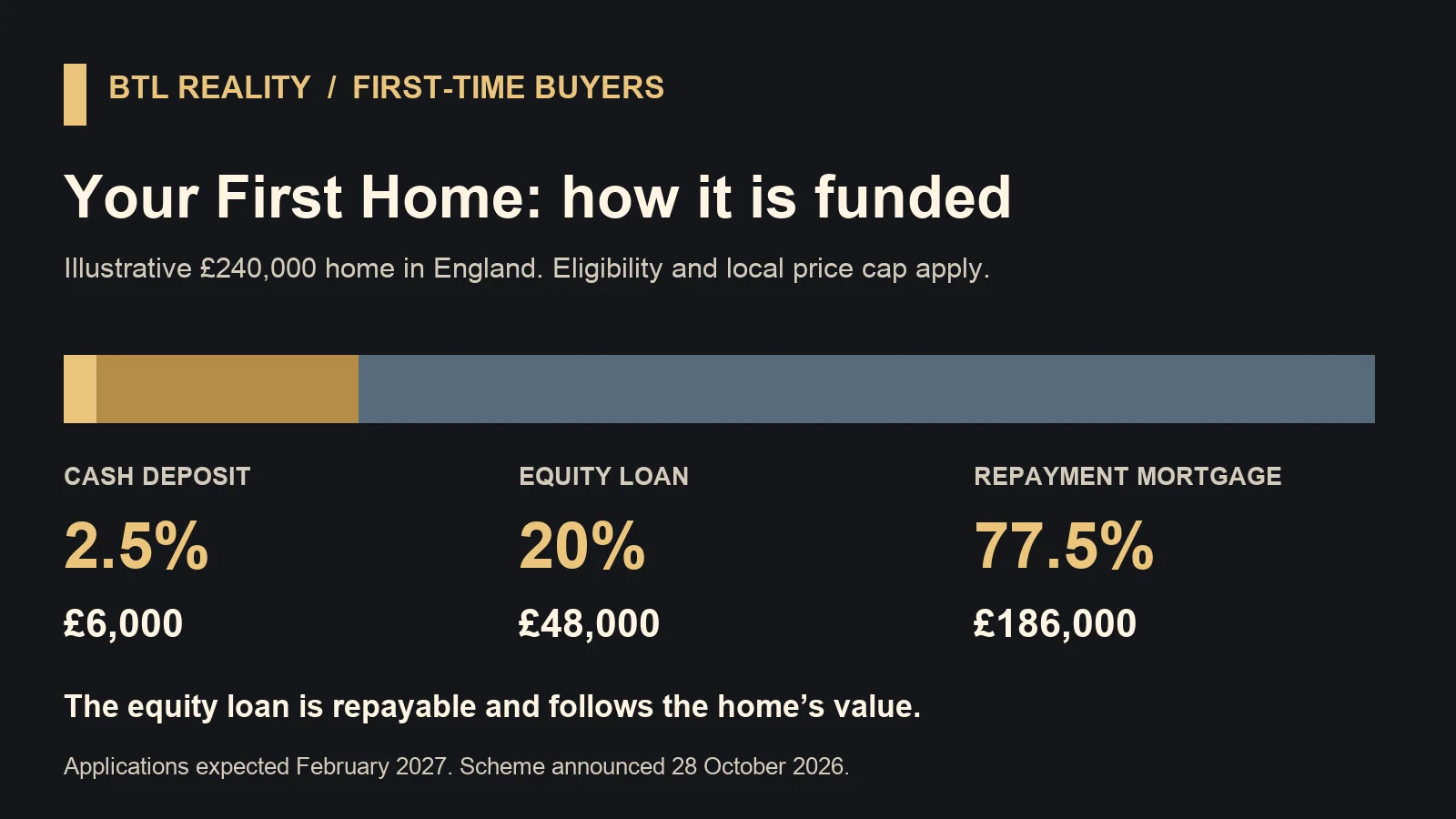
Here is an original hypothetical purchase, not a mortgage quote. Assume the home and buyer meet the eventual rules, the purchase price is £240,000, the deposit is 2.5% and the government equity loan is 20%. Ignore transaction costs for this first table, then budget for them separately.
| Funding source | Share of price | Amount |
|---|---|---|
| Buyer’s deposit | 2.5% | £6,000 |
| Government equity loan | 20% | £48,000 |
| Repayment mortgage | 77.5% | £186,000 |
| Total | 100% | £240,000 |
The deposit calculation is £240,000 multiplied by 2.5%. The bank mortgage is what remains after the deposit and equity loan. The model still uses £234,000 of borrowing to fund the price. The equity loan has not become the buyer’s own savings.
That distinction matters when assessing readiness. You need to understand both debts, rather than concentrating on the bank mortgage because it produces the first regular payment. Keep legal fees, mortgage fees, moving costs and an appropriate cash buffer outside the deposit figure.
What happens when the interest-free period ends?
The equity-loan guidance sets interest at 0% for years one to five, 1.5% in year six and 3% from year seven. Interest does not reduce the equity loan owed. The collection arrangements will be explained before applications open.
For our example, assume a 30-year repayment mortgage at 5%. That produces a monthly bank payment of £998.49. Hold that assumed mortgage rate constant in the table purely to isolate the equity-loan charges. It is not a forecast that a buyer will keep the same mortgage rate for seven years.
| Period | Bank mortgage | Equity-loan interest | Combined payment |
|---|---|---|---|
| Years 1–5 | £998.49 | £0 | £998.49 |
| Year 6 | £998.49 | £60 | £1,058.49 |
| From year 7 | £998.49 | £120 | £1,118.49 |
The extra £60 is £48,000 multiplied by 1.5%, divided by 12. At 3%, it is £120. These figures follow the published illustration approach and assume no equity-loan repayment; final terms still need checking.
For comparison, a standard 95% mortgage on the same £240,000 price would use a £12,000 deposit and £228,000 bank loan. At the same assumed rate and term, its calculated monthly payment is £1,223.95. That difference of about £225 a month is an initial bank-payment comparison, not a total long-term saving. The scheme uses less deposit cash but adds the separate value-linked debt. Actual mortgage rates and fees may differ.
The combined figure excludes council tax, insurance, maintenance, any service or estate charge and other ownership costs. If the mortgage rate changes when a fixed period ends, the bank payment changes too. Test those possibilities together before deciding what feels affordable.
The repayment follows the home’s value
The government’s repayment explanation says a 20% equity loan will normally be repaid as 20% of the home’s independently assessed value. The amount can rise or fall. It is normally repaid on sale, with earlier partial or full repayment possible; detailed repayment rules, valuation requirements and fees are still to follow.
Apply that mechanism to three hypothetical valuations for our £240,000 purchase. These are scenarios, not predictions about what the property will be worth.
| Home’s later valuation | 20% repayment | Difference from £48,000 advanced |
|---|---|---|
| £216,000 | £43,200 | £4,800 less |
| £240,000 | £48,000 | No difference |
| £264,000 | £52,800 | £4,800 more |
These amounts do not tell you the cash left after selling. You would also need the outstanding bank mortgage, selling costs and any other amounts due. The repayment mortgage balance may have reduced, while the equity-loan interest payments in the earlier table have not bought down the government’s share.
I would write down a repayment plan before relying on the scheme. “I will refinance later” needs testing against the possible mortgage balance, property valuation, future income and lender assessment. An intention to refinance is not an approved future loan.
Compare the home as well as the funding
Start with the property’s supported value. Compare suitable new-builds and existing homes, allowing for condition, location, space, tenure and recurring charges. Do not treat the local price cap as confirmation that a home is worth that amount.
Ask what the developer’s price includes. Distinguish the purchase figure from incentives, upgrades, fixtures and any contribution towards costs. Have the lender and conveyancer assess the actual arrangement rather than assuming a sales offer improves every part of the transaction.
A home outside the scheme may need more deposit cash but have a different price or cost profile. A scheme home might bring the mortgage payment within reach while leaving a larger eventual equity-loan repayment than you first expected. Compare complete options, using the same assumptions.
That comparison should include how long you expect to live there. Moving costs and selling arrangements matter if the property is only suitable for a short period. Avoid choosing the most expensive eligible home simply because a calculator says the opening payment fits.
Prepare a budget that survives beyond moving day
Build three figures: the cash needed to complete, the ordinary monthly ownership cost and the money retained afterwards. Our property starting-budget guide explains why the deposit is only part of the cash requirement. For this purchase, use owner-occupier costs rather than rental-income assumptions.
Use the rent-versus-buy calculator to compare a full ownership budget with continuing to rent, checking its assumptions against the equity-loan charges shown here. Compare the whole ownership budget with your current housing costs. Rent and a mortgage payment are not identical cost categories. Include the bills and responsibilities that change when you buy, and avoid adding a service-charge item twice if it already includes something elsewhere in the budget.
Then consider the period when the equity-loan interest starts. Allow for foreseeable changes in your circumstances instead of assuming income will rise enough to cover everything. A buyer’s own future plans can matter more than a national forecast.
What I would do during the pre-launch period
Gather income evidence, review existing commitments and establish the deposit and reserves available. Ask a mortgage adviser what information will be needed once participating lenders publish their terms. Keep an unresolved eligibility question separate from an affordability calculation.
For a shortlisted development, record the price, expected completion date, recurring charges and what remains unconfirmed about participation. Do not make a reservation decision on the assumption that a particular property, lender or buyer will definitely be accepted.
Write down your accommodation timetable too. If you need to leave a rental home before the new-build is ready, how would the gap be funded? Check the mortgage offer’s actual expiry and conditions alongside the expected completion date. An affordable mortgage calculation does not pay for an unplanned period in temporary accommodation or confirm that the transaction can complete on time.
Use the time to compare alternatives and prepare questions. If you want help organising the wider buying plan, a free initial strategy call is available. Mortgage suitability and the legal terms need the appropriate professional advice.
Frequently asked questions
Can I apply for Your First Home today?
No. Use the pre-launch period to prepare and check the official guidance as it develops. Pre-registration is different from an approved loan or confirmed purchase.
Can I use Your First Home to buy a rental property?
The scheme is for a main home. Do not assume permission to let later; check the final terms.
Does meeting the income cap guarantee a mortgage?
No. Scheme eligibility, lender approval and the property’s acceptance are separate. Obtain an assessment of your circumstances rather than treating the maximum income figure as an approval.
Is the government equity loan a free grant?
No. The valuation scenarios show the repayment obligation. Include it in the purchase plan.
Do the interest payments reduce the equity loan?
No. Interest does not buy down the equity share. Repayment is separate; check the final rules.
Should I choose the most expensive home allowed by the local cap?
Choose a home whose price, suitability and complete ownership budget stand up to investigation. An eligibility ceiling is not a spending target or a valuation.