UK Mortgage Rates October 2026: Costs and Deal Availability
October 5, 2026
19 OCTOBER 2026 UPDATE · PRODUCT AVAILABILITY
A mortgage product’s shelf-life is not your offer deadline
Moneyfacts’ release published on 19 October puts the average mortgage product shelf-life at 13 days in October, compared with 14 in September. Its January-to-October 2026 average is 16 days, against 20 for the whole of 2025. This is an average across the products measured, not a countdown attached to every mortgage.
There are two separate questions here. How long is a product being marketed before it changes or disappears? And how long is your lender’s offer valid for your transaction? The first statistic cannot answer the second. Ask your broker or lender to confirm the position for your application, the point at which a rate is secured, and the conditions and expiry date of any offer.
For a purchase or refinance, keep the paperwork ready before choosing a product. Record the quotation date, rate, fees, loan amount and monthly payment. If the terms change before they are secured, rerun the appraisal. A property that only works on an old quote needs another look.
The release’s October rate table is also a dated snapshot: Moneyfacts says its table uses the first available day of each month unless otherwise stated. It is not a set of 19 October live quotations. The earlier 5 October analysis below retains its own observation dates. Neither dataset establishes the buy-to-let rate available to you today.
Use the payment comparison below to test a changed quotation, then include purchase and operating costs in the Buy-to-Let Deal Analyser. Being ready to compare the actual terms is useful. Rushing into a weak property deal because a national average says 13 days is not a sensible substitute for checking the numbers.
Earlier 5 October 2026 assessment
The rates and market observations below remain the dated 5 October review. The worked examples are illustrative assumptions, not offers.
The average five-year fixed residential mortgage rate has reached 6%, according to Moneyfacts on 5 October 2026. For a property buyer, the useful question is how much room your budget has if borrowing costs more than expected.
This update separates the latest published figures from our own worked examples. Use the calculator below to compare two rates on the same loan, then take the result into a full property appraisal. A national average helps explain the market; your actual mortgage offer determines your payment.
What has changed in October?
Latest update, 5 October: Moneyfacts reports an average five-year fixed residential rate of 6.00%. Its two-year average rose from 5.96% on Friday 2 October to 5.98% on Monday morning. Source: Moneyfacts’ 5 October mortgage analysis.
Keep the two trackers separate. The Moneyfacts figures below are a newer observation from a different dataset. They are not a like-for-like change from Rightmove’s 3 October figures. Rightmove describes a sample of 21 lenders, excludes some specialist lenders and bases its headline table on products with fees around £999. Neither average is a personalised offer or a buy-to-let quotation.
| Source and data date | Two-year fix | Five-year fix |
|---|---|---|
| Moneyfacts, 5 October | 5.98% | 6.00% |
| Rightmove / Podium, 3 October | 5.56% | 5.53% |
Rightmove’s table updated on 3 October 2026 puts the average two-year fixed residential mortgage at 5.56%, up 0.07 percentage points over the week. The five-year average is 5.53%, up 0.06 percentage points. Its figures use Podium’s lender sample and products with fees around £999. These are residential market indicators, not buy-to-let quotations. Source: Rightmove’s dated mortgage-rate table.
The Bank of England kept Bank Rate at 3.75% in September. Its minutes also described increases in market interest rates passing through to borrowing costs. The next scheduled decision is 5 November 2026. There is no announced cut to build into a purchase budget. Source: September monetary-policy decision.
Those dates matter. This is a 5 October assessment of the latest checked releases, not a claim that every lender changed its prices today. Products and availability can change after publication. Obtain a current quotation before making a commitment.
What does a rate rise cost on your mortgage?
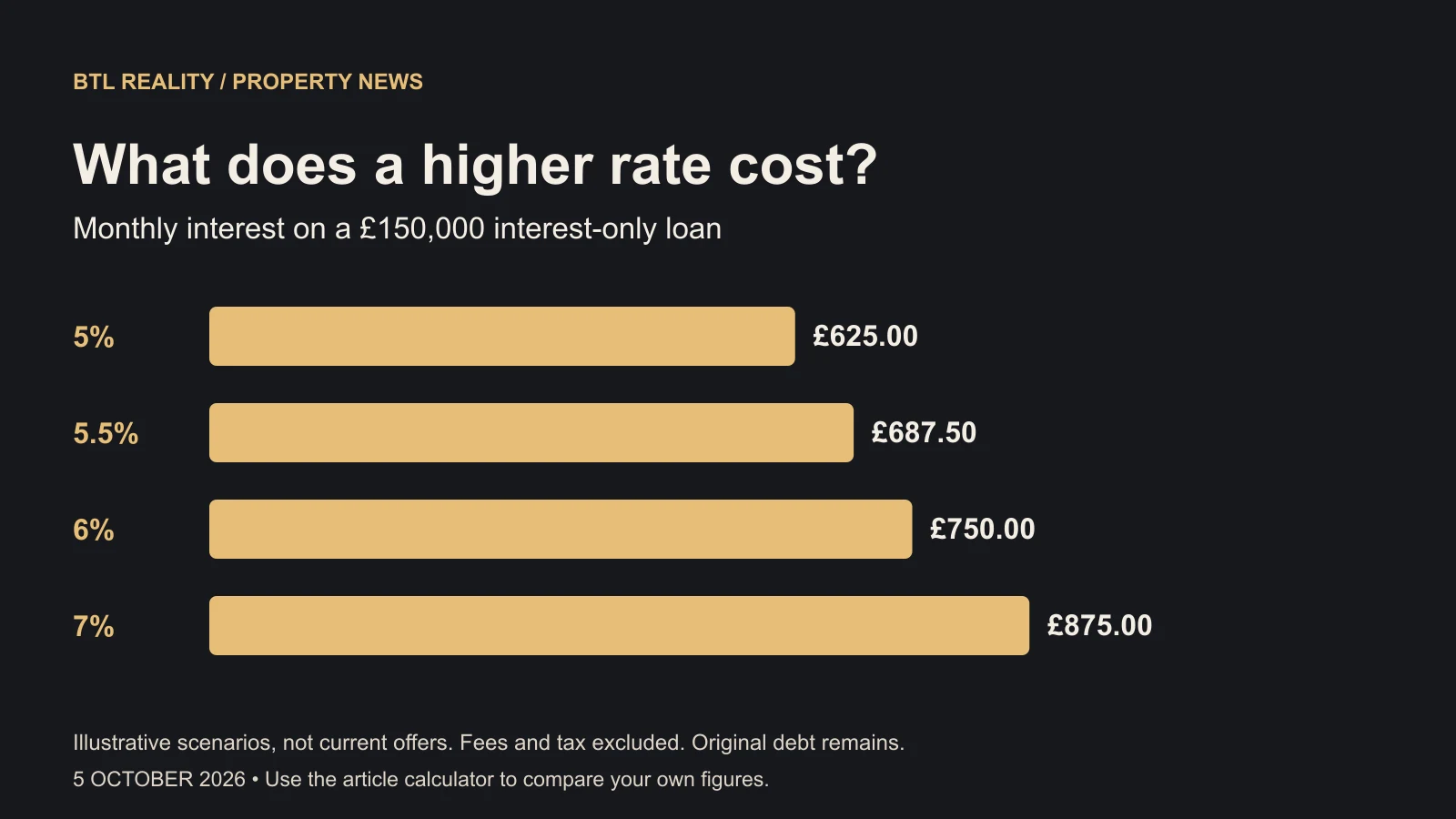
Start with the loan balance, not the property value. A £200,000 property with a 75% mortgage has a £150,000 loan. If that borrowing is interest-only, moving from an assumed 5% rate to 5.5% increases monthly interest from £625 to £687.50: £62.50 more each month, or £750 a year.
That is an illustrative half-percentage-point stress test. It is much larger than the weekly movement in the table and is not a forecast. The point is to expose how sensitive your own numbers are before a lender changes them.
What would 6% mean in pounds? On the same hypothetical £150,000 interest-only loan, 6% costs £750 a month, compared with £625 at 5%. That is £125 more a month or £1,500 over twelve equal payments. This is a one-percentage-point scenario, not the measured daily rise in the Moneyfacts average.
For a £150,000 capital-repayment mortgage with 25 years remaining, our model gives about £966.45 a month at 6%, versus £876.89 at 5%. The monthly difference is about £89.57, calculated before rounding the payments. It is smaller because the payment includes capital repayment as well as interest, but still leaves less room in the household budget. In the calculator, select repayment and change the comparison rate to 6 to reproduce it.
For interest-only borrowing, the calculation is loan × annual rate ÷ 12. Each extra percentage point costs approximately £83.33 a month per £100,000 borrowed. A capital-repayment mortgage behaves differently because the payment also repays part of the debt. The calculator handles both methods.
What does a rate change cost you?
Move the sliders or type your figures. These are assumptions, not available mortgage offers.
Same starting balance and term. Interest-only leaves the original debt outstanding. Repayment uses monthly amortisation. Rates are held constant for each calculation. Excludes fees, tax and insurance. Values stay on this page.
The calculator compares the same opening balance and remaining term at two constant rates. It excludes fees, insurance, tax and early repayment charges. Its annual difference is twelve monthly payment differences, not the total cost of changing lender. It does not assume that today’s advertised rate will last for the full mortgage term.
A rental example: the same house, a thinner margin
Imagine a rental collecting £1,100 each month. Assume £300 is set aside for the combined effect of management, ordinary maintenance, voids, insurance and other operating costs. That leaves £800 before finance and tax. These are made-up appraisal inputs, not a recommended allowance for every property.
With £150,000 of interest-only borrowing at 5%, £625 of monthly interest leaves £175 before tax. At 5.5%, the figure falls to £112.50. At 6%, it falls to £50. The property, rent and tenant have not changed; a one-point increase has absorbed £125 of monthly cash.
| Assumed rate | Interest | Cash remaining |
|---|---|---|
| 5% | £625 | £175 |
| 5.5% | £687.50 | £112.50 |
| 6% | £750 | £50 |
A £600 repair would therefore represent twelve months of the £50 surplus in the final scenario. In real life, repairs do not arrive in neat monthly instalments. Keep accessible reserves and avoid treating the whole theoretical surplus as money available for your lifestyle.
This example also leaves out purchase costs and major works. For a complete deal, enter those separately in the buy-to-let deal calculator. Do not confuse the cash left after mortgage payments with taxable profit or a guaranteed investment return.
Why cheaper borrowing cannot be your whole strategy
It is tempting to look at a tight deal and assume it becomes comfortable after the next rate cut. That could happen. It could also take longer than expected, arrive after your refinancing deadline, or be offset by another cost.
Our approach is to write three versions of the appraisal: the available terms, a more expensive refinancing scenario, and a cheaper borrowing scenario. Keep the rent and operating assumptions visible in each version. Then change those too, so a hopeful rent increase is not silently cancelling out a difficult mortgage assumption.
For example, combine the 6% borrowing scenario above with a £100 reduction in average monthly receipts. The £50 surplus becomes a £50 deficit before tax. That combination is more informative than looking at the mortgage rate alone. Use the mortgage stress calculator to explore the wider pressure on the deal.
Compare the fee as well as the percentage
A smaller interest rate can come with a larger product fee. Suppose two hypothetical interest-only offers on £150,000 have identical conditions except for price: 5.25% with a £3,000 fee, or 5.75% with a £999 fee. Assume fees are paid in cash and the balance remains unchanged.
Over two years, the first costs £15,750 in interest plus £3,000, making £18,750. The second costs £17,250 plus £999, making £18,249. In this deliberately simplified comparison, the higher-rate offer costs £501 less over the two-year period.
That is not a product recommendation. Valuation charges, legal costs, incentives, exit terms and eligibility could change the result. Adding fees to the loan also changes both borrowing and interest. Ask a qualified mortgage adviser to compare the available products on a consistent basis and explain any costs omitted from an illustration.
What does the wider lending data show?
The Bank of England’s August figures, released on 29 September, recorded 54,900 house-purchase mortgage approvals, down from 55,900 in July. The effective rate on newly drawn mortgages rose from 4.45% to 4.60%. Source: Money and Credit, August 2026.
These measure a different stage of borrowing from advertised October products. An effective rate on loans already drawn is not a rate that a new applicant can necessarily obtain today. The data gives useful background, but it cannot tell you whether a particular house is fairly priced or whether your application will be accepted.
That is why local evidence still matters. Check realistic rent, comparable completed sales, required work and the actual finance available for the property. A slower national approval figure is not proof that every seller will negotiate, just as a competitive local market does not remove the need for a disciplined appraisal.
A useful action plan for this week
If you already own a rental, note the fixed-deal end date, outstanding balance and any early repayment charge before comparing alternatives. Gather the existing mortgage statement and ask an adviser what options apply to your situation. An advertised offer is not the same as an approved replacement loan.
If you are buying, request a quotation against the actual property and ownership structure. Record its date, fee, assumed valuation, monthly payment and conditions. Revisit the appraisal if the valuation or product changes, rather than carrying the original spreadsheet forward as though nothing happened.
If you are still learning, practise with two real asking prices and independently supported rental estimates. Work out which assumptions determine the result. Our buy-to-let mortgages guide explains the wider funding process, while the interest-rate outlook covers what might influence future decisions.
Want help turning those numbers into a property plan? Explore Starter Club. You can use the free resources without joining. The aim is a purchase you understand, with financing and reserves you can support, rather than a decision driven by a rate headline.
Frequently asked questions
Have five-year mortgage rates reached 6% in October 2026?
Yes. Moneyfacts reported a five-year fixed residential average of 6.00% on 5 October, with its two-year average at 5.98%. That does not mean every mortgage costs 6%. The Rightmove figures use another sample and date; neither tracker guarantees an offer to an individual borrower.
Does a higher average mortgage rate change my existing fixed payment?
A change in an advertised market average does not itself change your contractual fixed rate. Check when your fixed period ends and what happens afterwards. If you have variable borrowing, the contract determines how the rate changes. Your lender or adviser can explain the specific terms.
How much does a 0.5 percentage-point rise cost on £150,000?
On an interest-only balance of £150,000, it adds £750 a year, or £62.50 a month, before fees. For a repayment mortgage, the difference depends on the starting rate and remaining term. Select repayment in the calculator to model that version using the same loan balance.
Can a landlord use residential mortgage averages in a buy-to-let appraisal?
Only as clearly labelled background or a hypothetical scenario. They are not evidence that you can borrow at that rate for a rental property. Use buy-to-let quotations matching your circumstances for the base appraisal, then vary the assumptions to understand the downside.
Should I wait for mortgage rates to fall before buying a rental?
There is no universal answer. Compare a purchase you can fund today with the costs and uncertainties of waiting. Avoid assigning a guaranteed future rate or house price. If a deal only works after cheaper borrowing arrives, recognise that dependency before committing.
Does a longer repayment term solve an affordability problem?
It can reduce the monthly payment in the model, but leaves the debt outstanding for longer and can increase total interest if other assumptions stay the same. Availability depends on lender criteria. It also does not fix weak rental demand, major repair needs or an inadequate cash reserve.
About this update
Property education and illustrative calculations only, not personalised financial, mortgage or tax advice. Actual lender calculations can differ. Borrowing is secured on property, which may be repossessed if repayments are not maintained. Data checked 5 October 2026; sources retain their own publication dates.