Tenant Wants a Smart Meter: Can a Landlord Refuse?
October 22, 2026
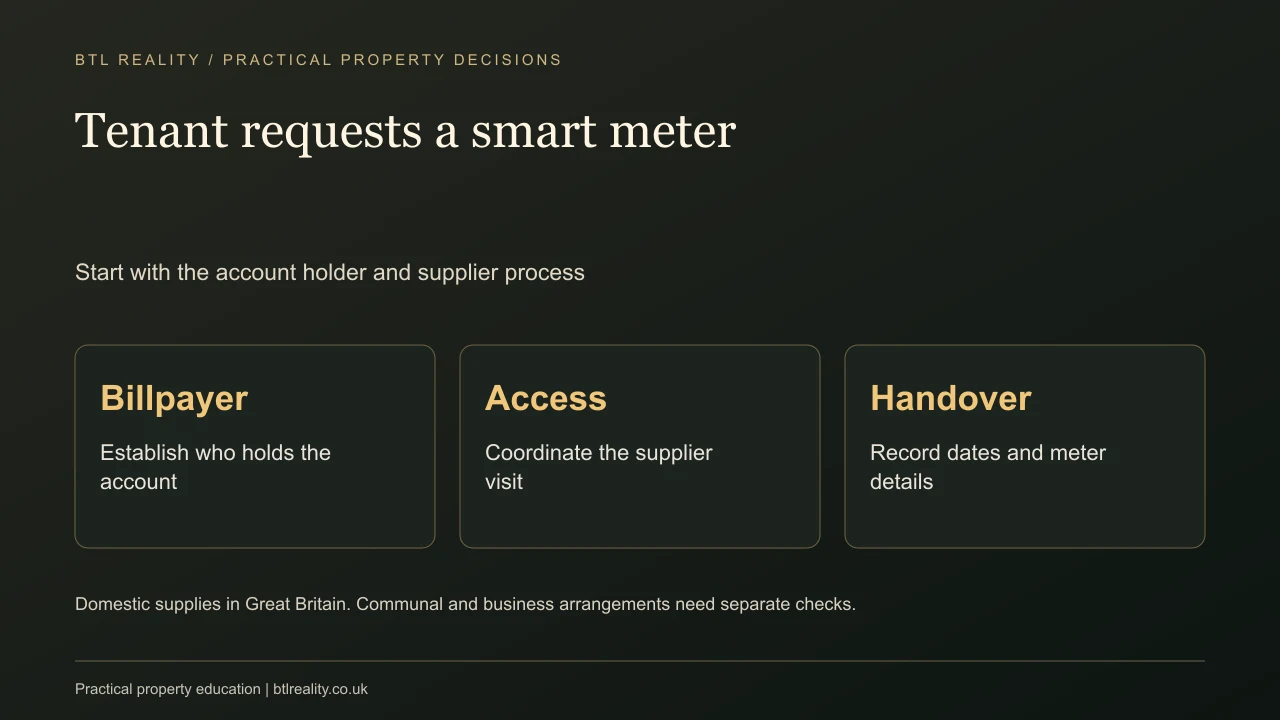
If your tenant pays the energy supplier directly, a request for a smart meter should start with that billpayer relationship. Owning the property does not mean every energy decision belongs to the landlord.
For a domestic rental in Great Britain, the practical approach is to check who pays, read the agreement, coordinate access and let the supplier assess the installation. A blanket refusal based on the word “smart” is unlikely to help either side.
This guide covers domestic supplies in England, Scotland and Wales, with sources checked on 19 October 2026. Northern Ireland has a different energy framework. Communal supplies, private submeters and business energy contracts need separate consideration.
Who can request the smart meter?
The government’s smart-meter service expectations say a person paying for their energy, whether owner or renter, should be able to book an installation where it is expected to work. Smart Energy GB’s landlord guide explains the billpayer distinction and says permission clauses should not be used unreasonably to prevent installation.
So establish the account arrangements first. If the tenant has their own domestic account, ask them to coordinate with the supplier and keep you informed about anything affecting the property. If you pay the supplier under a bills-inclusive arrangement, the request needs to be considered through your account.
A tenant paying an amount towards energy in the rent is not necessarily the energy supplier’s account holder. Do not confuse the person who ultimately bears a cost with the person holding the supply contract.
Read the request before saying yes or no
Ask which supply is involved, the supplier, the proposed appointment and whether the installer has identified any unusual work. A normal meter replacement and a request to move equipment to a different part of the building are not the same project.
For a flat, find out where the meter sits and who controls access to that area. The building manager may need to arrange entry to a locked cupboard. Your tenant should not have to guess which contractor can open it.
Keep the answer proportionate. If the only missing detail is an appointment time, ask for that detail. Do not turn a straightforward supplier visit into a demand for an unrelated financial or immigration file.
Where the supplier says the installation cannot yet work at the property, retain its explanation and next steps. A technical limitation should come from the supplier’s assessment, not an assumption that all flats are unsuitable.
Use a short coordination checklist
| Question | Information to confirm | Who helps resolve it? |
|---|---|---|
| Who holds the account? | Tenant, landlord or communal arrangement | Billpayer and supplier |
| What work is proposed? | Replacement, location and any extra work | Supplier installer |
| How is access arranged? | Home and any locked meter area | Tenant, landlord or building manager |
| What changes need recording? | Meter identity, readings and instructions | Billpayer and handover record |
| What happens if there is a problem? | Supplier contact and complaint route | Account holder and supplier |
The record is there to prevent avoidable confusion, not to create a new consent barrier. If you have a legitimate property concern, explain it specifically and ask the supplier how it can be addressed.
A smart meter does not guarantee a cheaper bill
The meter measures use and can support accurate readings or suitable tariffs. It does not by itself remove standing charges, change the household’s consumption or guarantee that every offered tariff costs less.
Ofgem’s current smart-meter help describes automatic readings, monitoring and access to more flexible tariffs. The useful comparison still involves the actual tariff and how the household uses energy.
As an illustration, suppose two tariffs have the same standing charge. A household uses 2,400 kWh of electricity annually. A uniform 2p per kWh difference would amount to £48 over that year: 2,400 multiplied by £0.02. That is a tariff calculation, not a promised saving from fitting the meter.
If one tariff instead charges more at busy times, the answer depends on when electricity is used. Do not advertise a rental as having a guaranteed annual saving merely because a smart meter is installed.
Keep bills-inclusive arrangements clear
Where you pay the supplier, consider how meter information helps you manage the actual costs and understand unusual use. Do not treat access to the account as permission to monitor the tenant’s daily life unnecessarily.
Review the agreement before changing how utilities are charged. An installation does not automatically amend a bills-inclusive rent or authorise a new separate payment. The bills-inclusive rental guide explains the wider budgeting and charging questions.
For a shared building with private submeters, establish which meter belongs to the licensed supplier and which devices are part of the landlord’s system. A supplier smart meter at the main intake does not automatically measure every room separately.
If there is uncertainty over the supply arrangement, resolve that before making promises about individual bills or meter access. The supplier and a competent adviser can identify the relevant system.
Record the change properly at installation
Ask the billpayer to keep the supplier’s installation record and opening information. Where relevant to your property file, record the meter location and identity without unnecessarily collecting the tenant’s account login or detailed consumption history.
Do not ask a tenant to send a supplier password. They can communicate the property information you need without giving you control of their personal energy account.
Check that the in-home display and instructions remain with the property where appropriate, and record their presence at handover. If the display stops working, it does not automatically mean the meter has stopped measuring use. Report the actual symptom to the supplier.
Where a contractor identifies remedial property work, keep it separate from the meter installation. Obtain an appropriate scope and quote rather than assuming every suggested electrical job is included in the standard visit.
What if the tenant leaves shortly afterwards?
Keep the normal change-of-occupier process. Record the move-out date and appropriate meter readings, notify the supplier of your own period of responsibility and ensure the incoming tenant establishes their account correctly.
Automatic readings can help, but they do not tell the supplier who legally occupied the property on every date. A clean tenancy and account handover still matters.
For an illustrative three-week void, an assumed daily standing charge of 60p costs £12.60 before any energy use: twenty-one days multiplied by £0.60. The meter does not remove that cost. Add actual consumption and the real tariff.
The empty-property cost guide helps budget the void. Keep the account dates aligned with the property record so a previous tenant’s use is not accidentally mixed with your own holding period.
Handle problems through the supplier process
If billing, communications or installation problems arise, the account holder should raise them with the supplier and keep the complaint reference. Help with property access and relevant records where needed.
Do not assume a meter is faulty solely because a bill increased. Check whether the bill is estimated or based on readings, the period, tariff changes and actual use. Equally, a supplier reassurance should not prevent a specific unresolved problem being followed up.
For a remote landlord, agree who will coordinate any necessary property visits. The overseas management guide helps make those responsibilities explicit without taking over a tenant’s personal account.
Give a practical written response
A useful reply confirms the account arrangement, asks for the supplier appointment details and identifies any access coordination. Where you need more information, say exactly what is missing and how it can be resolved.
Keep the decision about the actual installation. A smart-meter request should lead to a workable supplier visit and an accurate property record, rather than an argument based on assumptions about technology or ownership.
Your questions answered
Can a tenant request a smart meter without the landlord paying the bill?
If the tenant holds and pays the domestic energy account, the supplier request is generally theirs to make. Keep the landlord informed and address any agreement or access arrangements proportionately.
What if energy bills are included in the rent?
Establish who holds the supplier account. Where the landlord pays the supplier, the installation decision needs to be considered through that account, with the tenancy charging terms kept separate.
Does installing a smart meter guarantee lower bills?
No. Actual costs depend on consumption, tariff rates, standing charges and timing of use. The worked tariff saving in this article is illustrative, not a promised meter benefit.
Can a tenant arrange access to a locked communal meter cupboard?
Coordinate with the person controlling the area and the supplier. The tenant should not improvise access or assume a home appointment gives permission to alter communal equipment.
Should the tenant give me their supplier password?
No. Ask only for relevant property and installation information. Do not collect account passwords or take over a personal energy account merely to update your property file.
Does a smart meter end the need for move-out readings?
Keep a proper account handover and appropriate readings. Automatic data does not replace accurate occupancy dates and notification of who is responsible for each period.