Can You Buy a Section 106 Restricted Property to Let?
October 20, 2026
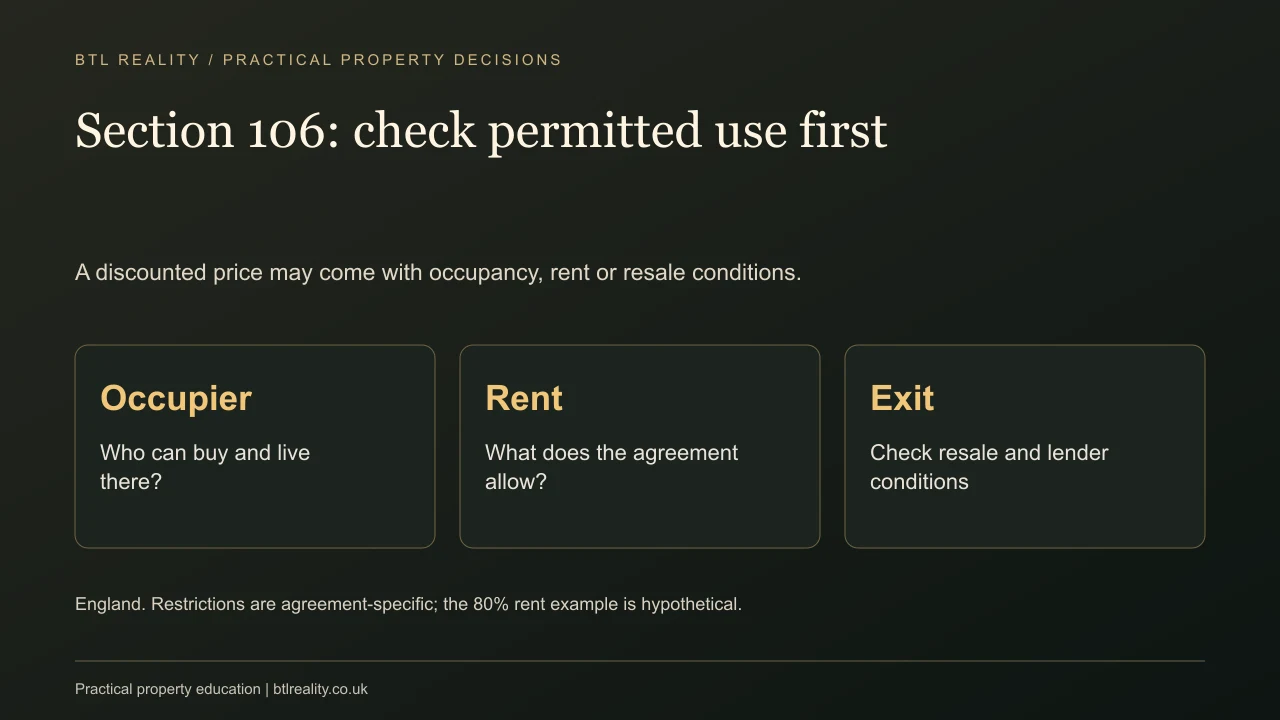
A house is advertised below nearby sale prices, and the yield looks excellent at the rent other houses achieve. Then the solicitor identifies a section 106 agreement. Before calling it below market value, find out whether the price reflects restrictions that also affect who can buy, occupy or rent the property.
Some section 106 obligations concern development contributions and do not prevent ordinary letting. Others impose important occupancy, affordable-housing or resale conditions. The actual agreement decides the issue. This guide focuses on England, with primary guidance checked on 19 October 2026.
What is a section 106 agreement?
The government’s planning-obligations guidance explains that planning obligations are legally binding, enforceable arrangements that run with the land. Section 106 agreements are one way of securing them. A sale does not automatically make an ongoing obligation disappear.
The words section 106 do not identify one universal restriction. An agreement can address several parts of a development, with schedules applying to different plots or tenures. Ask the conveyancer to obtain the complete agreement, plans and later modifications rather than rely on a short entry in search results.
Ask which obligations affect the particular home and which have already been satisfied. A developer’s original payment obligation is not the same as a continuing occupation restriction. The report should distinguish them so you do not treat every entry as either harmless or a permanent ban on letting.
Confirm who can buy and occupy the property
Some homes are restricted to eligible households, people with a local connection or a defined form of occupation. Ask what the agreement actually requires and how eligibility is demonstrated. Do not assume you qualify because you already own a nearby rental or operate a local company.
Check whether the owner must live in the property, whether letting is permitted and whether any proposed tenant must meet conditions. A property that can be sold to you in one capacity may not support the separate letting strategy you intend. Explain the whole plan to the solicitor.
Affordable-housing arrangements can differ materially. The government’s First Homes guidance, for example, describes a particular discounted-market-sale tenure with eligibility and resale restrictions secured through planning obligations. That is one scheme, not a set of rules to apply indiscriminately to all section 106 properties.
A concession permitting temporary letting is not automatically permission to buy the home as an unrestricted permanent rental. Ask about duration, conditions and approvals. The seller’s current circumstances and consent may not carry over to a new owner with a different plan.
Check whether the rent is restricted
If letting is allowed, establish how rent is set and who can occupy. The agreement might specify a formula, qualifying tenants, nomination arrangements or another requirement. Do not substitute the unrestricted market rent from a letting agent for the permitted rent under the agreement.
Ask who confirms the figure, how reviews operate and what records or approvals are needed. Also check the applicable tenancy law and letting requirements separately. A planning obligation and the tenancy’s rules need to work together rather than being treated as alternatives.
If the property is currently let, obtain the existing consent, tenancy documents, rent history and compliance evidence. A tenant already living there does not establish that every planning obligation has been met, or that the same arrangement can simply continue after sale.
Use the rental-demand guide for evidence about suitable local households and achievable rents. Then apply the actual occupancy and rent restrictions. High unrestricted demand is not a complete forecast for a home that can only be let on defined terms.
Resale restrictions affect the exit
Ask whether the sale price is capped or discounted, which buyers are eligible and whether the council must approve the transaction. Establish how a valuation is obtained, what certificates are required and whether marketing periods or other conditions apply.
A restricted price is not necessarily a temporary discount you keep when selling at full market value. For some schemes, restrictions are designed to continue for future purchasers. A return calculation based on an unrestricted sale can therefore overstate the investment outcome.
Ask whether any exception or release route genuinely applies, what it requires and whether payment is due. Do not assume a clause protecting a mortgage lender on enforcement gives the ordinary owner the same unrestricted sale right. The solicitor should explain the relevant provisions in the context of your transaction.
Compare suitable restricted comparables where possible. The sold-comparables guide helps structure valuation evidence, but an unrestricted house next door may not be a fair like-for-like benchmark when the title and occupation differ.
A worked example: the market rent is the wrong input
Assume a hypothetical agreement permits an investment letting but limits rent to 80% of an agreed £1,000 monthly market benchmark. Assume the resulting permitted rent is £800, annual running costs are £2,400 and annual mortgage interest is £6,600. This is an invented contract example, not a rule for section 106 housing.
| Illustrative forecast | Using unrestricted rent | Using assumed permitted rent |
|---|---|---|
| Monthly rent | £1,000 | £800 |
| Annual rent | £12,000 | £9,600 |
| Running costs and interest | £9,000 | £9,000 |
| Annual surplus before tax | £3,000 | £600 |
| Monthly equivalent | £250 | £50 |
The difference is £2,400 a year. A lower price might still make the permitted investment attractive, but you cannot assess that using income the agreement does not allow. If the agreement prohibits your intended letting altogether, the appropriate rental forecast is not simply a lower rent.
Use the Buy-to-Let Deal Analyser only after establishing the lawful model. Enter the permitted rent, actual finance, administration costs and realistic void assumptions. Test the resale using the applicable restriction rather than assume it will be removed.
Get the local authority’s required confirmation
Ask which council team deals with the agreement and what evidence it requires. Cornwall Council’s planning services illustrate separate processes for section 106 queries, compliance confirmation, eligibility and certain occupancy changes. That is a local example, not a national fee or universal approval route.
Your conveyancer should coordinate the enquiries and identify the relevant documents for your purchase. Obtain written confirmation where the agreement requires it. A phone conversation with an officer unfamiliar with the specific schedule is not a replacement for the required consent or certificate.
Allow for the actual process and costs in the acquisition timetable. Ask which steps can be completed before exchange and which depend on completion. A cheap property can become an expensive delay if nobody establishes the approval route until the mortgage offer is close to expiry.
Confirm lender acceptance on the restricted basis
Give the broker and lender the full agreement and relevant consents. A lender may need to assess occupancy, resale, valuation and mortgagee-protection clauses. Do not obtain a mortgage on assumptions that conflict with the legal use you intend.
Your own agreement in principle does not confirm that the property is acceptable security. Nor does an estate agent’s statement that lenders have accepted other homes on the development. The exact property, restriction and proposed loan need a specific review.
A cash purchase leaves the same use restrictions in place. If the strategy depends on refinancing or selling to a mortgaged buyer, include that in the pre-purchase assessment. Cash is a funding choice, not an exemption from a planning obligation.
A change is possible only when properly established
The government guidance describes routes to change planning obligations, subject to the legal process and circumstances. A possible negotiation is not evidence that a restriction will be removed, and a seller’s intention to apply is not a completed modification.
Ask a planning solicitor or appropriate adviser about any proposed change before basing the purchase on it. Identify the authority’s role, evidence, costs and realistic uncertainty. Private-covenant insurance should not be assumed to authorise a use prohibited by an enforceable planning obligation.
Before exchange, you should be able to explain the permitted buyer, occupier, rent, resale and approval position in plain language. If those requirements do not fit your investment plan, the attractive headline price is not a reason to force the deal. Choose a property whose actual permitted use matches the rental you want to operate.
Frequently asked questions
Does every section 106 agreement stop a buy-to-let purchase?
No. Agreements vary and may concern obligations unrelated to letting a particular home. Have the conveyancer identify the schedules affecting the property and any continuing restrictions. The section number alone does not settle the investment decision.
Can I buy a discounted home and rent it at full market rent?
Only if the applicable agreement and other requirements permit that strategy. Some arrangements restrict buyer eligibility, occupation or rent. Establish the lawful position before using an unrestricted rent in the forecast.
Will a temporary letting consent allow permanent buy-to-let ownership?
Do not assume so. Read the consent’s duration, conditions and who it benefits. Permission addressing an existing owner’s temporary circumstances may not apply to a new investor or an indefinite letting.
Does paying cash remove section 106 restrictions?
No. Planning obligations can run with the land. Cash removes the immediate mortgage application, not the occupation, rent or resale rules. Your future refinance and buyer pool still need consideration.
Can the restriction be removed after I buy?
A change may be possible through the relevant process, but it is not guaranteed. Obtain specialist advice and any necessary completed modification before relying on unrestricted use or value. A proposed application should remain an uncertainty in the purchase decision.
Is a section 106 planning obligation the same as a private covenant?
No. Both can affect a purchase, but their legal basis and resolution routes differ. Ask the conveyancer to classify the issue correctly. Do not assume a remedy or insurance approach for a private covenant solves a planning obligation.