Who Pays for Tree Work in a Rented Garden?
October 22, 2026
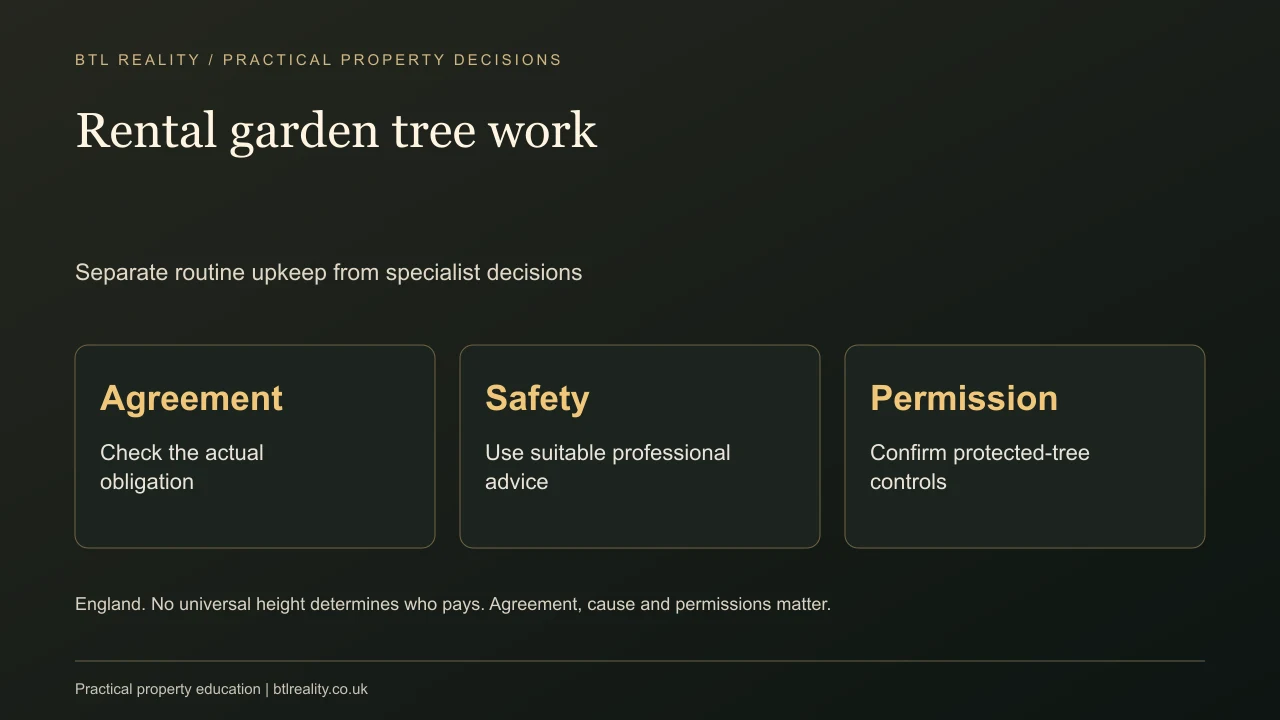
A garden clause saying the tenant should keep things tidy does not automatically answer who should organise major tree work. Routine mowing, a damaged branch, a protected tree and a dispute over ownership are different situations.
Start with the agreement and the actual tree. Establish who owns or controls it, whether there is a safety issue and what permissions are required. Only then decide the scope, contractor and payment arrangement.
This guide concerns English private rentals, using government and council tree guidance checked on 19 October 2026. It does not set a universal height at which every tree becomes the landlord’s job. Lease terms, safety duties and planning controls need to be considered for the actual property.
Separate routine upkeep from specialist work
Read the tenancy’s garden terms and identify what the tenant actually agreed to maintain. A straightforward task within ordinary garden care is different from climbing, felling or substantial pruning requiring specialist equipment and competence.
Do not tell a tenant to undertake dangerous work because “the garden is yours”. Equally, do not assume every leaf or small plant creates a specialist landlord repair. Describe the task precisely enough to assess it sensibly.
Check the starting condition in the inventory and any later agreement. A tree already overgrown at move-in should not be silently presented as a problem entirely created by the current tenant.
If the clause is disputed, obtain appropriate advice on its effect rather than quoting a generic internet rule. A garden’s size or a tree’s height alone does not settle every contractual question.
Establish ownership and control
A trunk beside the fence may stand on your land, a neighbour’s land or a shared boundary. For a flat, the garden may be communal or subject to lease restrictions. Check the title, lease and physical information before instructing work.
Merton Council’s private-tree guidance explains owner or managing-agent responsibilities and recommends checking deeds or obtaining advice if ownership is unclear. Treat that as a prompt to establish the facts, not proof that every tree visible from your rental belongs to you.
If the tree is on a neighbour’s property, communicate clearly before work. Do not authorise entry onto their land or cutting beyond what is lawfully permitted merely because a contractor can reach it.
Keep the location and tree identity in the work instruction. “Cut back the tree” is dangerously vague where several trees stand along a boundary.
Check protection and other permissions
The government’s Tree Preservation Order guidance explains that protected-tree works generally require the local planning authority’s written consent, subject to specific exceptions. Conservation-area rules and other controls also need checking.
A landlord’s agreement does not replace planning consent. Nor does a neighbour’s request, an insurer’s suggestion or the contractor’s availability automatically remove the restrictions.
Chichester’s tree FAQs distinguish public planning permissions from additional private permissions on rented land. Check the relevant local authority for this property and retain the actual decision and conditions.
Where somebody says work is exempt because a tree is dangerous or dead, obtain competent advice and follow the applicable notice and evidence requirements. Do not use a vague safety concern as a shortcut around the proper process.
Respond properly to a reported danger
Ask for the location, what has changed and photographs taken only from a safe position. A fallen branch, visible damage after a storm or movement reported near a building warrants an appropriate professional response.
Do not ask the tenant to climb, pull a branch down or test whether the tree is stable. Keep people away from an immediate hazard and use the appropriate emergency or professional help for the circumstances.
Record when the concern was reported and the action taken. If an arborist recommends work, retain the findings and the time frame advised. “Tree man booked” is less useful than the assessed issue, agreed scope and completion evidence.
Permission questions and urgent safety action may need to be handled together. Contact the relevant authority or adviser promptly rather than assuming either that all work must wait or that all controls disappear.
Use a clear decision table
| Situation | First issue to resolve | Useful next step |
|---|---|---|
| Ordinary garden tidying | Agreed upkeep and starting condition | Discuss the specific task |
| Large pruning proposal | Ownership, competence and permissions | Obtain a scoped professional assessment |
| Damaged branch after a storm | Immediate safety risk | Prompt suitable advice and mitigation |
| Protected tree | Consent, notice or valid exception | Contact local planning authority |
| Neighbour’s tree | Boundary, rights and protection | Communicate and establish lawful scope |
Once those questions are answered, the payment discussion becomes more specific. You can identify the work required and the obligation relied upon instead of arguing over the word “garden”.
Compare tree-work quotes on the same scope
Ask each contractor to identify the tree, work proposed, access needs, waste removal and any exclusions. Check suitable competence and insurance for the work. The lowest price is not useful if it omits half the job.
Suppose an illustrative quote is £420 for the agreed work but excludes £90 waste removal. The completed price is £510. A £480 quote including the same work and removal is £30 less on those assumptions.
If a third quote says only “reduce tree £300”, ask what reduction, which tree and what happens to the material. Comparing £300 with £480 without a common scope would be misleading.
These are assumed figures, not a market guide. The quote comparison guide provides the same useful discipline for other property work: compare the completed scope and record changes.
Do not turn the invoice into an automatic tenant charge
Even where a tenant has an upkeep obligation, a contractor invoice does not itself prove every cost can be recovered from them. Establish the contractual basis, breach, cause and reasonable remedy.
Keep normal growth, prior condition, weather damage and alleged neglect distinct. A decision to redesign the garden or remove a healthy tree for your convenience is different from restoring a condition the tenant was obliged to maintain.
For a proposed deposit deduction, use the relevant scheme process and evidence. Avoid a fixed “tree penalty” or a demand for an upgrade disguised as maintenance. Get advice where liability is disputed.
The maintenance budget guide helps fund work that remains the landlord’s responsibility without relying on uncertain recovery.
Agree access and protect the rest of the property
Coordinate dates with the tenant and explain the contractor’s needs. Ask about vehicles, access routes and any area that must be kept clear, while leaving the contractor to manage the professional safety arrangements.
Record the condition of affected access areas where useful and agree who handles reinstatement. A quote may include taking branches away but exclude repairing a gate removed for access.
For a leasehold or shared garden, make sure the person instructing has the necessary authority. A tenant’s agreement to a visit does not necessarily authorise changes to communal landscaping.
If you are overseas, the remote management guide helps specify reporting and authorisation. Request the assessment, permissions and completed work record, not only a before-and-after photograph.
Keep a useful future record
Save the tree identity, assessment, permissions, work scope and completion date. Record any professional advice about future review. Do not turn an illustrative budgeting period into an invented statutory inspection interval.
For example, setting aside an assumed £480 over three years means £160 annually or about £13.33 monthly. That is cash planning for anticipated work, not evidence that every tree must be pruned every three years.
At the next letting, make ordinary garden responsibilities clear and describe the starting condition accurately. The property should have a process for reporting a concern about a tree without the tenant first needing to decide the legal bill.
A good arrangement makes routine upkeep understandable and specialist work safe, properly authorised and fairly allocated. Those are better outcomes than a blanket assertion that either the landlord or tenant always pays.
Your questions answered
Are all garden trees automatically the tenant’s responsibility?
No blanket answer follows from having a garden. Read the agreement and consider ownership, the actual task, safety duties and permissions. Specialist work is different from ordinary tidying.
Does a tree become the landlord’s job above a fixed height?
This guide does not identify a universal legal height threshold. Assess the actual work and obligations rather than relying on an invented seven-foot or two-metre allocation rule.
Can I authorise pruning of a protected tree myself?
Landlord consent does not replace the local planning authority’s permission or required notice. Check the actual protection and any valid exception before work.
Can the tenant be told to remove a damaged high branch?
Do not instruct dangerous work beyond appropriate competence. Respond to the actual risk and arrange suitable professional or emergency help as needed.
Can I automatically deduct the tree surgeon invoice from the deposit?
No. Establish the justified claim, obligation, cause and reasonable amount, with evidence and the appropriate scheme process. An invoice alone does not settle tenant liability.
Is the three-year saving example a pruning rule?
No. It simply spreads an assumed £480 cost into a cash budget. Actual review and work should follow the tree, competent advice and applicable permissions.