Removing a Joint Owner From a Buy-to-Let Mortgage
October 20, 2026
Removing someone from a jointly owned buy-to-let involves more than agreeing how much to pay them. The property ownership, mortgage borrowers and any money changing hands need to be dealt with together. A private agreement between the owners does not by itself release a borrower from the lender’s contract.
Start with the proposed end position: who will own the property, who will owe the mortgage and how the outgoing owner will be paid. Then ask the lender and solicitor which route can achieve it. The process is often called a transfer of equity, although a remortgage may also be needed.
Ownership and mortgage liability are separate
The title records legal ownership. The mortgage agreement identifies the borrowers and their obligations. Changing one does not automatically complete the other. If someone is to leave both, the conveyancing and lender approval must produce that result.
For example, The Mortgage Works’ buy-to-let transfer-of-equity form provides an application route for adding or removing an applicant. It is an assessment process, not an instruction the borrowers can impose unilaterally.
Other lenders may restrict such changes or require a replacement mortgage. Ask specifically about a let property: a residential change-of-borrower page does not necessarily describe the buy-to-let policy. Your current product and the proposed borrowing amount can also affect the route.
Agree the valuation and equity calculation
Get a realistic current property value and the actual mortgage redemption figure. Outstanding interest, fees or an early repayment charge can make that figure different from the approximate balance shown in your own spreadsheet.
The usual starting calculation is property value minus debt, but that does not establish each person’s legal entitlement. A declaration of trust, different contributions, a partnership agreement or family-law circumstances may change the settlement. Ask the relevant legal adviser to confirm the allocation.
Keep transaction costs visible. The owners may need to agree who pays legal fees, valuation costs, lender charges and any tax. Do not let the headline buyout payment obscure several thousand pounds of additional cash needed to complete the arrangement.
A £240,000 rental buyout example
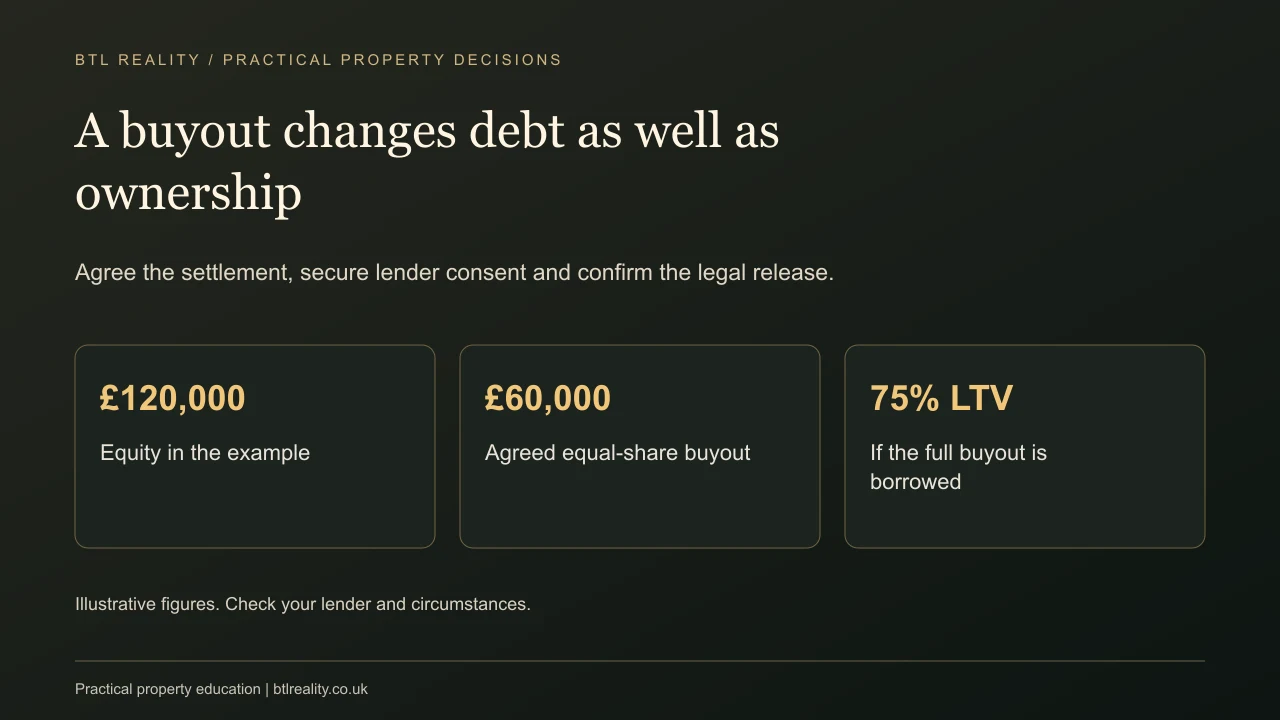
Assume two owners have agreed an equal split of the equity in a property worth £240,000 with £120,000 of mortgage debt. Ignore fees, tax and any repayment charge for this initial illustration. The equity is £120,000 and the outgoing owner’s agreed half is £60,000.
| Item | Cash-funded buyout | Entire buyout added to borrowing |
|---|---|---|
| Property value | £240,000 | £240,000 |
| Existing mortgage | £120,000 | £120,000 |
| Agreed owner payment | £60,000 cash | £60,000 additional loan |
| Mortgage after transaction | £120,000 | £180,000 |
| Loan-to-value | 50% | 75% |
The second route only works if the lender accepts both the change of borrower and the larger loan. Having £60,000 of equity available on paper is not the same as qualifying to extract £60,000 of cash.
Use the deal calculator to assess the resulting investment. Enter the borrowing after the buyout, rather than judging the property using the old shared mortgage.
Check cash flow after one owner leaves
At an illustrative 5.5% interest-only rate, £120,000 costs £550 a month. A £180,000 balance costs £825. If rent is £1,200 and other monthly cost allowances are £300, the surplus falls from £350 to £75 before tax and exceptional repairs.
The £275 monthly difference is the financing cost of raising the extra £60,000 at that assumed rate. It does not include the outgoing owner’s previous share of income, the cost of replacement management or any different tax position.
Use the mortgage stress calculator to test the proposed balance at a higher rate too. The lender may also apply a rental-cover test different from your operating budget. Passing one does not make the other unnecessary.
Does the existing lender allow both changes together?
Ask whether the lender can process the borrower change with additional borrowing, or whether one must complete before the other. A transfer on the existing balance and a capital-raising remortgage are different applications.
Confirm whether the existing rate can be retained, what checks are needed and what happens to early repayment charges. Do not assume keeping the same property means keeping every existing mortgage term.
Compare the existing-lender route with a suitable remortgage, including fees and the full remaining debt. The product-transfer and remortgage guide explains the wider cost comparison, but a basic product transfer is not itself an ownership change.
Tax can arise even where little cash changes hands
For England and Northern Ireland, HMRC’s ownership-transfer guidance explains that taking responsibility for mortgage debt can be chargeable consideration for SDLT. A transaction described casually as a gift is not necessarily free of purchase-tax consequences.
The outgoing owner may also need advice about Capital Gains Tax and any relevant relief or special circumstances. Scotland and Wales have different transaction taxes. This article does not calculate the bill because ownership, relationship, debt and other properties can change the answer.
Give the solicitor the complete proposed payment and debt arrangement before agreeing the settlement. Tax paid by one party may affect what each regards as a fair overall outcome, even though it is not part of the simple value-minus-mortgage calculation.
Keep the rental operating during the process
Decide who receives rent, authorises repairs and pays the mortgage while the transfer is considered. An application can take time, and the property’s obligations continue. Do not stop paying because the owners have agreed privately that one will take over later.
Tell the solicitor about the tenancy, deposit records, agent and any licences. Ask what notifications and record changes are needed on completion. A change in landlords does not justify ignoring the occupier’s existing rights or assuming a new agreement is automatically required.
Keep a written completion checklist covering the mortgage, title, insurance, agent, bank details, tax records and landlord administration. Update each at the appropriate point rather than making a mixture of premature and late changes.
The outgoing owner needs confirmation of release
Retain the lender’s confirmation and the solicitor’s completion documents. The outgoing person should understand exactly which obligations have ended and whether any guarantee or other liability remains under separate documents.
A promise from the continuing owner to make every payment is not the same as the lender releasing a borrower. If the lender still has contractual rights against someone, the private agreement may not prevent it using those rights.
Where the lender declines the request, revisit the options with advisers. A sale, a different mortgage, a smaller settlement or another agreed structure may need consideration. Do not treat an unapproved removal as complete because a payment has already been made between owners.
Test a lower valuation
If the lender values the example property at £225,000 rather than the agreed £240,000, a £180,000 loan would be 80% LTV. A product capped at 75% would support £168,750 on that value, leaving £11,250 to fund elsewhere if the settlement stays unchanged.
This is why the owners’ agreed price and the lender’s acceptable borrowing are separate decisions. Decide who bears the effect of a valuation difference before the transaction is committed. A settlement can be perfectly clear between the parties yet still require more cash than the continuing owner expected.
What to prepare for the first conversation
Have the mortgage account details, property value evidence, agreed ownership shares, settlement proposal, rent and running costs ready. Identify the intended remaining borrower, their finances and any deposit or buyout funds.
Also identify deadlines and unresolved disagreements. A broker cannot make a lender accept a disputed ownership arrangement, and a solicitor cannot guarantee a mortgage. Coordinating both early helps avoid committing to an agreement that the available finance cannot support.
The useful outcome is a documented, funded completion in which the ownership and liability match the parties’ intention. That is more important than finding the quickest way to remove a name from one document.
Questions about removing a joint buy-to-let owner
Can I remove a joint borrower without asking the lender?
No private agreement should be treated as lender release. Ask for the lender’s formal process and consent, with legal work to align ownership and borrowing. Confirm completion in writing.
Is the buyout simply half the property value?
Not usually where there is debt. Value minus the relevant mortgage gives an initial equity figure, but legal shares, agreements, costs and individual circumstances determine the settlement. Obtain advice on the actual entitlement.
Can I borrow the money needed to buy the other owner out?
Potentially, subject to current lending criteria, rental coverage, LTV and the proposed borrower. Calculate the property’s cash flow on the larger balance and include fees and tax in the cash requirement.
Will a gift avoid SDLT on a mortgaged transfer?
Not necessarily in England and Northern Ireland. Taking over mortgage debt can count as consideration. The solicitor should assess the actual transaction, relationship and applicable rules before completion.
Do mortgage payments continue while the transfer is processed?
Yes, the existing contract continues until an approved change completes. Keep the mortgage and property obligations up to date and agree clearly who handles payments and management during the process.
How does the departing borrower know they are released?
Keep the lender’s release confirmation and solicitor’s completion records. Check separate guarantees or obligations too. A change to rent receipts or a promise by the other owner is not enough.