From Property Videos to Your First Practical Step
October 11, 2026
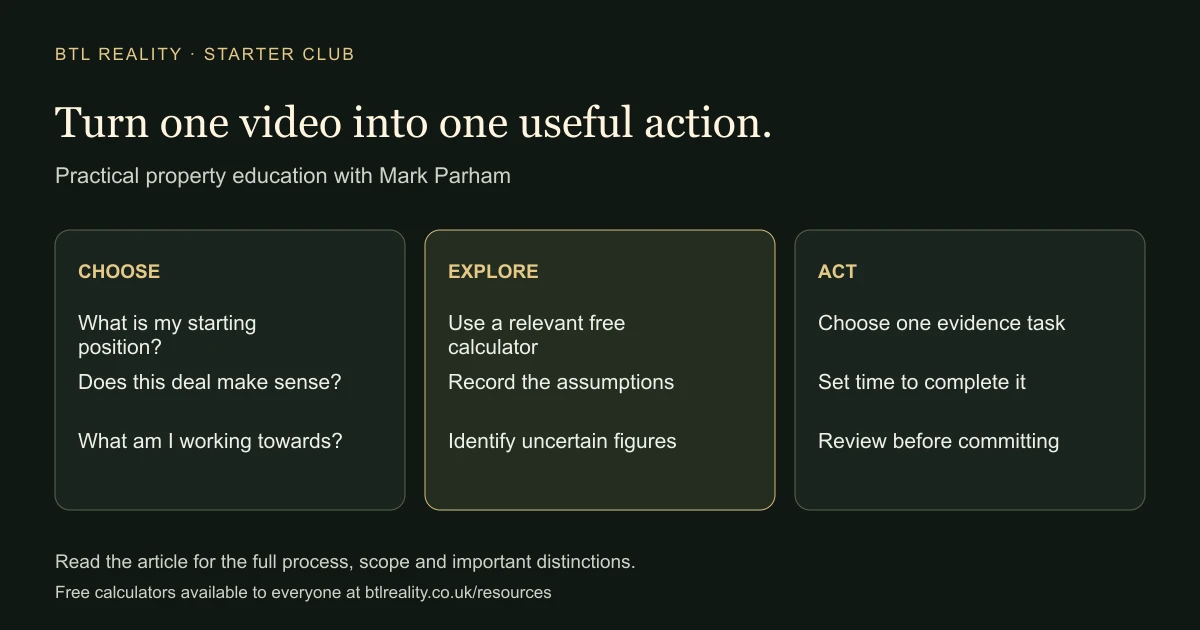
Watching property videos can improve your understanding, but the next useful step is usually something you do with the information. That does not have to mean making an offer or buying a course. It can be a small task that makes your own situation clearer.
If you have watched my content and wondered where to begin, this is the process I would use: choose one question, gather the relevant facts, try a calculation and decide what evidence you need next.
The aim is to leave the article with a completed piece of work or a specific research task, not another long list of videos to save. The BTL Reality calculators are free to use without joining Starter Club, so you can start there today.
Why more content can stop feeling useful
A video can explain a concept clearly while leaving you unsure how it applies to your circumstances. You may understand gross yield but not know which rent estimate to use. You may have heard about refinancing without knowing what limits the amount available.
Collecting another example can feel productive because it is easier than confronting an uncertain number in your own plan. The problem is not learning. It is learning without a question that connects the material to a decision.
You also see examples from different people, places and periods. Their finance, costs and objectives may not match yours. Combining the most attractive part of each example can create a plan that nobody has actually tested.
Choose the question first. Then use content to help answer it, rather than allowing the next recommended video to decide what your goal should be.
Pick one of three starting questions
If you are unsure where to begin, choose the question closest to your current position. You can return to the others later.
The first is: “What resources do I actually have?” That points towards understanding assets, debts, cash and commitments. It is particularly useful if your goal feels large but your starting picture is vague.
The second is: “How do I judge this potential property?” That points towards a consistent appraisal, supported rent estimates, costs and the questions that need professional checks.
The third is: “What am I trying to achieve over time?” That points towards desired income, your time horizon and the trade-offs between spending, saving, investing and borrowing.
Choose a practical starting task
List your assets and debts, then separate accessible cash from your total net worth.
A learning task, not an investment recommendation. Your selection is not saved or sent.
The selector links to a relevant free starting tool. It does not recommend an investment or decide that a property is suitable. Use it to choose a task, not to obtain permission to buy.
Task one: write down your starting position
Use the net worth calculator to organise the relevant assets and debts. Keep a separate view of accessible cash and money already needed for other commitments.
The distinction matters. A property valuation can contribute to net worth without providing cash for a deposit. Borrowing against it, if available, introduces a different set of costs and responsibilities.
You do not need perfect figures to notice where the gaps are. Mark estimates clearly and identify which ones need better evidence before a real decision.
Your output from this task could be one page showing what you know, what you have estimated and what you need to confirm. That is a more useful foundation than choosing a purchase target from someone else’s portfolio story.
Task two: analyse one property consistently
If you are already browsing listings, choose one example and work through the buy-to-let deal calculator. Do not treat the result as a verdict or use the most optimistic available figures simply to make it attractive.
Separate the purchase price, deposit, buying costs, works and reserve. Then look at rent, financing and operating assumptions. Record the source of each important input.
For example, if the rent is only an agent’s initial estimate, write that down. If maintenance is a general allowance rather than an assessment of the building, make that visible too.
Your completed task is an appraisal with a list of questions. It is not an obligation to pursue the property. Discovering that the figures are uncertain or unworkable can be a useful result.
Task three: connect an ambition to a number
If your objective is more freedom or a different working life, describe the spending you would want to support and the time horizon you are considering. Avoid using someone else’s income target simply because it sounds successful.
The financial freedom calculator lets you explore assumptions behind a capital target and contribution scenarios. The compound interest calculator helps show the effect of time and regular contributions.
Change an assumption and note what happens. If the result only works at an optimistic return, that is information about the plan’s dependence on growth, not evidence that the optimistic return will occur.
The output is a clearer question: what would need to be true for this scenario, and what can you influence today? Keep projections separate from commitments you cannot afford to miss.
Give yourself an evidence task, not just a number
A calculator can process an input accurately even when the input is poorly supported. The next step is often to improve the evidence rather than build a more complicated model.
For a rental, you might gather comparable letting evidence for the actual property type. For works, you might establish what needs inspecting before asking for a quote. For finance, you might identify the questions to discuss with a broker.
Choose one task with a defined finish. “Understand the market” can continue forever. “Collect three relevant examples and explain why they are comparable” has a clearer endpoint.
Keep a record of what would change your view. If a rent assumption is lower than expected, update the appraisal rather than leaving the preferred number in place because you like the property.
A simple one-hour starting session
If you can protect an hour, use it deliberately. Spend the first ten minutes choosing the question and gathering the information you already have. Spend the next twenty minutes using the relevant tool or organising the figures.
Use another twenty minutes to identify uncertain assumptions and decide how you will check them. In the final ten minutes, write one next action and a realistic time to do it.
This is a suggested learning routine, not an estimate of how long due diligence should take. A real purchase can require extensive work and professional input. The hour is simply a way to move from watching to producing something useful.
If you only have twenty minutes, choose a smaller task. Consistency matters more than making the first session look impressive.
Ask a question that someone can help you answer
Once you have done a little preparation, support becomes more useful. Explain the decision, the evidence you have and the uncertainty you want to resolve.
“I have tried the deal calculator, but I am unsure which running costs I have missed” is easier to discuss than “tell me everything about property”. It gives the conversation a starting point.
If you want ongoing group support, Starter Club includes a personal roadmap, a monthly live group call and the founding WhatsApp arrangement described on its page. My weekly founding-group participation is for your first twelve months while subscribed, not unlimited private messaging or lifetime access.
The article on property mentoring through WhatsApp explains how to make those questions useful and what boundaries to expect.
You do not have to buy support to take action
The free tools and articles are there for you to use independently. Every calculator provides results on the page. Optional personalised reports may ask for contact details, but paid membership is not required.
You can decide later whether you want help turning the work into a personal plan. If the issue is finding a property rather than learning the process, Done For You is a separate sourcing service against an agreed brief.
Do not confuse taking action with buying something immediately. Taking action can mean organising your finances, ruling out a weak assumption or deciding not to proceed with a property that does not fit.
For the background to that approach, read why I created BTL Reality Starter Club. The paid offer adds support; the starting tools remain available to everyone.
Decide what you will do after this page
Choose one concrete next step before returning to another video. Open the calculator that matches your question, make a short note of your starting figures or schedule a focused research session.
If you have already done that work and want to discuss the support available, request a free strategy call. Explain the question you have reached rather than feeling you need to sound like an experienced investor.
A useful learning process is not measured only by how much content you consume. It is measured by whether you understand the next decision more clearly and know what to check before making it.
Frequently asked questions
What is the first practical step after watching property videos?
Choose one question about your own position and gather the information needed to explore it. A free calculator can help organise the next task.
Should I start viewing properties straight away?
Not necessarily. Establishing your budget, objectives and key assumptions may be more useful first. Readiness depends on your circumstances.
Can I use the tools without giving an email address?
The calculators provide on-page results. Contact details are requested if you choose certain optional personalised reports, not as a paid-membership requirement.