Budget 2026: Property Income Tax Set to Rise Again
October 28, 2026
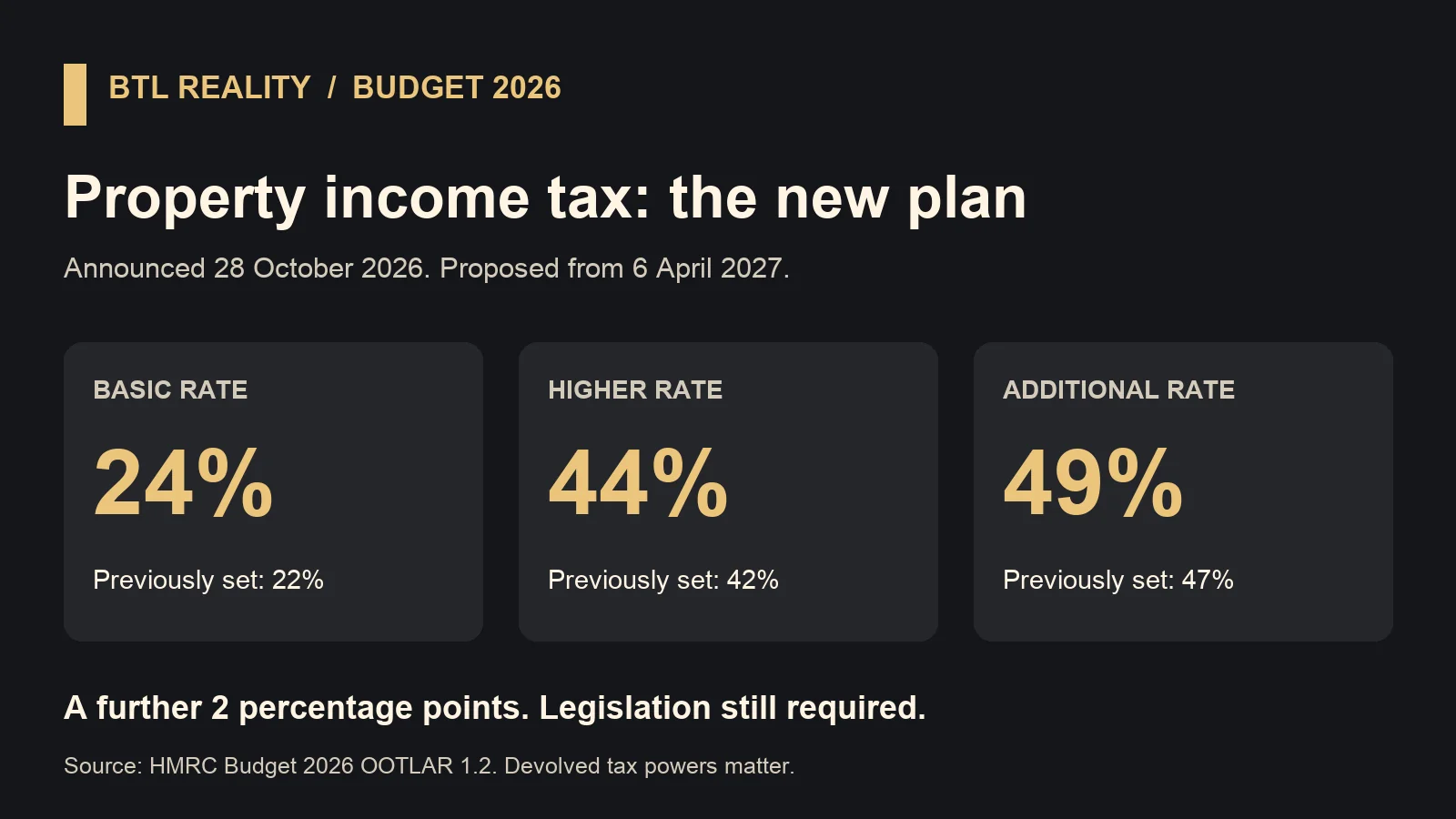
The Budget has announced another increase in the tax rates for property income. From 6 April 2027, the government plans rates of 24%, 44% and 49% in England, Wales and Northern Ireland. These replace the 22%, 42% and 47% already scheduled for that date. The new increase still needs legislation.
The practical job is to update your numbers without confusing next year’s proposal with the tax rules applying now. I would start with the property’s taxable profit, the owner’s wider income and the assumptions already sitting in the forecast. Applying a headline percentage to the rent landing in your bank account will not give you a reliable answer.
What has changed in Budget 2026?
The Treasury’s tax legislation overview, section 1.2, confirms a further two percentage point increase across the property basic, higher and additional rates. It proposes to introduce this through Finance Bill 2026–27, taking effect from 6 April 2027.
This is a fresh increase. Finance Act 2026, section 7, already sets the lower set of property rates for 2027–28. Today’s announcement would increase those again. A forecast prepared after the previous Budget may therefore already include part of the change, but still need adjusting.
| Rate | 2026–27 current rates | 2027–28 already legislated | 2027–28 announced today |
|---|---|---|---|
| Basic | 20% | 22% | 24% |
| Higher | 40% | 42% | 44% |
| Additional | 45% | 47% | 49% |
Current figures follow the government’s 2026–27 rates guidance. The announced rates are two percentage points above the previous plan and four points above the current rates. Those are changes in the rate, not a statement that every landlord’s tax bill will rise by the same percentage.
When would landlords actually be affected?
The proposed start is the 2027–28 tax year. The announcement does not put the new rates into your 2026–27 calculation or create an extra payment tomorrow. Keep the date beside every forecast column so that a future assumption does not quietly overwrite the current-year calculation.
The Budget document’s property taxation section specifies England, Wales and Northern Ireland. Scotland needs separate consideration, and the documents also describe devolved powers. Cross-border circumstances should be assessed properly rather than decided from the location of one rental property.
The owner’s tax residence and taxpayer status matter. In particular, a Scottish taxpayer with an English rental should not automatically use this table. Have the interaction with Scottish rates, or Welsh devolved rules where relevant, checked for the owner. The statutory framework distinguishes these positions. This article does not resolve a cross-border calculation.
This is an Income Tax announcement about property income. It is not a new Corporation Tax rate for a property company. If you own through a company, the company’s profit and any money you take out personally need their own calculation.
The planned Finance Bill matters too. The Treasury has announced what it intends to legislate. The final rules and any amendments must still be checked. For budgeting, I would show the announced position clearly while keeping the current and already legislated positions available for comparison.
A checked example using £12,000 taxable profit
Take a hypothetical individual landlord with an unfinanced rental property producing £12,000 of taxable profit after allowable operating expenses. Assume no mortgage interest, no unused Personal Allowance and that the whole £12,000 falls within one rate band. Keep the profit unchanged between comparisons. This isolates the rate change and is not a complete personal tax return.
| Assumed band | Tax at current rate | Tax under previous 2027 plan | Tax under Budget 2026 plan |
|---|---|---|---|
| Basic | £2,400 | £2,640 | £2,880 |
| Higher | £4,800 | £5,040 | £5,280 |
| Additional | £5,400 | £5,640 | £5,880 |
In each row, today’s extra two percentage points add £240 a year compared with the previous plan: £12,000 × 2% = £240. That is £20 a month less retained profit under these assumptions. Against the current rates, the total planned increase is £480 a year, or £40 a month.
For the higher-rate row, retained profit would be £7,200 at the current rate, £6,960 under the previous plan and £6,720 under today’s announcement. Do not add the £240 and £480 together. They compare the same new position against two different starting points.
A real owner may have profit spanning bands, allowances, losses or other adjustments. Another year’s profit may also differ. The example shows the rate effect on a fixed taxable amount; it does not estimate your property’s final tax bill or assume every landlord has the same exposure.
Mortgage finance costs need a separate calculation
A mortgaged individual landlord should not simply take cash left after interest and multiply it by the new rate. The restriction on residential finance-cost deductions can make taxable profit different from cash surplus. Our guide to making a cash loss while still paying tax explains that distinction.
Do not carry a flat 20% finance-cost relief assumption into a 2027–28 model either. Finance Act 2026, Schedule 1 paragraph 40, links the relevant reducer rate to the property basic rate. Section 6 provides the 2027–28 commencement. The announced 24% property basic rate would therefore feed into that calculation if implemented, subject to the existing limits and final legislation.
That does not mean every pound of interest automatically receives a 24% reduction. Ask for the calculation to show the restricted finance costs, the permitted reducer and any limits separately. This is why the worked example above excludes borrowing rather than pretending one simple uplift describes every leveraged portfolio.
Update the forecast in the right order
Start with the ownership structure and the actual records. Reconcile rent received, allowable operating expenses and the separate loan payments. Then establish taxable profit using the correct treatment of those costs. A property’s bank balance is useful evidence, but it is not the tax calculation.
Our buy-to-let deal calculator helps organise the purchase and operating numbers. Keep the personal tax calculation alongside it. Do not assume a calculator has incorporated a Budget change unless its stated assumptions confirm that.
For a portfolio, keep the individual property records and the owner’s overall calculation connected. There is no fresh Personal Allowance for each additional rental. Looking at one flat in isolation can hide the effect of the wider income position. Ask the accountant to reconcile the forecast with the ownership records and other income, then return a figure you can trace back to those inputs. Keep business cash movements, personal drawings and the tax provision identifiable so that an apparent bank surplus does not become the spending budget.
Next, add three dated tax columns: the current-year position, the previous 2027 plan and today’s announced 2027 position. This makes it clear whether your existing reserve already allowed for the earlier increase. It also stops the same increase being counted twice.
Ask your accountant to consider the property’s profit alongside salary, pensions and other relevant income. A rate-band label used last year may not describe next year’s circumstances. Give them a supported forecast rather than a guessed percentage of gross rent.
Finally, put the resulting tax provision into the cash plan beside maintenance, voids and mortgage commitments. Cash earmarked for tax is not money available for a refurbishment or the deposit on another property. Review the timing of actual payments with the adviser rather than assuming the effective date is the payment deadline.
A tax increase does not settle the property decision
I would avoid turning one announcement into an instruction to sell, incorporate or increase the rent. Each action has its own costs, legal requirements and commercial consequences. Establish the changed annual exposure first, then compare realistic options.
Putting an existing personally owned property into a company is not a free administrative switch. Our company versus personal-name guide provides useful background, but an existing owner’s transfer needs a current, individual assessment.
Nor does a tax cost establish what a tenant can afford or what the local market will support. Keep rent-setting and the relevant legal process separate from the tax provision. An extra £20 of rent is not automatically £20 of additional money after tax.
The next useful checks are the Finance Bill wording, the confirmed rates and the way they apply to your circumstances. Keep a record of the assumptions you change. A free initial strategy call can help organise the wider investment decision; your accountant should confirm the personal tax treatment.
Frequently asked questions
Are the 24%, 44% and 49% rates already law?
No. They were announced at Budget 2026 on 28 October, with legislation planned through Finance Bill 2026–27. The intended start is 6 April 2027.
Were rental income tax rates not already due to increase?
Yes. The previously legislated 2027–28 rates were 22%, 42% and 47%. Today’s announcement adds a further two percentage points to each.
Should I multiply my gross rent by the new tax rate?
No. Start with the taxable profit calculation, allowances and applicable bands. Expenses and finance-cost treatment can make gross rent, taxable profit and cash surplus very different figures.
Does the announcement change Corporation Tax for my property company?
These are personal Income Tax rates for property income. A company’s tax and the tax on money extracted from it require a separate assessment.
Can I leave mortgage-interest relief at 20% in my 2027 forecast?
That would miss the statutory link to the property basic rate from 2027–28. Have the permitted reducer and its limits calculated alongside the announced rate change.
How much extra cash should I allow for the new announcement?
Calculate it from your own taxable profit and circumstances. In our unfinanced, single-band £12,000 example, today’s addition is £240 a year above the previous 2027 plan. It is not a universal reserve figure.