NRL1 Form: How Overseas Landlords Apply to Receive Rent Gross
October 20, 2026
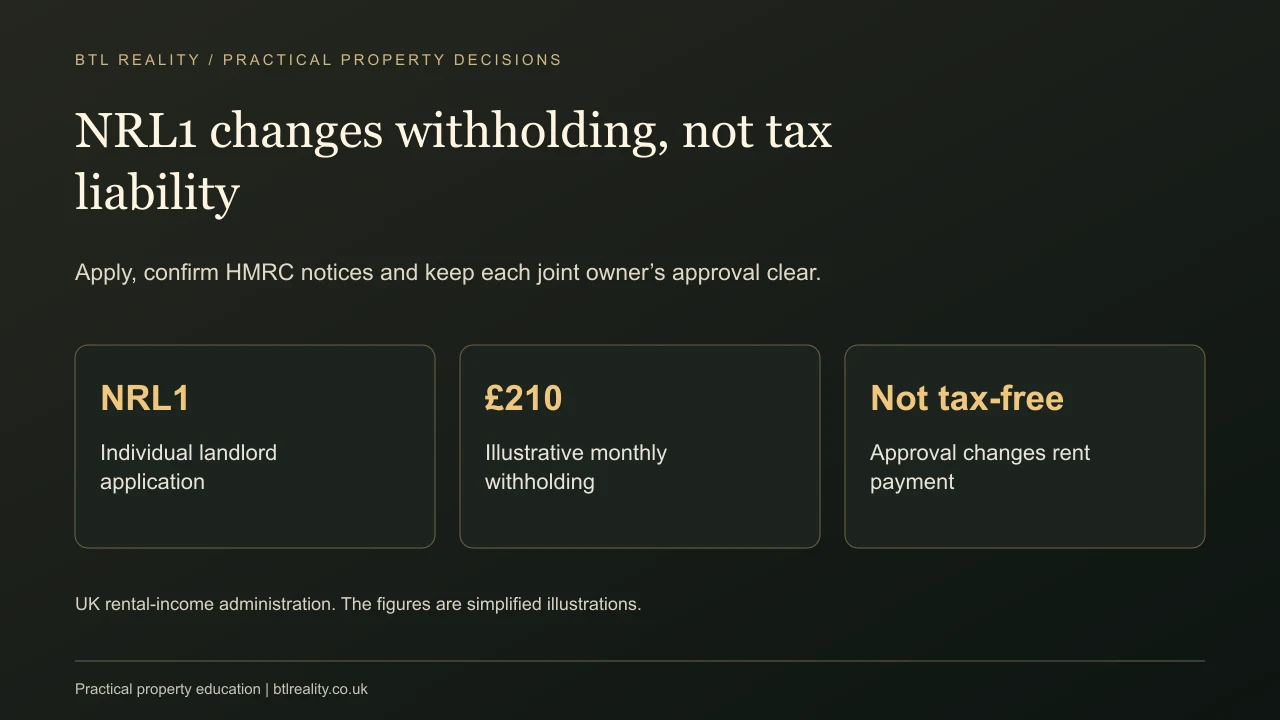
Form NRL1 lets an individual overseas landlord apply for UK rental income to be paid without tax being deducted under the Non-resident Landlords Scheme. Approval changes how rent is paid. It does not make the rental income tax-free.
The practical task is to get the correct application and HMRC notices in place, then keep rental records and tax arrangements organised. This matters whether you live in Dubai, Europe or elsewhere. It concerns UK property income, rather than a special tax exemption for one destination.
Check whether the scheme applies to you
HMRC’s explanation of the Non-resident Landlords Scheme uses the landlord’s usual place of abode. That is not always the same as residence for tax purposes. HMRC normally regards an absence of six months or more as indicating an overseas usual place of abode.
Do not assume a UK passport, UK bank account or continuing UK tax residence removes the scheme. Equally, assess your actual circumstances rather than treating every short overseas trip as a change. Tell your accountant and letting agent about the move and its timing.
NRL1 is for individuals. HMRC’s application guidance identifies NRL2 for companies and NRL3 for trustees. A property company and its overseas director are different persons. The correct form follows the landlord receiving the income, not simply whoever completes the paperwork.
What happens without gross-payment approval?
The person handling rent may need to deduct basic-rate tax under the scheme. HMRC’s agent and tenant guidance distinguishes a letting agent, which generally operates the scheme regardless of rent level, from a tenant paying an overseas landlord directly, where the £100-a-week threshold is relevant.
The scheme calculation allows relevant deductible expenses actually paid by the agent or tenant. It is not simply your annual tax return completed every month, and it does not necessarily equal your final tax liability.
That distinction matters for cash flow. If withholding leaves too little cash to pay the mortgage, the mortgage payment does not wait for your annual tax position to be settled. Plan the arrangement before relying on the full rent arriving in your bank account.
A simple withholding example
Assume an agent collects £1,200 a month and pays £150 of allowable expenses for the landlord. For this simplified illustration, assume no other payments affect the scheme calculation and the basic rate used is 20%.
| Item | Without gross-payment approval | With applicable approval |
|---|---|---|
| Rent collected | £1,200 | £1,200 |
| Expenses paid by agent | £150 | £150 |
| Amount after those expenses | £1,050 | £1,050 |
| Scheme tax deduction at 20% | £210 | £0 |
| Cash remitted to landlord | £840 | £1,050 |
The £210 difference is a change in withholding, not a £210 tax saving. Over twelve identical months it is £2,520 of different cash timing. Once rent is paid gross, you still need an appropriate reserve for the tax ultimately due.
Use the buy-to-let deal calculator to assess the property’s operating figures. Keep the scheme deduction and your eventual tax provision separate so that you neither omit both nor count the same tax twice.
Prepare the information before applying
Use HMRC’s current NRL1 application page. It explains the online route and the print-and-post alternative, including the separate process where you want to authorise a tax agent.
Gather your residential and correspondence details, any known UTR, National Insurance number if you have one, property details and the relevant agent or tenant information. Read the form’s notes rather than guessing what a field means. Keep the name and reference of the rent-handling agent consistent with its records.
Save a copy of what you submit and the submission evidence. Record when the application was made, the income it concerns and who was named to receive rent-payment authorisation. That makes a later query much easier to resolve.
Submission and approval are different stages
Sending an application does not itself tell the agent to stop deducting tax. HMRC issues an approval notice and separately notifies the named agent or tenant. Check the effective date on the notice and make sure the rent handler has the authority relevant to that landlord.
Do not promise a particular turnaround time to a tenant, lender or contractor. Budget for the existing lawful payment arrangement until approval is confirmed. If an application is incomplete or HMRC asks for more information, respond through the stated process and keep the correspondence.
Once the notice arrives, reconcile the first affected statement. Ask the agent to explain any adjustment instead of treating an unexpectedly high remittance as new rental profit. The correct treatment depends on the notice’s effective date and the scheme records.
Joint owners need individual attention
HMRC treats spouses or civil partners who jointly own a UK property and both have an overseas usual place of abode as separate landlords for the scheme. Each needs an application if each wants their share paid without deduction. One person’s notice does not automatically authorise gross payment to the other.
Tell the agent the ownership and income-allocation details supported by your records and advice. Do not assume that the bank account receiving rent establishes who is entitled to it. Tax ownership and income allocation deserve their own assessment where the position is not straightforward.
For a simple agreed equal split of the example, each owner’s after-expense amount is £525. If only one has applicable approval, the other owner’s illustrative 20% deduction is £105. The agent needs enough information to treat each share correctly.
What if you change letting agent?
Include the NRL position in the handover checklist. Give the new agent the correct landlord details and ask what HMRC notification it needs. A notice addressed to a previous agent should not be treated casually as universal permission for anyone to pay the rent gross.
Reconcile the final statement from the outgoing agent with the first statement from the new one. Record who collected each rent payment, which expenses were paid and what deductions were made. Preserve any annual certificates and reports received.
The overseas property-management guide helps organise the wider handover. Mortgage permission, repair authority, tenant communication and tax administration should all have a named person responsible.
Gross rent still needs a tax plan
Ask your tax adviser what UK returns, payments and records your circumstances require. Approval to receive gross rent is not a calculation of the final bill. Personal allowances, other income, ownership and finance-cost treatment can affect the outcome.
A useful bank-account routine is to separate operating cash, repairs reserves and the amount reserved for tax. The exact provision should come from the expected tax position, not an assumption that the scheme’s withholding rate describes your overall effective rate.
If you live in Dubai, the Dubai landlord tax overview covers the wider UK rental-income question. This NRL1 process is narrower: establishing who can pay the rent gross and from what date.
Do not confuse a tax agent with a letting agent
The letting agent collects or manages rent. A tax agent deals with HMRC under the appropriate authority. They may be different businesses, and appointing one does not automatically appoint the other. Make clear who receives approval correspondence and who actually changes the rent-payment treatment.
Ask both to confirm their responsibilities in writing. The landlord should still retain the notices and statements, rather than assuming all records sit in somebody else’s system. That is especially useful if an accountant or property manager changes while you are overseas.
Keep the arrangement current
Review the records when you move, return to the UK, acquire another rental, change ownership or appoint a different agent. Tell the adviser about changes promptly. An old approval notice is not a reason to ignore a new circumstance or an HMRC information request.
Keep a short control sheet showing each owner, property, rent handler, application reference, approval status and effective date. Put the actual notice beside it. That single record prevents a verbal “we are registered” from being mistaken for verified approval covering every owner and every payment.
Questions about NRL1
Does NRL1 approval mean my rental income is tax-free?
No. It allows applicable rent to be paid without tax deducted under the scheme. Your final UK tax liability and any return obligations are separate. Keep records and reserve money for the expected bill.
Can I apply before leaving the UK?
HMRC’s application guidance allows eligible landlords to apply before leaving or before letting starts. Use the current form and give accurate expected details. Receiving approval and checking its effective date remain separate steps.
Do joint owners need separate NRL1 applications?
Where both are individual non-resident landlords and want gross payment, each needs their own approval. The agent must apply authorisation to the named person’s share rather than assuming one notice covers the whole property.
Can my agent stop deducting tax as soon as I apply?
Submission alone is not the authorisation. The agent needs the applicable HMRC notice and effective date. Keep enough cash to meet the property’s commitments while the application is being considered.
Is NRL1 the right form for my limited company?
No. HMRC identifies a separate NRL2 route for company landlords. Do not use an individual director’s application as permission for a company’s rent. Confirm the actual landlord and relevant company tax arrangements.
Does having a UK bank account remove the scheme?
No. The scheme concerns the landlord’s usual place of abode and UK rental income. The location of the receiving bank account does not by itself determine whether rent should be paid gross.