Is £1 Million in Property Enough to Retire On?
October 4, 2026
A £1 million property portfolio might support retirement, but its headline value cannot answer the question. You need to know the mortgage debt, realistic net rent, tax, future repair needs and the amount your lifestyle requires. £1 million of houses is very different from £1 million of accessible money.
I would start with the income you want to spend, then work back to the assets and debts supporting it. A smaller, better-funded portfolio can provide more usable income than a larger, heavily borrowed one. The practical question is what reaches your household after every obligation has been allowed for.
Property value, equity and cash are different
Gross property value is what the properties might sell for before selling costs. Equity is that value less the secured debt. Accessible cash is money you can actually use without another transaction or someone else's approval.
If properties are worth £1 million and mortgages total £750,000, gross equity is £250,000. That is before possible selling fees, early repayment charges and tax. It is not a £250,000 bank balance, nor does it tell you the monthly rental profit.
This is one reason I distinguish building wealth from spending it. The route discussed in building a £1 million property portfolio is an accumulation exercise. Retirement requires a second exercise: checking how the portfolio funds your life while remaining financially workable.
Compare three versions of the same portfolio
Take a deliberately simplified portfolio worth £1 million. Assume scheduled rent of £70,000 a year and £21,000 of annual operating allowances. Those allowances collectively cover management, repairs, insurance, empty periods and other recurring costs. The operating surplus before finance and tax is £49,000.
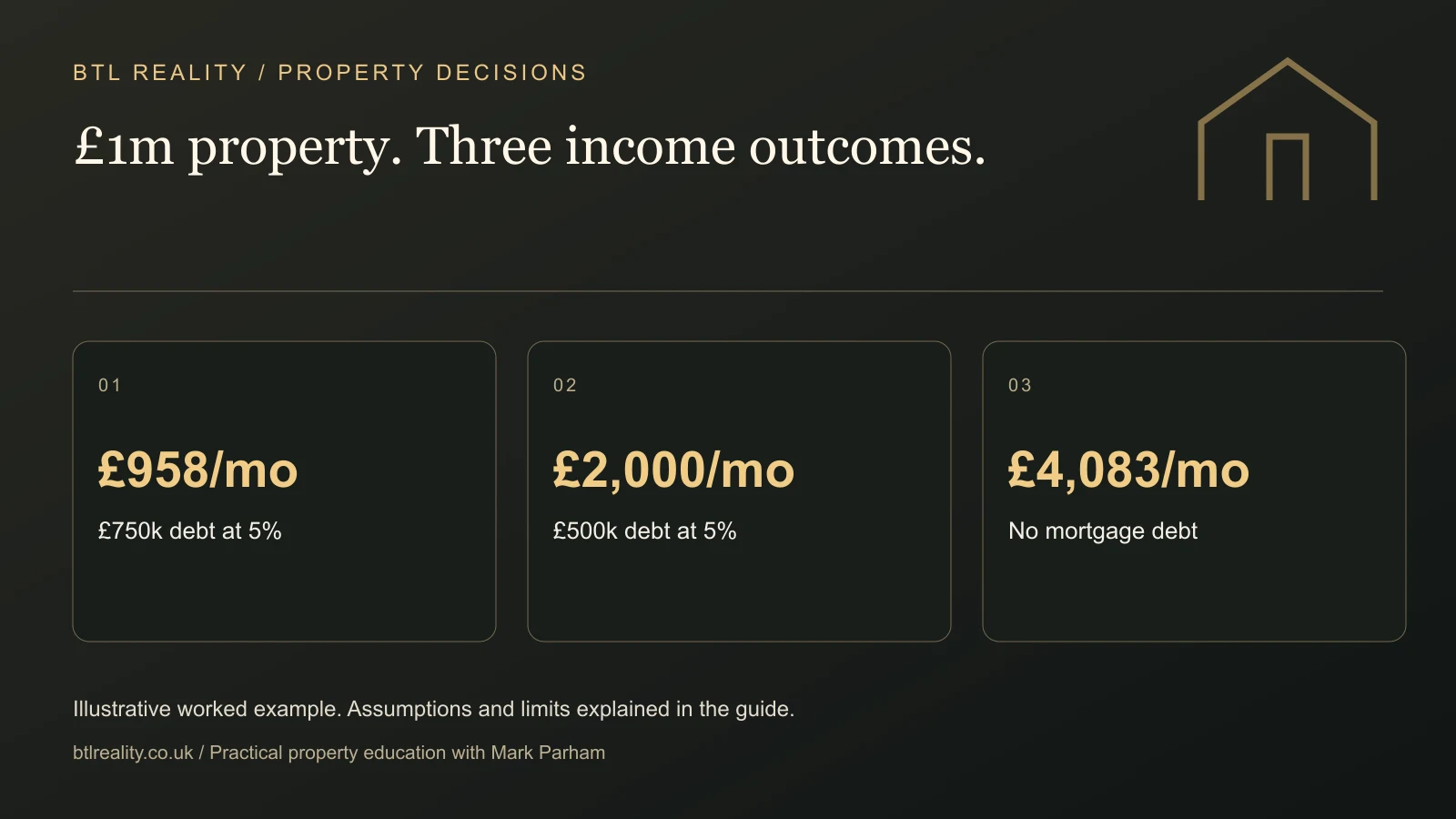
At a 5% interest-only borrowing cost, £750,000 of debt costs £37,500 a year. That leaves £11,500 before tax, approximately £958 a month. Equity is £250,000.
With £500,000 of debt, annual interest falls to £25,000. The surplus becomes £24,000 before tax, or £2,000 a month. Equity is £500,000.
With no mortgage debt, the same assumed rental operation produces £49,000 before tax, approximately £4,083 a month. Equity equals the gross property value before disposal costs. These are illustrative numbers, not current market yields or promised outcomes.
Monthly cashflow before tax, same £1m property value
Make the example your own
Same £1m portfolio, different debt
Move the debt slider to see how leverage affects equity and pre-tax rental cashflow. Annual rent £70,000; operating costs £21,000.
Interest-only model. No tax, capital repayment or exceptional capital works included. Illustrative only. Inputs stay in this page and are not saved or sent.
The mortgage rate can change the answer quickly
In the £750,000 debt example, a rise from 5% to 6% adds £7,500 of annual interest. The £11,500 pre-tax surplus falls to £4,000, approximately £333 a month. A one-percentage-point change has reduced that surplus by about 65%.
That is the effect of leverage on the income left over after costs. The properties do not need to fall in value for your lifestyle budget to become uncomfortable. Equally, a lower borrowing cost can improve the position, but I would not make a retirement commitment that requires the favourable case.
Use the mortgage stress calculator to test higher rates. Check when each actual mortgage deal ends rather than applying one average rate indefinitely. Also identify how the capital will be repaid when an interest-only loan reaches maturity.
Convert the surplus into a household spending figure
Pre-tax cashflow is not take-home income. Personal ownership and company ownership can produce different tax and extraction outcomes. Other income, allowable costs, finance-cost treatment and future changes also matter.
Ask your accountant to estimate what is genuinely available to you under your ownership structure. If the properties are in a company, the company receiving rent does not make all that cash yours to spend. If you own them personally, simply applying your marginal tax rate to the cash surplus may also be wrong.
For a first planning pass, show tax as a separate allowance rather than pretending it is zero. Mark the result as provisional until checked. The government's rental-income tax guidance is a starting point for understanding why income, deductible expenses and finance costs need separate treatment.
Match the income to the life you want
Our monthly financial freedom guide uses different lifestyle budgets to make the target concrete. The useful figure is your own budget, including housing, travel, transport, family costs, irregular spending and a margin for change.
If you want £4,000 a month after tax, the mortgage-free example does not automatically achieve it. Its £4,083 monthly figure is before tax and could still be affected by costs outside the assumed allowances. The leveraged versions plainly produce much less spendable income under these assumptions.
Other income can close the gap. A pension, part-time work or investment withdrawals may form part of the household plan. Record each separately, with its access date and uncertainty. A future pension cannot pay a bill due before you can access it.
Keep repair money separate from lifestyle money
An annual maintenance allowance smooths the forecast but does not smooth the timing of a roof replacement. You might receive modest monthly rent and face a large invoice in one week. That needs liquid reserves.
Avoid counting the same reserve twice. If £20,000 is allocated to property repairs and vacancies, it cannot simultaneously be the household's full emergency fund. Decide what each pot is for and what would cause you to rebuild it before increasing spending.
A practical income policy might set a regular household transfer below the expected average surplus, retain a property reserve, and review the position periodically. This gives you a mechanism for handling irregular costs rather than relying on a perfect year every year.
What about growth and refinancing?
Capital growth can increase wealth without increasing the cash available this month. To spend some of that equity, you generally need to sell, refinance or use another arrangement, each with its own costs and constraints.
Refinancing releases borrowed money. It also increases debt and usually changes interest costs. If you spend the release on your lifestyle, the money no longer remains available to buy another property. Counting it in both places makes a model look much stronger than it is.
The Financial Freedom Calculator lets you compare rent-only funding with a route that can include capital releases. Treat the second route as conditional on future lending and valuations. A rising value line is not an income guarantee.
Test three uncomfortable years before trusting the plan
First, test a year with lower rent receipts and an unexpectedly large repair. Does the reserve cover the gap without disrupting essential spending? If not, either the spending target, reserve or portfolio needs attention.
Second, test a mortgage reset at a higher rate. Check whether the income remains adequate and whether the borrowing remains feasible. Third, test a period when refinancing is unavailable. A plan that still pays the bills has different characteristics from one that requires a fresh loan every two years.
You do not need to assume every problem occurs permanently. You do need to understand which problems your plan can absorb, what action you would take and whether that action is realistic while you are relying on the portfolio for income.
The retirement number I would track
Track dependable household income, available reserves, property debt and the gap against your spending target. Keep gross property value on the dashboard, but do not let it become the only measure of success.
Run your own position through the free Financial Freedom Calculator and compare the funding choices. The personalised report can help organise your assumptions. For a more involved strategy discussion, Private Mentorship explains the application requirements and scope of support.
£1 million can be a meaningful milestone. Financial freedom is reached when the whole plan supports the life you want, with room for the parts that rarely go perfectly. That is a more useful ambition than owning an impressive number that cannot comfortably pay your bills.
Frequently asked questions
How much monthly income can a £1 million rental portfolio produce?
There is no single reliable figure. Our illustration ranges from about £958 to £4,083 a month before tax solely by changing debt, with rent and operating costs held constant. Actual property type, expenses, vacancies, interest and ownership can change the result substantially. Start from your portfolio's verified income and costs.
Does a £1 million property portfolio make me a millionaire?
It establishes a gross asset value, not necessarily net wealth. Subtract mortgage debt and other liabilities when calculating net worth, and recognise potential disposal costs separately. A portfolio worth £1 million with £750,000 of debt contains £250,000 of gross property equity. Other assets and debts also affect the household's overall position.
Can I retire with £1 million in property and a mortgage?
Possibly, if the complete income plan supports your spending and obligations. The mortgage's size, rate, term and repayment plan matter more than its mere existence. Test higher rates, irregular costs and periods without refinancing. Retirement readiness also depends on reserves, other income, tax and how much flexibility your household has.
Should I pay off my buy-to-let mortgages before retiring?
Reducing debt can improve rental cashflow and reduce interest-rate exposure, but it uses capital that might otherwise remain liquid or serve another purpose. Compare both positions after costs and tax, including your emergency reserves. The right decision is personal; the calculator can organise scenarios but cannot choose a mortgage or investment strategy for you.
Is property equity the same as retirement income?
No. Equity is an ownership value after debt, while income is money available over time. Accessing equity may require selling or borrowing, with costs and conditions. A retirement plan should distinguish recurring net rent, investment withdrawals, pension income and loan proceeds rather than presenting them as one interchangeable stream of profit.
How do I check whether my property income can keep up with inflation?
Increase your spending assumption over time and separately model achievable rent and cost changes. Do not assume they all rise at the same rate. Mortgage resets, large repairs and tax can also affect the gap. Review the plan periodically using actual results, rather than trusting a fixed growth assumption indefinitely.
Put the next step into practice
Use the free tools to test your numbers, then choose the level of support that fits your next decision.