Leaseholder Protections: The Six-Property Proposal Explained
October 28, 2026
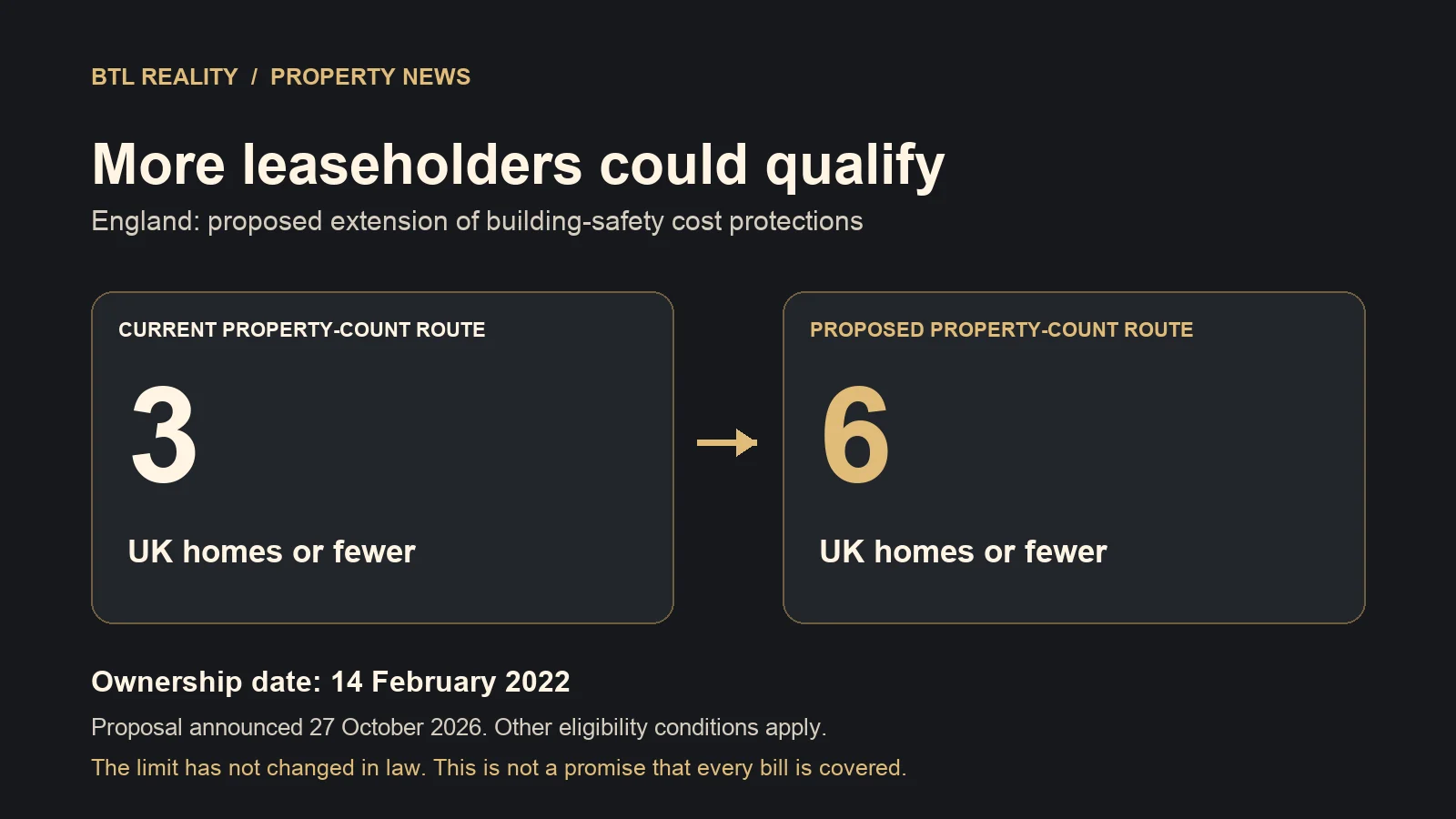
The government plans to extend non-cladding building-safety cost protections in England to some people who owned four to six properties on 14 February 2022. The 27 October announcement is a proposal. Eligibility details and commencement are still to come.
That could matter to a landlord whose flat missed the existing ownership test. But I would keep two files: the position that applies to the lease now, and the possible benefit of a future change. A promise of wider protection is worth following. It is not yet a replacement for the legal assessment behind a purchase or a disputed demand.
What is proposed, and what remains unsettled?
In the Commons debate, ministers committed to amendments raising the ownership limit from three to six. Separately, government promises funding towards internal high-risk, high-cost fire-safety defects in collectively owned and enfranchised buildings. It is also exploring help for later buyers whose only or main home inherited an unprotected lease. These are different gaps, with details to follow through the Remediation of Unsafe Cladding Bill or alongside it.
Do not combine those announcements into one automatic entitlement. A portfolio landlord, a resident-owned block and a later owner-occupier may need different answers. The eventual wording, evidence requirements and start arrangements will determine how a particular property is treated.
The Commons agreed second reading on 27 October, with committee scrutiny still ahead. That stage does not make the announced extension law.
For someone considering a flat, the useful response is to identify which problem the proposal might address. Is the obstacle the former owner’s property count, the building’s ownership structure or the nature of the work? Without that diagnosis, “more leaseholders protected” tells you very little about the exposure you are taking on.
Start with the lease’s position under current law
Section 119 of the Building Safety Act 2022 uses circumstances at the start of 14 February 2022. The ownership route currently allows no more than three UK dwellings in total, including the flat. A separate route covers an only or principal home. The original lease must have been granted for more than 21 years, before that date, with service-charge liability. This concerns the original term, not years remaining.
Check the building separately. The government’s relevant-building guidance requires at least 11 metres in height or at least five storeys, at least two dwellings and no leaseholder-ownership exclusion. These current statutory tests are not published eligibility rules for the proposed collective funding. Portfolio size alone cannot answer whether the statutory protections apply.
I would ask the conveyancer for a written explanation identifying the route relied on, the supporting evidence and any unresolved issue. A statement that a seller “should be covered” needs turning into something more specific before it supports a buying decision.
Four hypothetical ownership cases
The table isolates the ownership question. Assume individual ownership in an eligible English building, with all other lease and defect conditions met and no unusual ownership arrangements. It does not determine any bill or promise eligibility under legislation that has not been finalised.
| Hypothetical position | Current ownership test | Next question |
|---|---|---|
| Four UK dwellings, including a let flat | Let flat fails the property-count route. | Potentially within the planned extension; await final conditions. |
| Six UK dwellings, including a let flat | Let flat fails the property-count route. | Same proposed opportunity, without a present guarantee. |
| Seven UK dwellings, including the owner’s principal home | Main home can use its separate route; let flats fail the count route. | Do not confuse a principal-home route with protection for the whole portfolio. |
| A 2025 buyer makes a previously unprotected flat their only home | Moving in does not reset the historical qualifying test. | The later-buyer gap is being explored separately. |
The first two cases explain why a small portfolio owner should pay attention. The third shows why counting rental properties alone can mislead. The fourth is a different purchase problem, which cannot be solved simply by looking at the buyer’s present circumstances.
Build the ownership history for the actual lease rather than choosing the nearest-looking row. Joint ownership, trusts and company-held interests need their own assessment. This table gives no answer about how those structures would be treated under the planned extension.
A later purchase does not start the eligibility clock again
Current qualifying-lease guidance says the lease’s protected or unprotected status passes to later buyers. A new owner’s intention to live there does not, by itself, turn a non-qualifying lease into a qualifying one.
That makes the seller’s evidence important even when you are buying your first home or first rental flat. Ask for the earlier ownership history and the documents supporting the stated status. If something is missing, establish who can obtain it and what remains uncertain.
A low asking price can reflect several unresolved issues at once. You might be offered a discount for uncertainty, but that does not tell you the likely cost, timing or funding of the work. Keep those questions distinct when discussing the purchase with the solicitor, surveyor and lender.
Protection from a bill is different from every cost disappearing
The current remediation-cost guidance distinguishes cladding from non-cladding work. Qualifying leaseholders are protected from cladding-system remediation charges. Certain other costs can be prevented or limited under separate tests. Non-qualifying leases can also benefit where the developer test applies.
That is why I would ask for an itemised explanation of proposed work. Which items are historical safety remediation, which are ordinary maintenance, and what evidence supports the allocation? A document headed “major works” does not settle those questions.
Do not assume this news removes ordinary service charges or unrelated repairs. Our buy-to-let service-charge guide helps organise the recurring ownership budget. Keep recurring ownership costs apart from the cost and timing of safety work. A seller’s estimate does not settle the building-safety allocation.
For a proposed purchase, record the current evidenced exposure separately from any possible future relief. If the figures only work after assuming an unconfirmed saving, that dependency should be visible before exchange. Use the deal calculator to organise evidenced purchase costs and cash needs. It cannot determine legal liability or turn an unknown cost into zero.
Gather the documents that answer the actual question
The government’s certificate guidance explains the leaseholder deed of certificate and landlord’s certificate. These serve different purposes. A formal request for evidence should not be left unanswered while you wait for a policy change.
- Keep the lease, title details and available evidence of the relevant owner’s circumstances together.
- Obtain the certificates already issued, with the information used to prepare them.
- Request the defect reports, proposed scope, cost allocation and remediation programme available for the building.
- Identify any developer commitment or funding decision and exactly which work it covers.
- Put unresolved questions in writing, naming who is investigating each one and the next response date.
Keep a simple record of what each document establishes. An assessment identifying a defect is not a funding approval. A funding application is not an award. A proposed programme is not evidence that work has finished.
When several parties are involved, ask them to reconcile conflicting information. Do not let a sales email become the assumed answer to a point the legal paperwork leaves open. The aim is a usable account of the building’s position, rather than a large folder nobody has read.
What owners and buyers can do before the details arrive
An existing owner can map the affected flats, organise the evidence and ask advisers whether any current protection has been overlooked. Someone with an active demand should obtain advice on that demand and its deadlines. This announcement is not an instruction to stop paying or ignore correspondence.
A buyer can give the conveyancer a precise question: what protection applies on the evidence available today, and which part depends on a future change? Ask the broker to establish the lender’s position on the actual building and documents. Legal protection and mortgage acceptability need separate confirmation.
For a collectively owned block, establish who can coordinate the technical information and respond when funding details emerge. Do not assume there is already an open application, a confirmed award or a payment date.
The next useful development will be the detailed rules, eligibility and commencement arrangements. Until then, keep any potential benefit outside the committed purchase budget. That lets you recognise the significance of the proposal without spending a saving that has not been secured. A free initial strategy call can help organise the wider investment decision; the legal conclusion about an individual lease belongs with your conveyancer.
Frequently asked questions
Can I rely on the six-property limit today?
No. The announcement sets out a plan, with further details still to come. Obtain advice on the current position for your lease.
Does my own home count towards the property total?
The current test concerns total UK dwellings, including the flat being assessed. The only or principal-home route is separate. Check the statutory test against the ownership history.
Will selling properties now change the historical test?
It does not rewrite the ownership position on the qualifying date. Do not make a disposal solely on the assumption that it will retrospectively change another lease’s status.
Does a non-qualifying lease mean every safety bill is payable?
No. The current cost rules include protections that can apply beyond qualifying leases. Have the actual demand, defect and ownership evidence assessed.
Does funding for a collectively owned building mean an application is open?
The release does not provide an application process. Keep the building’s evidence ready and wait for the published scheme conditions rather than treating the promise as an award.
Should I exchange contracts expecting the proposal to cover the bill?
I would assess the purchase on the documented position first. Ask the conveyancer to explain unresolved exposure before making a commitment that relies on future relief.