How Much Should You Offer on a Buy-to-Let?
November 10, 2026
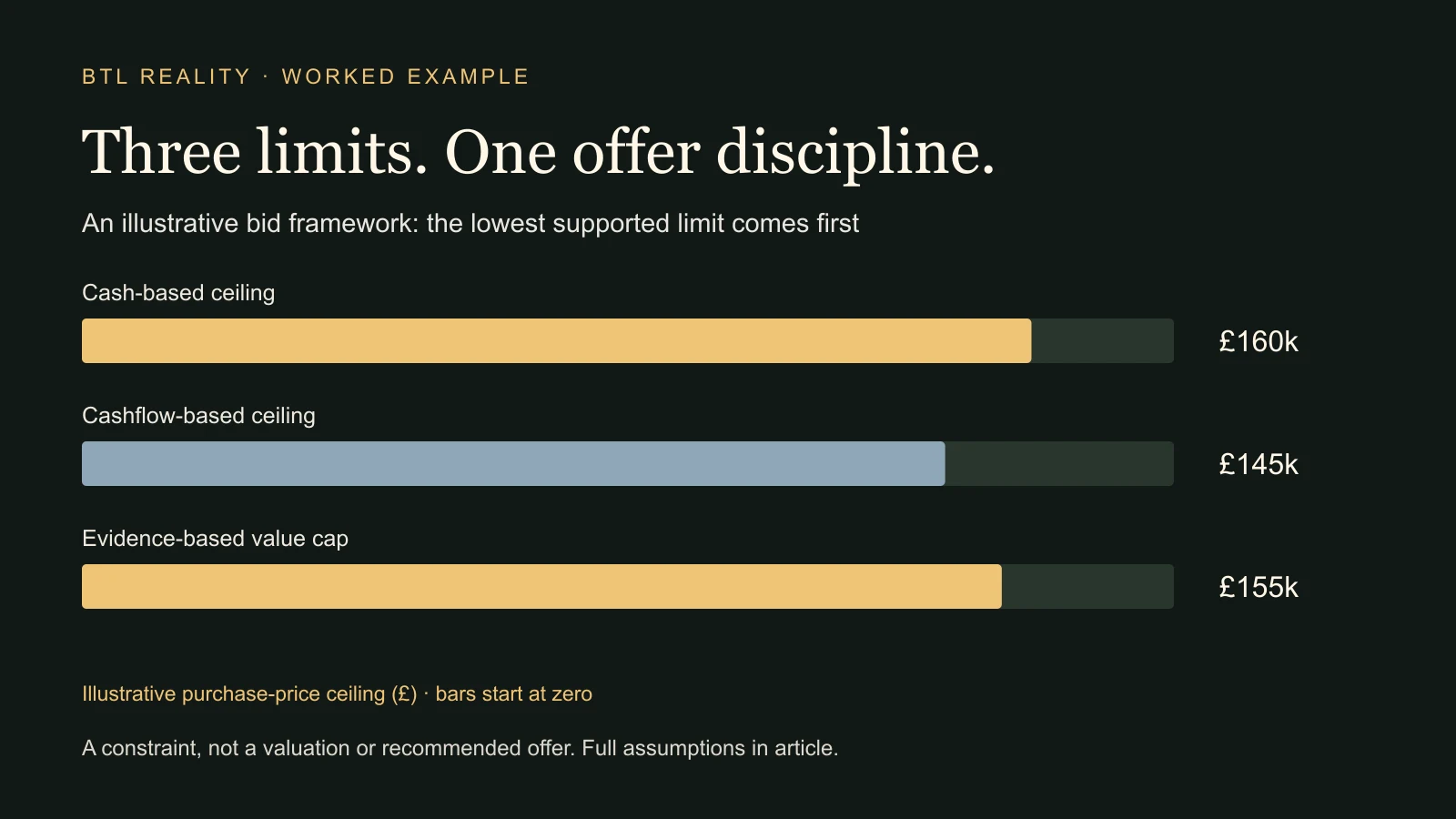
Your maximum offer on a buy-to-let should come from the investment's evidence and your financial limits, not a fixed percentage below the asking price. A £10,000 reduction can still leave a poor deal expensive. Paying close to asking price can be reasonable when the price, condition and rental evidence support it.
Work out three limits before negotiating: what the property is worth on reliable evidence, what your available cash can fund and what purchase price produces acceptable cashflow. Then account for repairs, uncertainty and the seller's circumstances. The lowest supported limit gives you a starting discipline, not an automatic instruction to buy.
Separate asking price from investment value
The asking price is a seller's marketing position. It may be realistic, ambitious or deliberately low to attract interest. It does not tell you what a lender will value the property at, what comparable homes have sold for or what return it can generate.
Use completed comparable sales, adjusting carefully for location, size, tenure and condition. An asking-price discount is only a negotiating statistic until you establish value. Our guide to sold comparables provides a framework for making those adjustments explicit rather than choosing the highest nearby figure.
Keep three numbers on the appraisal: asking price, evidenced value range and proposed offer. If the seller reduces from an unrealistic £200,000 to £180,000 while similar properties support £170,000, the reduction has not created a £20,000 bargain.
Establish achievable rent independently
Rental income drives the cashflow limit, so it deserves at least as much scrutiny as the asking price. Compare genuinely similar properties and speak to local letting agents about achieved rents, tenant demand and likely time to let. Record whether a figure is advertised, agreed or actually being collected.
For a tenanted property, inspect the tenancy and payment evidence through the appropriate process. Mark's rent-checking due-diligence example illustrates how misunderstanding a reported figure can change an appraisal. Seller income, rent and money left after costs are different things.
Do not increase assumed rent simply to make the offer work. If evidence supports £950, calculate at £950 and test a downside. A hoped-for future improvement can be a separate scenario, with the cost and feasibility of achieving it shown.
Work backwards from the cashflow you require
Assume an illustrative £1,000 monthly rent, 25% operating and ordinary void allowance, £100 additional fixed costs and a £150 target monthly surplus before tax. That leaves £500 a month available for interest: £1,000 less £250, £100 and £150.
At 5.5% interest, £500 monthly supports approximately £109,091 of interest-only debt. At 75% borrowing against the purchase price, that implies a price around £145,455. A higher price would reduce the target surplus unless another assumption changes.
This is a cashflow-derived limit, not a valuation or a lender's maximum offer. It excludes tax and any costs not entered. The property may be worth less, the lender may offer less debt, or the required deposit and fees may exceed your cash.
Calculate the cash limit separately
Suppose you have £55,000 available and reserve £15,000 for taxes, fees, works and retained liquidity. That leaves £40,000 towards the purchase price. With a 25% contribution, the theoretical cash limit is £160,000.
In this example the £145,455 cashflow limit is lower than the £160,000 cash limit. Being able to fund a higher price does not mean it meets the return objective. Likewise, a property can meet a monthly target yet require more upfront cash than you possess.
Costs linked to the purchase price need recalculating when your proposed bid changes. A fixed allowance is convenient for a first pass but can become inaccurate across stamp-duty bands, percentage fees or a different financing structure.
Use the maximum-offer worksheet
Enter your cash, non-price allowance, rent, running costs, desired surplus, interest rate and proposed loan-to-value. The worksheet compares the two mechanical ceilings and lets you add an independently supported value cap.
Compare your three offer constraints
Interest-only illustration, before tax. Costs and reserve must be recalculated for the proposed price. Value cap requires independent evidence. No mortgage approval is implied.
Calculations stay in your browser. Nothing you enter is saved or sent.
The output is not personalised advice or an approval to borrow. It assumes interest-only borrowing at the entered rate and LTV, with mortgage funds available as planned. It cannot assess property defects, legal restrictions, personal eligibility or a lender's rental-coverage criteria.
Use the full buy-to-let deal calculator for the complete purchase appraisal and the mortgage stress calculator to examine borrowing pressure. A maximum-offer number should sit inside that wider assessment.
Price known work and unknowns differently
Known work should have a scope and quotation, including VAT where applicable and related making-good costs. If the roof needs attention, a vague £2,000 entry is not evidence merely because it makes the purchase fit your budget.
Unknowns need investigation and an appropriate contingency. Some uncertainties cannot sensibly be solved by adding a small allowance. A title issue, structural concern or restriction on intended use may change whether you can proceed at all. Obtain professional advice before treating it as a simple negotiation point.
Include the time before the property can produce rent. A £10,000 refurbishment taking several months has more consequences than its contractor bill. Financing, insurance, utilities and delayed rent can all affect the maximum price you should consider.
Leave room for being wrong
A deal that works only at the highest rent, lowest quote and most generous valuation is fragile. Test at least one less favourable combination. Lower the rent, raise the interest rate and increase repair spending without assuming growth rescues the result.
For the worked example, interest increasing from 5.5% to 7% reduces the debt supported by £500 monthly interest to roughly £85,714. At 75% LTV that is a £114,286 cashflow-derived price ceiling. This is a sensitivity, not a prediction that rates will reach 7%.
You do not necessarily have to buy at the stressed ceiling. You do need to understand the cash support and reserve the higher-price deal could require. A planned risk is different from a surprise created by ignoring the scenario.
Turn the appraisal into a credible offer
Explain the offer in terms of evidence: comparable transactions, identified work, funding readiness and your ability to proceed. Keep the explanation concise and factual. A seller is more likely to understand a clear reason than an arbitrary demand for a discount because you are an investor.
Ask the agent about the seller's priorities and timetable. Flexibility on timing or a straightforward chain position may matter, but do not promise speed or certainty your finance and legal work cannot support. Your solicitor should confirm the implications of any unusual arrangement.
Set an initial offer, a negotiation range and an absolute stopping point before the conversation becomes competitive. Do not repeatedly move the stopping point simply because you have spent time on the property. Sunk viewing and survey effort does not improve future returns.
Recheck the deal after an accepted offer
Acceptance is the start of verification, not proof the appraisal was correct. Review the survey, legal information, mortgage valuation and contractor evidence. If new facts materially change the numbers, update the decision before committing further.
A lower valuation may reduce the mortgage and increase cash required. A repair may change both spending and the letting date. Our refinance calculator shows the later refinancing version of this problem; the same habit of separating value from available cash is useful at purchase.
Keep an audit trail of the assumptions and why they changed. It helps you make a reasoned decision and gives your advisers a clear picture, rather than a spreadsheet that silently changes until it reaches the answer you want.
Get the brief right before finding the property
Your maximum offer depends on what the investment needs to achieve. An investor seeking current income may reject a deal another investor accepts for a different long-term plan. Define your capital, reserve, preferred involvement and acceptable downside first.
If you want support finding property against an agreed brief, Done For You sourcing explains the service. Sourcing is not a substitute for independent legal, survey and finance checks. It should help you assess suitable opportunities with a clear brief and complete numbers.
Frequently asked questions
Should I always offer 10% below asking price?
No. A percentage below an unsupported asking price is not an investment appraisal. Base the offer on value evidence, costs, funding and your objectives.
Is the lowest calculated ceiling my exact bid?
It is a decision constraint under your assumptions. Unknown defects, uncertainty or a weaker valuation can justify a lower offer or walking away entirely.
What if someone else offers more?
They may have different evidence, finance or objectives, or they may be overpaying. Their offer does not make your own cashflow or funding limit disappear.