Can You Get a Buy-to-Let Mortgage on a Freehold Flat?
October 19, 2026
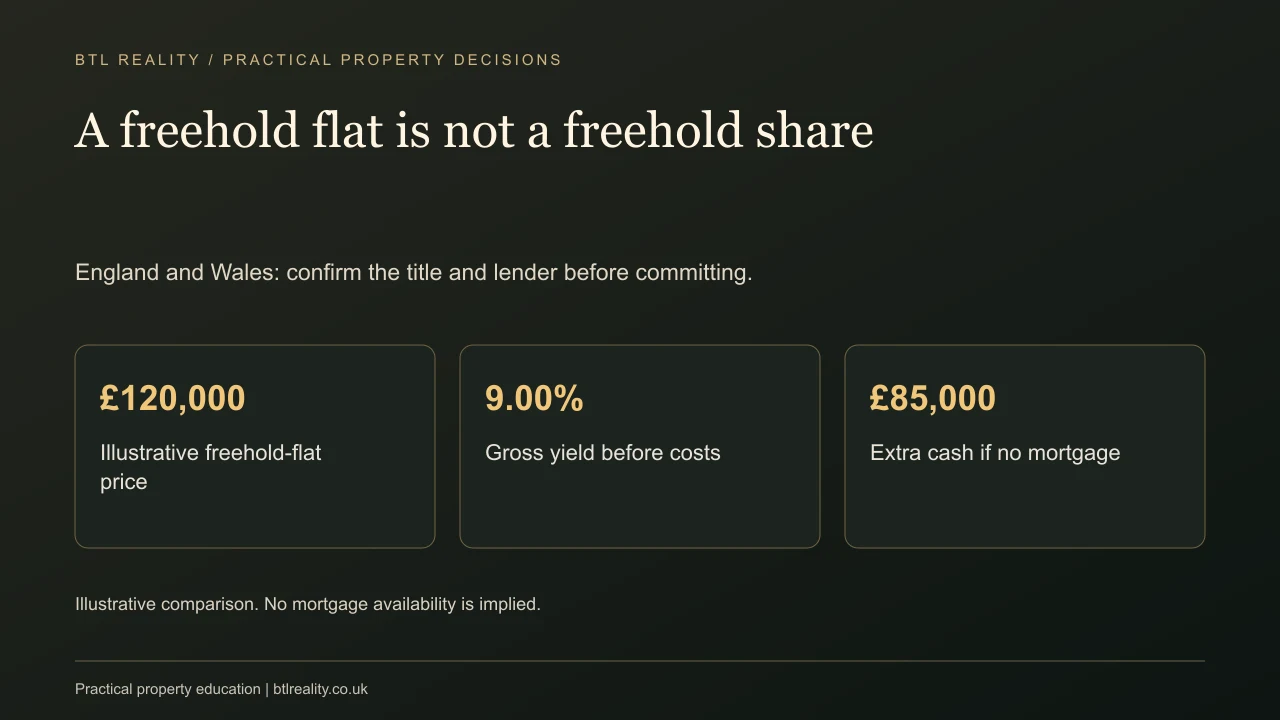
A flat described as “freehold” can look attractive to a landlord who wants to avoid lease problems. But a true freehold flat can be harder to mortgage than an ordinary leasehold flat. Before comparing yields, establish exactly what legal interest is being sold.
This guide concerns England and Wales. Flats in Scotland sit within a different ownership system, so an English lender’s objection to a freehold flat should not be applied to a Scottish flat by analogy. Northern Ireland also needs its own title and lending checks.
True freehold flat or share of freehold?
These descriptions are easily confused. A true freehold flat means the flat itself is held on a freehold title. A flat sold with a share of freehold commonly still has a lease, alongside an interest in the building’s freehold, held directly or through a company.
In that second situation, the lease remains important. Owning part of the freehold does not automatically remove the lease, its letting restrictions, its repair obligations or the need to maintain the building. The Leasehold Advisory Service’s freehold guidance distinguishes buying a building’s freehold share from owning the individual leasehold flat.
Ask for the title numbers and the lease, rather than relying on an estate agent’s short description. HM Land Registry’s register guidance explains the information available for property in England and Wales. Your conveyancer needs to interpret the actual documents and any rights affecting adjoining parts.
Why can a freehold flat concern a lender?
A flat depends on more than the rooms inside its front door. The roof, foundations, structure, access and services may involve other owners. A lender wants a property that can be occupied, maintained and sold, including if it ever needs to enforce its security.
The questions are practical: who must repair the roof, how can costs be collected, who insures the whole building, and what happens if an upstairs owner refuses access? A reassuring verbal arrangement with a neighbour does not establish enforceable rights for a future owner or lender.
That does not mean every unusual title is defective. It means the legal structure and the lender’s criteria must match. A valuer’s favourable opinion about rent or the flat’s condition does not replace a conveyancer’s title investigation.
What do published lender rules say?
Checked on 19 October 2026, Accord’s buy-to-let tenure criteria state that freehold flats are not acceptable. This is an exclusion in that lender’s policy, not a statement that no mortgage can ever exist on the property.
Virgin Money’s flat criteria describe a narrow exception for Tyneside flats with reciprocating lease and freehold arrangements, with specified security. That is not general acceptance of any flat marketed as freehold. Virgin’s current criteria index states that it no longer offers new buy-to-let lending; these published rules concern existing-customer changes. They are an illustration of a narrowly defined title policy, not a new-mortgage recommendation.
A broker should establish the title type before making a lender shortlist. Sending an ordinary leasehold application and hoping the conveyancer can sort out the difference later risks wasted valuation, legal and application costs. Ask for the relevant criteria in writing before committing to a timetable.
A cheap price can hide an expensive funding difference
Consider two illustrative flats producing the same £900 monthly rent. Flat A is a conventional leasehold purchase at £140,000. Flat B is a true freehold flat at £120,000. Assume, solely for comparison, that Flat A qualifies for a 75% mortgage and Flat B has no confirmed mortgage route.
| Item | Flat A | Flat B |
|---|---|---|
| Purchase price | £140,000 | £120,000 |
| Annual rent | £10,800 | £10,800 |
| Gross rental yield | 7.71% | 9.00% |
| Confirmed illustrative borrowing | £105,000 | £0 |
| Purchase cash required | £35,000 | £120,000 |
The cheaper flat needs £85,000 more purchase cash in this scenario. That does not prove Flat A is better: it has interest costs and its own lease obligations. It shows why a high gross yield cannot answer a funding question.
Use the buy-to-let deal calculator to compare a realistic funded case with a cash case. Add the actual legal, insurance and maintenance costs. Do not enter a hypothetical mortgage as if an offer already exists.
Could the legal structure be changed?
Sometimes the parties explore a lease structure or other title arrangements that a lender can accept. Whether that is possible, who must agree and how much it costs depend on the building and existing rights. It is a conveyancing project, not a box the purchaser can tick alone.
Ask the solicitor to identify the required parties, documents, consents and registration steps. Then ask the proposed lender whether the completed structure would meet its criteria. An estimated legal fee is less useful without a clear description of the result being delivered.
Keep timing in the budget. If a solution requires another owner’s cooperation, the completion date may not be within your control. A mortgage offer or auction contract can impose deadlines that do not fit a complicated title repair.
Cash buying does not remove the resale issue
A cash buyer can avoid the immediate mortgage application, but the next buyer may need finance. A limited future buyer pool can affect how long a sale takes and what price buyers are willing to pay. Assess the exit before deciding that today’s discount compensates for the title.
Do not assume you can buy with cash and refinance once you own the flat. Ownership alone does not change its tenure. A lender may still reject it six months later for the same reason it would reject it today.
The cash purchase followed by a mortgage guide explains the wider funding sequence. For a true freehold flat, add a separate condition: a documented route to acceptable security, rather than an expectation that refinancing will become available with time.
The documents to examine before an offer becomes binding
Obtain the title register and plan, any lease or relevant transfer, the building-insurance arrangements and details of how shared repairs are agreed and funded. Ask about previous disputes, unpaid contributions and upcoming structural work. Check whether alterations were properly authorised.
For a share-of-freehold purchase, confirm how that share transfers with the flat and whether the company or joint ownership records are in order. Read the lease even if the ground rent is minimal. The service-charge guide helps assess the recurring building costs.
Also check that letting is permitted under the legal documents and the proposed mortgage and insurance. A property can have an acceptable title but an unsuitable letting restriction. Getting one part right does not establish the whole buy-to-let case.
Ask for evidence of the building working in practice
Recent insurance schedules, repair invoices and records of contributions can show how the arrangements have operated. They do not replace the title documents, but they can expose a difference between a paper system and everyday reality. A building with no regular contributions may simply be postponing necessary work.
Ask what happens when an owner sells. The incoming owner needs to understand the same obligations, and the transfer of any company share or freehold interest must be dealt with properly. A system depending on the current owners being friends may become less comfortable when one is replaced.
For a future sale comparison, ask local agents about completed sales of flats with the same title structure. A nearby leasehold flat achieving a good price does not prove that lenders and buyers will treat this flat identically. Keep those comparable sets separate when deciding what discount, if any, is justified.
Make the decision around evidence
Separate three outcomes. The property may have an acceptable structure and a confirmed lender. It may have a plausible legal solution that must be completed first. Or the funding and title questions may remain unresolved. Each outcome justifies a different level of commitment.
If you proceed, make the offer and funding plan reflect the work and uncertainty you are actually taking on. Avoid paying for an uncomplicated leasehold purchase while accepting the delays and resale limitations of a much more specialist title.
Questions about freehold-flat mortgages
Can I get a buy-to-let mortgage on a true freehold flat?
Possibly, depending on the title and lender, but many standard lenders exclude them. Obtain a broker’s lender-specific assessment and a conveyancer’s review before assuming the flat can secure a mortgage.
Is share of freehold the same as a freehold flat?
No. Share of freehold commonly combines a leasehold flat with an interest in the building’s freehold. The lease remains relevant. Check the actual title documents because marketing descriptions can be imprecise.
Are Tyneside flats always acceptable?
No. Some lenders publish a specific policy for reciprocal arrangements, but its conditions must be met. A Tyneside label in an advert does not establish that the security matches a particular lender’s requirements.
Will buying with cash make the flat mortgageable later?
No automatic change occurs. If the title remains unacceptable, a later lender may reach the same decision. Establish any required legal restructuring and lender acceptance before using refinancing as your intended exit.
Does freehold ownership mean there are no building costs?
No. Roofs, insurance and shared structure still cost money. The important questions are who is responsible, how contributions are calculated and how obligations are enforced. Budget for the actual arrangements rather than the label.
Does this issue apply to Scottish flats in the same way?
No. Scottish ownership and property law differ. Ask a lender and solicitor familiar with the relevant jurisdiction; do not transfer England and Wales freehold-flat criteria to a Scottish property without checking.