Can an Expat Get Buy-to-Let Finance With No UK Credit History?
October 20, 2026
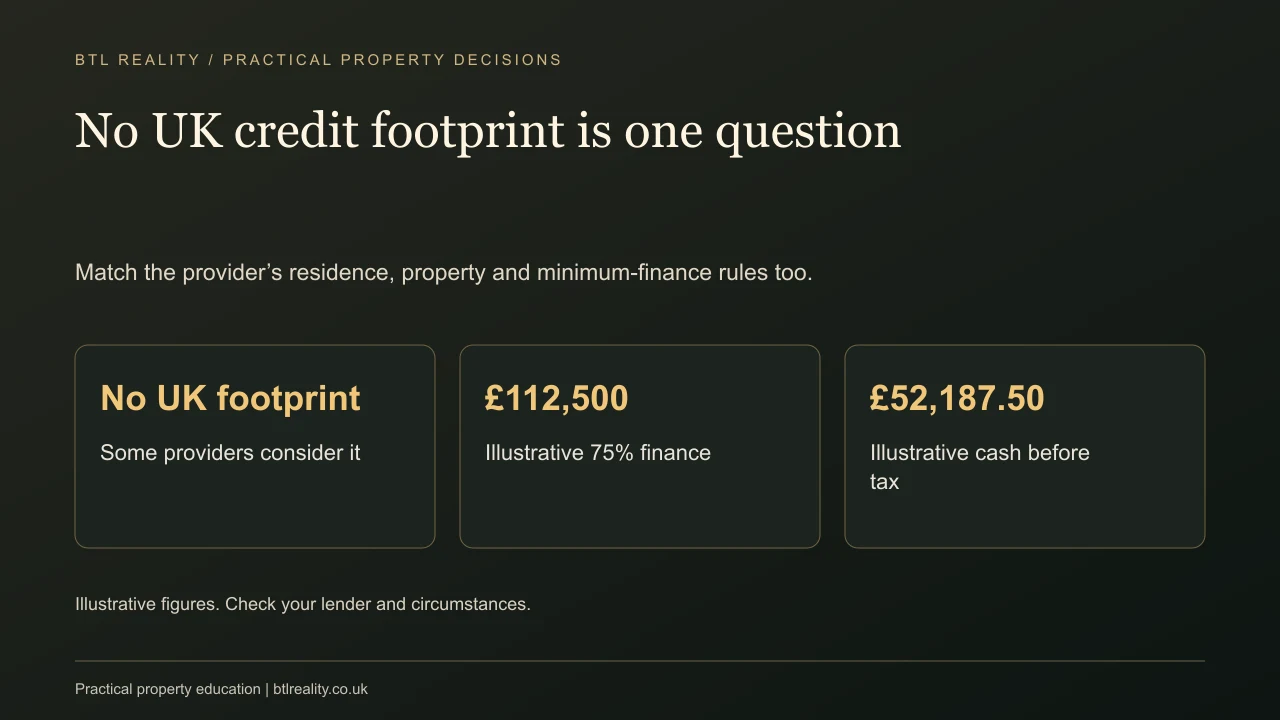
An expat without a recent UK credit history may still have buy-to-let finance options. Some providers expressly consider applicants with no UK credit footprint. That is different from saying that identity, overseas finances or adverse credit are ignored.
The useful task is to identify a provider whose criteria fit your actual residence and history, then present a complete evidence trail. A British passport, UK bank account or old address does not by itself establish that a standard domestic mortgage application is appropriate.
No credit footprint is different from poor credit
A thin or absent UK file can mean you have lived and borrowed elsewhere for years. Adverse history means there are relevant problems, such as judgments, arrears or defaults. A provider accepting the first situation does not necessarily accept the second.
Tell the broker what exists in both countries, including any UK accounts retained while abroad. If a UK credit report appears empty, do not assume there is no information anywhere that the lender will need.
Where there is a judgment, read the CCJ mortgage guide. The date and status of a credit problem require their own assessment; they are not solved by describing yourself as an expat.
A provider that expressly allows no UK footprint
Checked on 19 October 2026, Gatehouse Bank’s international and expat buy-to-let page states that a UK credit footprint and UK address are not required. Its property-finance proposition concerns England and Wales and includes a stated £75,000 minimum finance amount.
Gatehouse provides a Shariah-compliant property-finance structure, so compare the actual contract, payment basis, fees and exit terms rather than assuming it is identical to a conventional interest mortgage. The headline eligibility statement remains subject to its full assessment.
GB Bank’s published expat proposition also says it does not require an established UK credit footprint, but its stated starting loan size is £500,000. A provider can solve the history issue while being unsuitable for your loan size.
Match the whole case, not just one criterion
Check the applicant’s nationality, country of residence, employment or income source, property location, ownership structure and intended occupiers. Country and document requirements can be as important as the credit-footprint rule.
A provider considering overseas residents may not accept every jurisdiction or every source of money. Similarly, a product accepting companies may restrict the place of incorporation or ownership structure. Ask the broker to confirm the combination rather than assembling favourable statements from different products.
Use the lender’s current criteria and product documents. An old announcement that a bank entered the expat market does not prove its present loan limits, accepted countries or pricing.
A purchase still needs a complete cash budget
Suppose a property costs £150,000 and you plan 75% finance. The assumed borrowing is £112,500 and the price contribution is £37,500. This illustrates arithmetic only and is not an indication that either named provider will approve the case.
| Item | Amount |
|---|---|
| Price contribution at 25% | £37,500 |
| Assumed finance fee of 1.5% of £112,500 | £1,687.50 |
| Illustrative legal and survey costs | £2,000 |
| Initial property work | £5,000 |
| Operating reserve | £6,000 |
| Total illustrated cash | £52,187.50 |
The fee is a hypothetical planning assumption, not a live provider quote. Purchase taxes, currency conversion and other case-specific costs are excluded. The point is that accepting no UK credit history does not reduce the transaction to the deposit alone.
Use the buy-to-let deal calculator for the full cash and operating budget. Replace each allowance with quotations and include the tax appropriate to the ownership and property location.
Minimum finance can matter on a small purchase
At 75% finance, a £90,000 property produces a £67,500 advance. That would be below a hypothetical £75,000 minimum finance requirement, even though the deposit percentage looks reasonable. Different products can produce different constraints.
Do not borrow more than intended solely because one lender has a higher minimum. Ask for alternatives and assess the whole cost. Likewise, do not increase your property budget before checking rent, risk and available cash.
The minimum-value and minimum-loan guide explains why those are separate tests. The accepted credit-history position is only one part of eligibility.
Prepare residence and identity evidence accurately
Give the broker a truthful address history and the documents requested for the countries involved. Use your actual residential address. A correspondence address for receiving post is not necessarily the address where the lender needs to establish residence.
Ask whether documents need certification, translation or a particular format. Establish who can provide accepted certification before sending originals or paying for a service. A document that looks official to you may not satisfy the chosen provider’s process.
Keep names consistent across passports, bank statements, employment records and property documents. If there are genuine spelling variations or name changes, supply the supporting explanation. Avoid “correcting” information informally in a way that conflicts with the original records.
Show the deposit’s origin and movement
Provide the audit trail from the source of the money to the account funding the purchase. Overseas salary savings, business funds, gifts and investment proceeds can require different evidence. Ask about accepted sources before transferring money.
The source-of-funds guide helps organise this. A clean transfer trail does not replace evidence of how the money was earned or acquired. Keep both parts.
If the funds pass through a spouse’s account or another company, disclose that. Do not assume a final transfer from a UK account makes the earlier source irrelevant. The solicitor and finance provider may both need an explanation.
Check how rental income and personal income are assessed
Some buy-to-let finance is primarily assessed from the property’s rent, but providers may still examine personal finances, other borrowing and affordability. Ask which evidence is required even where there is no minimum income headline.
Where salary is paid abroad, residence and income currency are separate questions. The foreign-currency income guide explains conversion, underwriting adjustments and actual cash exposure.
Do not use the lender’s maximum borrowing as your operating target. Test rent collected, management, repairs, empty periods, tax and payments under the actual finance structure. A lender accepting your credit evidence does not guarantee the property produces worthwhile net income.
Ask how overseas credit evidence is obtained and who is responsible for it. If the provider requests a foreign credit report or account history, establish its accepted source, age and translation requirements. Do not pay a third party for an expensive report before confirming that the lender will use it. Keep any existing mortgage statements readily available too, including evidence of payment conduct where requested.
Organise the overseas completion process
Ask the solicitor and provider which signatures, identity checks and documents can be completed remotely. Check the expected time for certification, courier delivery or legal appointments where relevant. Build that into any purchase deadline.
Use secure instructions and confirm payment details through a trusted channel before transferring purchase funds. Keep the broker and conveyancer updated if residence, employment or the source of funds changes while the case is being assessed.
After completion, arrange access to UK funds for repairs and bills. The overseas landlord management guide helps assign responsibility when you cannot attend the property yourself.
Keep the intended use consistent
If the property will be a normal rental, describe it that way. If you expect to move into it on returning to the UK, house a relative or use it for short stays, explain that intention before selecting a finance route. A provider accepting overseas applicants for investment property does not necessarily accept personal or family occupation.
Also tell the adviser whether you want conventional mortgage borrowing or are willing to consider a different property-finance structure. Eligibility alone does not make every contract equally suitable. Compare how ownership, payments, charges and the exit work, with the legal explanation appropriate to the product you would actually sign.
Questions about expat credit history
Can an expat get buy-to-let finance without a UK credit history?
Some providers expressly consider it, subject to their full criteria. Match the country, property, income, loan amount and ownership structure as well as the credit-footprint rule.
Is no UK credit history the same as adverse credit?
No. A missing or thin file differs from judgments, arrears or defaults. Disclose relevant UK and overseas financial history so the adviser can assess the actual case.
Do I need to use a relative’s UK address?
Give the true residential history and distinguish any correspondence address. Do not use an address to create a misleading impression of residence. Some providers accept overseas addresses under their stated process.
Does a UK passport guarantee an expat mortgage?
No. Citizenship is only one criterion. Residence, income, property, source of funds, credit evidence and provider-specific rules still need to fit.
Can a lender accept my history but reject the loan size?
Yes. Minimum finance and property-value limits are separate. A provider starting at £500,000 borrowing would not suit a £112,500 application merely because it accepts applicants without a UK footprint.
Should I build UK credit first or apply through an expat route?
Ask a suitable adviser to compare the routes for your actual circumstances and timing. Do not assume waiting guarantees access or that taking unnecessary credit is required. Accurate evidence and appropriate eligibility matter first.