Empty Homes EDMO Rules: Six-Month Threshold Starts in England
November 5, 2026
Property News · England · Rules effective 5 November 2026
By Mark Parham · Rules effective 5 November 2026
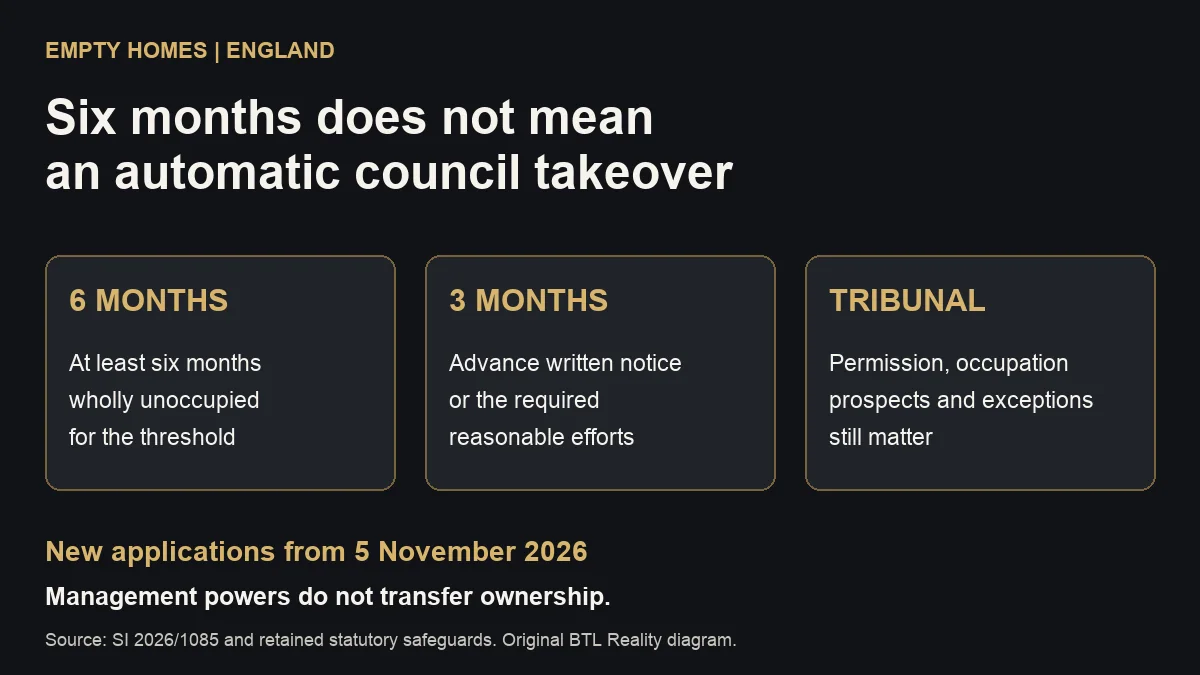
Councils in England can seek an Empty Dwelling Management Order after a home has been wholly unoccupied for at least six months, instead of two years, under rules in force from 5 November 2026. For a landlord with a long-running void, that makes an organised plan to bring the property back into use more pressing.
What changed on 5 November?
The 2026 amendment order, SI 2026/1085, restores the six-month threshold and removes two requirements for information about nuisance and community support. It was made and laid before Parliament on 14 October 2026. The changes concern England only.
The transition turns on the application date. Applications submitted before 5 November retain the previous rules; applications submitted on or after that date fall under the changes. The instrument does not say that every existing empty property starts a fresh six-month vacancy clock on commencement.
For an investor, the practical distinction is between a short gap during a normal change of tenant and a home drifting through months without an evidenced route back into occupation. Review the facts of each property before assuming that a headline about empty homes describes your position.
What still has to be proved?
Under section 134 of the Housing Act 2004, the tribunal must be satisfied that the home is wholly unoccupied, with no reasonable prospect of occupation in the near future, but a reasonable prospect of occupation if an interim order is made. The other statutory requirements must be met and a prescribed exception must not apply.
The tribunal must also consider the community’s interests and the effect on the proprietor’s and third parties’ rights. Removing the specific information requirements about nuisance and community support does not remove that wider scrutiny. “Wholly unoccupied” means no part is occupied, lawfully or unlawfully.
The three-month notification requirement introduced in 2012 remains. The council must notify the relevant proprietor in writing at least three months before applying, or have made all reasonable efforts to do so before that three-month period begins. Councils must also investigate the owner’s plans and possible exceptions.
Keep council correspondence with the property file and answer it with dated evidence. A vague intention to “sort it out soon” is less useful than an agent’s instruction, contractor schedule, planning reference or explanation of why the home is empty. These documents help establish the circumstances; none is a guaranteed outcome.
Which empty homes are excepted?
The existing exceptions in the 2006 order remain. They include:
- Homes previously occupied principally by their owner, now absent temporarily, receiving or providing personal care, or away through armed-forces service.
- Holiday homes and properties occupied occasionally by the owner or guests.
- Homes genuinely marketed for sale or letting.
- Certain agricultural holdings, farm business tenancies, employee residences and ministers’ residences.
- Properties subject to a freezing order, prevented from occupation by criminal proceedings or investigation, or held by a mortgagee in possession.
- Homes whose owner has died, until six months after the grant of representation, such as probate.
The probate protection is not simply six months after death. Repairs or an outstanding planning application are not blanket exceptions in this list: the council must explain why an order is needed where specified works or applications are involved. Retain the documents showing the actual circumstances.
Does the council become the owner?
No. The government’s explanatory memorandum describes a staged management process. An interim EDMO allows steps towards occupation, with the proprietor’s consent needed to let the dwelling. A successor final order can allow management and occupation without that consent for up to seven years. The council acquires no estate or legal interest and cannot sell the property under the EDMO.
The memorandum also flags an interaction with the 12-month restriction on re-letting after notices relying on possession Grounds 1 or 1A. Do not assume an EDMO overrides that restriction. The tribunal still assesses whether there is a reasonable prospect of occupation if an order is made.
If possession, a proposed sale and council enquiries overlap, take advice on the particular sequence before issuing notices or making promises about re-letting. A management order and a tenant-possession route answer different questions.
A vacancy-cost example: what does waiting cost?
Consider a hypothetical rental with an achievable rent of £1,100 a month. Assume its monthly cash outgoings while empty are £600 mortgage interest, £170 council tax, £70 insurance and £60 utilities and security. These are illustrative inputs, not typical charges or a forecast for your property.
| Assumed position | Each month | Six months |
|---|---|---|
| Cash outgoings while empty | £900 | £5,400 |
| Gross rent not received | £1,100 | £6,600 |
The £5,400 is cash leaving the owner’s account. The £6,600 is gross rent not received. Adding them into a £12,000 “loss” would blur different measures and can double count costs when comparing the empty and occupied positions.
For a simple comparison, assume mortgage interest and insurance continue after occupation, while the tenant becomes responsible for the council tax and utilities. Occupied cash flow before management, maintenance, tax and other omitted costs would be £430 a month: £1,100 minus £600 minus £70. Empty cash flow is minus £900. The difference is £1,330 a month, or £7,980 over six months.
This comparison is deliberately limited. It excludes letting fees, compliance work, repairs, arrears, income tax and changes in borrowing costs. A realistic occupied scenario needs those inputs. A renovation may also justify a planned void when its cost, duration and intended outcome have been assessed.
Use the empty rental property cost guide to build a void budget, then enter your own assumptions into the buy-to-let deal calculator. The calculator helps assess the deal; it does not decide EDMO eligibility.
What should an owner do now?
Start with a vacancy timeline. Record when occupation ended, why the property remains empty and what happens next. If an agent is marketing it, keep the instruction, listing, asking terms, enquiries and viewing feedback. Genuine marketing is a factual question, so retain more than a screenshot of an old advert.
For works, track quotes, instructions, access, milestones and the expected completion date. For an inherited property, keep the grant-of-representation date separately from the date of death. For temporary absence, retain evidence relevant to the reason the home is unoccupied.
Check insurance now rather than waiting for six months. Notification deadlines and unoccupancy conditions come from your policy, not the EDMO threshold. Our empty rental property insurance guide explains the questions to put to the insurer.
If the council contacts you, establish what action it is considering, respond to its questions and provide the relevant documents. Where the facts are disputed or formal action is proposed, get advice on the notice, exceptions and available response.
For help learning how to assess a property investment, explore Starter Club. Build a void reserve and a practical management plan into the deal before relying on the advertised rent.
Frequently asked questions
Can a council take over every home empty for six months?
No. Six months is the minimum vacancy threshold under the new English rules. The tribunal must authorise an interim EDMO, assess occupation prospects and other requirements, and consider applicable exceptions.
Do the new EDMO rules apply across the UK?
No. This amendment applies in England. Its transitional rule covers applications submitted on or after 5 November 2026; earlier applications remain subject to the previous requirements.
Can the council sell my property under an EDMO?
No. The power concerns possession and management, without acquiring ownership. An interim order requires consent to let; a final order can permit occupation without that consent.
Is a property for sale protected?
A home genuinely on the market for sale or letting falls within an existing exception. Keep evidence of real marketing and respond to council enquiries about the circumstances.
Does the council still have to give three months’ notice?
The requirement remains to notify the proprietor in writing at least three months before applying, or make all reasonable efforts before that period begins. It was not removed by this amendment.
Does renovation automatically exempt an empty property?
No blanket renovation exception appears in the existing order. Specified repairs, improvements or outstanding applications require the council to explain to the tribunal why an EDMO is needed to secure occupation.
Sources checked for the 5 November 2026 commencement. Legal eligibility depends on the property’s circumstances; the worked figures are an original illustration.