Replacing Windows in a Conservation-Area Rental: What to Check
October 20, 2026
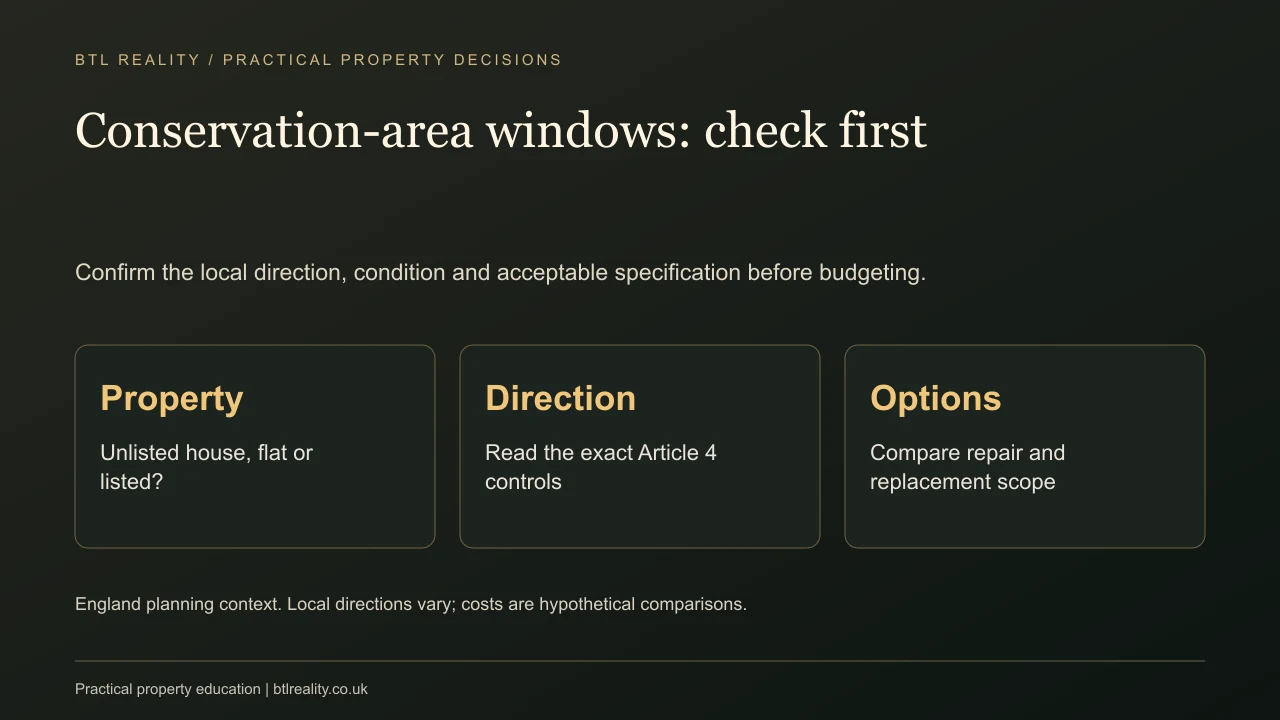
A rental house needs better windows, and the initial refurbishment budget includes standard replacements. Then the searches show a conservation area. Before assuming the cost will double or that nothing can be changed, establish the actual planning controls and condition of the windows.
This guide focuses on unlisted houses in England, with primary advice checked on 19 October 2026. Listed buildings and flats can have different requirements. The buying decision needs the address-specific rules, not a blanket statement that every window in every conservation area needs the same consent.
Confirm the property and the controls
Ask the conveyancer or planning adviser to confirm whether the house falls within the conservation-area boundary and whether an Article 4 direction affects it. Read the direction and plan rather than stop at a search flag. The exact development rights removed and the area or elevations covered matter.
Historic England’s conservation-area guidance explains that special controls can restrict changes normally possible without planning permission, including certain door and window work. It recommends checking locally. Conservation designation is a reason to investigate the rules, not a complete specification for replacement.
Also confirm whether the building is listed. If it is, use the listed-building buying guide alongside specific professional advice. Do not apply this unlisted-house discussion as though listed-building consent and ordinary planning permission were interchangeable.
The exact elevation and proposal matter
Make an inventory of windows by room and elevation. Note materials, opening style, glazing, dimensions and visible condition. A street-facing sash window can raise different design questions from a later rear addition. The relevant direction and local guidance should determine which distinctions matter legally.
Ask what is proposed: repair, draught-proofing, replacement glazing within a retained frame or complete replacement. Changes to profiles, opening patterns, materials or external appearance need to be described accurately. The word like-for-like is not enough if the quoted product looks or operates differently.
A contractor may understand a particular product but should not be the only source of planning advice. Obtain appropriate confirmation from the local planning authority or your adviser where the requirement is uncertain. Do this before placing a non-refundable order or assuming the property will be ready by a particular date.
Existing neighbouring windows are useful context, not proof of permission for yours. They may predate the direction, have a different consent or have been installed without approval. The buying budget needs a route that can be justified for this property now.
Assess repair before assuming replacement
Ask a suitably experienced independent professional about the existing windows’ condition and repair options. A replacement-sales quotation can be useful, but it may not provide an independent assessment of whether historic frames can be retained and improved.
Basingstoke and Deane’s window guidance illustrates the importance of condition: it distinguishes repairable historic windows from those demonstrated to be beyond repair. It recommends an appropriate independent report in uncertain cases. That is local guidance, not a rule that every English council will assess every window identically.
Obtain separate descriptions and quotations for the realistic options. Repair might include specialist joinery and decoration; replacement may include planning details, installation and making good. Compare complete scopes rather than assume the lower equipment price delivers the lower total project cost.
Historic England’s advice on repairing or changing older windows is a useful starting point for the condition and conservation questions. The final choice still depends on the building, acceptable specification and the performance needed for the home.
Check previous replacements during the purchase
Ask for the date and documents for existing window changes. The conveyancer should compare the planning history and any relevant direction with the current position. A certificate dealing with building-regulations installation requirements does not automatically answer whether planning permission was needed.
If approvals appear to be missing, ask what the issue is, which evidence might resolve it and what advice is required. Do not assume a historic replacement is lawful merely because it has been there for years. Equally, do not assume every modern window proves a breach.
Keep the planning issue separate from physical condition. A window can be well installed but lack required consent, or properly approved but in poor repair. You need both questions addressed before treating the item as complete in the acquisition checklist.
A worked example: compare two complete specifications
Assume an unlisted rental needs work to six windows. An initial standard-replacement allowance is £4,800, including installation. After inspection and local advice, the buyer compares an assumed acceptable repair package at £6,300 with a particular replacement specification at £9,600.
Assume each option also needs £600 of assessment and professional work, and neither adds holding time. These are invented comparison figures, not typical prices or a statement that either option will receive permission at a particular address.
| Illustrative option | Works | Professional costs | Total |
|---|---|---|---|
| Initial standard allowance | £4,800 | £0 | £4,800 |
| Assessed repair package | £6,300 | £600 | £6,900 |
| Specific replacement package | £9,600 | £600 | £10,200 |
The repair option is £2,100 above the initial allowance. The replacement option is £5,400 above it and £3,300 above the repair option. That does not establish which has the better lifetime cost; maintenance, expected service life and suitable performance need comparing too.
Use the Buy-to-Let Deal Analyser to update the actual works budget. Do not assume a higher specification produces an equal rent increase. Check local rental evidence and let the property decision stand on supported numbers.
If approval or manufacture adds time after completion, include the actual extra holding cost. If the window work can occur within the original refurbishment programme, do not add a delay merely because a permission process exists. Use a coordinated programme rather than automatically stack every quoted timescale.
Compare performance and permissions together
Explain the home’s practical needs to the adviser and contractor, including ventilation, ease of use, repair condition and any relevant safety or energy requirements. Ask them to develop options that work as a whole, rather than select a product first and discover conflicts later.
Listed status or conservation designation should not be used as a shortcut to assume all other letting requirements are exempt. Check the applicable obligation and any exemption separately with an appropriate professional. A planning officer’s view on appearance is not a complete rental compliance assessment.
For quotations, use the refurbishment comparison guide to record assumptions, drawings, exclusions, making good and approvals. A quote for replacement units only cannot be compared fairly with a fully installed and decorated repair package.
Plan the purchase around what can be delivered
Before exchange, establish whether the rental works with the existing windows, an identified repair scheme or a replacement that still needs permission. A deal that depends on a particular transformation should not be valued as though the approval has already arrived.
Ask what must be resolved before committing, who prepares the information and how much is payable before a decision. Make a realistic allowance for professional advice without inventing a universal consent timetable. The uncertainty belongs in the investment decision rather than being hidden in a general contingency.
After completion, give the managing agent the relevant specifications and permission records. If one window later fails, they need to know whether an ordinary replacement can be ordered or whether advice is needed. Routine management is easier when the approved approach is documented.
The label alone is not the verdict
A conservation-area house can be an appealing, manageable rental. The useful assessment is the actual window condition, local controls, acceptable options and cash needed to deliver them. Sometimes repair is the appropriate route; sometimes an evidenced replacement proposal can be considered.
What does not work is assuming either that standard replacements will be accepted or that conservation status automatically makes the property unaffordable. Resolve the address-specific questions and compare complete quotations before deciding what the house is worth to your rental strategy.
Frequently asked questions
Do all window replacements in conservation areas need planning permission?
Do not assume a blanket answer for every unlisted house. Check the actual permitted-development position, any Article 4 direction and the proposed work. Flats and listed buildings need separate consideration, and local guidance can be important.
Does Article 4 mean the council will refuse new windows?
Not automatically. A direction can require permission for work that would otherwise be permitted. Whether a proposal is acceptable depends on its details and the applicable policies. Obtain advice on the actual windows and specification.
Can I copy a neighbour’s uPVC windows?
A neighbour’s installation does not prove permission is available for yours. It may predate controls, have different consent or be unauthorised. Check the address-specific position before ordering products or including an assumed saving in the budget.
Should I replace every old timber window before letting?
Not without a condition assessment. Some windows may be repairable and capable of improvement. Compare appropriate repair and replacement options, practical performance and permissions rather than assume age alone decides the right approach.
Does an installation certificate prove planning permission was granted?
No. A document relating to building-regulations compliance does not automatically establish the separate planning position. Ask the conveyancer and adviser to confirm what each document covers and what was required at the time.
How much extra should I budget for conservation-area windows?
Use actual professional advice and comparable quotations for an acceptable scope. There is no reliable universal premium. Include making good, professional work and any real extra holding period, while avoiding duplicate allowances.