One Mortgage-Free Rental or Two Mortgaged Properties?
October 19, 2026
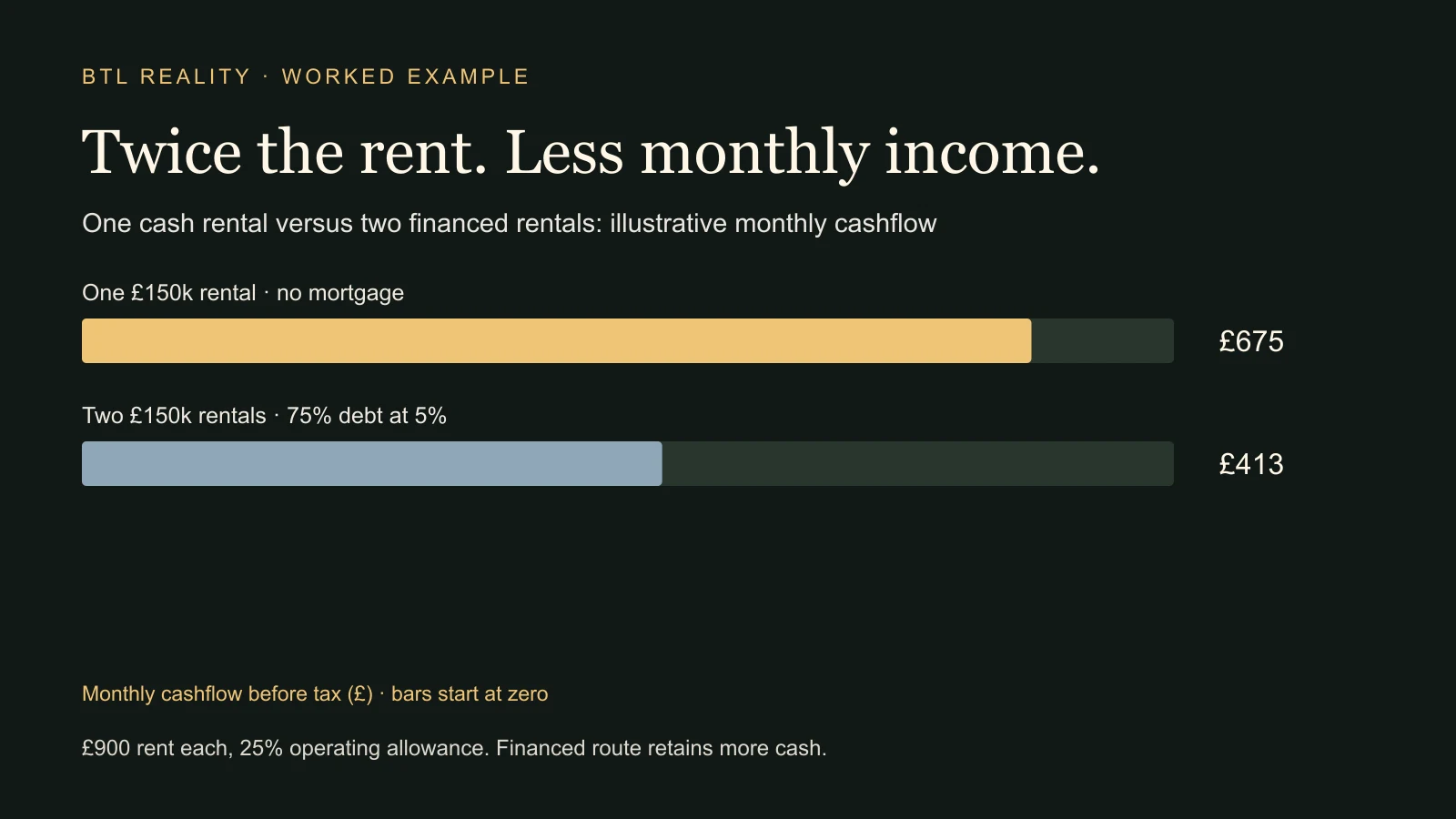
One mortgage-free rental can produce more monthly income than two mortgaged properties. Two financed properties can provide greater exposure to changes in house prices and leave more starting cash available. Neither statement tells you which is better until you compare the whole balance sheet and decide what you want the money to do.
The right comparison uses the same starting capital, includes purchase costs and shows unspent cash. Otherwise it is easy to make borrowing look superior by comparing two larger assets with one smaller asset while ignoring the additional debt. It is equally easy to make cash buying look superior by ignoring the flexibility of money not tied up in a house.
Start with the same pot of money
Imagine £200,000 of available capital. Route A buys one £150,000 rental outright and allows £10,000 for all acquisition costs. It leaves £40,000 cash. Route B buys two £150,000 rentals using 75% interest-only mortgages, with £10,000 acquisition costs per property. The deposits total £75,000, costs total £20,000 and £105,000 remains in cash.
The £10,000 cost per property is a rounded illustrative allowance, not a stamp-duty calculation or a quotation. Tax, legal work, surveys, finance fees and initial works vary. Replace it with your actual figures before comparing a real purchase. Both routes must also meet eligibility, property-condition and lending requirements.
This example deliberately keeps property price and rent the same per unit. It does not assume the financed route spends every remaining pound. Cash left outside the properties is part of the answer, not an inconvenience to hide from the comparison.
Compare monthly income before growth
Assume each property rents for £900 a month and operating costs plus ordinary void provision use 25% of rent. The mortgage-free property produces £675 monthly cashflow before tax and any costs outside that allowance.
The two-property route collects £1,800 and retains £1,350 after the same percentage allowance. But £225,000 of combined debt at 5% costs £937.50 a month. The remaining cashflow is £412.50, which is less than the single mortgage-free property's £675.
That does not make the two-property route a mistake. It shows that collecting twice the rent is not the same as collecting twice the spendable income. The second route also retains £65,000 more starting cash, which may have a useful purpose. This worksheet assumes no return on that cash so the property comparison stays visible.
Use the same-capital comparison
Change starting capital, price, rent, costs and interest. Both properties in the financed route use the same inputs. This makes the trade-offs easy to see, but a real portfolio should also model each property's separate characteristics.
One cash purchase versus two financed purchases
Same starting capital, identical properties. Interest-only loans, before tax; no interest on unused cash. Value change is a one-time scenario, not a forecast.
Calculations stay in your browser. Nothing you enter is saved or sent.
The worksheet shows acquisition funding, remaining cash, debt and monthly cashflow before tax. Its value-change control shows a one-time movement in property values, not a forecast or a multi-year total return. It excludes sale costs, tax, interest earned on cash and any principal repayment.
More properties mean more price exposure
A 5% increase on one £150,000 property adds £7,500 to its value. The same percentage across two properties adds £15,000. That is the attractive side of controlling more property with borrowed money, but the original mortgage balances still have to be repaid.
A 10% fall removes £15,000 from the cash property's value and £30,000 from the two-property portfolio. Gross property equity in the financed route falls from £75,000 to £45,000, a 40% reduction, before disposal costs. A modest percentage movement in asset prices can therefore produce a much larger percentage movement in equity.
Cash retained outside the properties helps the overall position, but it does not erase the loss on the assets. Keep property equity, cash reserves and debt as separate lines. Our portfolio loan-to-value guide explores why asset value alone can give a misleading impression of financial strength.
Acquisition costs affect the starting position
Immediately after buying, the cash route has £150,000 property value plus £40,000 cash, or £190,000 before any other changes. The financed route has £300,000 property less £225,000 debt plus £105,000 cash, or £180,000. The difference comes from paying acquisition costs twice.
Neither figure is a professional valuation or an amount guaranteed on sale. The example assumes purchase price equals market value and that the £10,000 per property has been spent. If you buy below independently evidenced value, need works or add mortgage fees to the loan, the balance sheet changes.
This is why “I control twice as much property” is an incomplete performance statement. Include the price paid to establish that position and the liabilities attached to it. See our deal comparison guide for a broader appraisal structure.
Test interest rates rather than assuming today's payment lasts
At 7% instead of 5%, monthly interest on £225,000 becomes £1,312.50. With the original rent and allowance, the two-property surplus falls to only £37.50 before tax. The mortgage-free property's direct borrowing cost remains zero.
Actual loans may be fixed for a period, and the rate you face later is unknown. That is a reason to test several outcomes, not to assume an immediate change or permanent protection. Include refinancing fees and dates in a property-by-property funding schedule.
The cash route still has risks: rent can stop, repairs can arrive and values can fall. Removing mortgage interest does not make property risk-free. It removes one important cash commitment and one source of refinancing pressure.
Two tenants can help, but concentration remains
With one property, a vacancy can remove all property rent. With two, one tenant may continue paying while the other unit is empty. That can improve income diversity, but the usefulness depends on the properties, tenant markets and cost commitments.
Two similar houses in the same small area may share exposure to a local employer, flooding, contractor shortages or weak demand. If both mortgages end together, their financing risk may also arrive at the same time. Counting doors does not measure those connections.
Stress the portfolio with a simultaneous rate change and a missing-rent period. Our portfolio stress-test guide separates recurring cashflow pressure from an immediate repair bill and the reserve needed to meet it.
Decide what the unspent cash is for
The £105,000 left in the financed example could remain as a substantial reserve, support another investment or be used for personal commitments. Each choice produces a different overall result. Do not assume it both earns an investment return elsewhere and remains instantly available without risk.
Likewise, the £40,000 cash-route reserve might be sufficient or insufficient depending on the owner's wider situation. A reserve should be linked to likely bills, income security and other commitments, rather than chosen because the spreadsheet happens to leave that amount over.
If the intention is eventually to use the financed route's spare cash to buy more properties, model those later purchases explicitly. Their fees, borrowing and running costs cannot be omitted while their future growth is counted.
Tax and ownership structure can change the comparison
These examples show cashflow before tax. Personal residential landlords and companies can have different tax treatment, and individual landlords' finance-cost restrictions mean the tax result may not follow a simple rent-minus-interest calculation. HMRC explains the residential finance-cost rules.
Ask an accountant to assess the relevant structure and your wider circumstances. Do not choose an ownership route solely from an online illustration of one year's cashflow. Purchase taxes, ongoing tax, administration and the eventual exit all matter.
Which route fits your objective?
If the main objective is dependable current income with fewer financing commitments, the mortgage-free route may deserve serious consideration. If the objective is longer-term growth and capital flexibility, a sensibly financed portfolio may fit, provided you can tolerate the downside and keep adequate reserves.
Neither objective excuses weak buying. A poor property bought for cash remains a poor property; borrowing does not turn an uneconomic deal into a strong one. Start with credible rent, condition and value evidence, then compare funding choices.
For a first purchase, use the buy-to-let deal calculator to build the appraisal. For an existing portfolio and a more complex capital-allocation decision, Private Mentorship explains the application process and support available.
Frequently asked questions
Is buying without a mortgage always safer?
It removes borrowing payments and refinancing risk, but not property, tenant, liquidity or price risk. It can also concentrate more cash in one asset. Compare the complete position.
Do two mortgaged properties always grow wealth faster?
No. Greater exposure magnifies adverse price changes as well as favourable ones, and interest, tax and costs can reduce returns. Future growth is uncertain.
Should all spare cash be invested immediately?
Only after considering the reserve and other commitments it must support. Unspent cash has an opportunity cost, but it also provides flexibility when a bill or opportunity arrives.