Buy-to-Let Mortgage Fees: Low Rate or Low Fee?
October 13, 2026

By Mark Parham
BTL Reality · Practical property education
A buy-to-let mortgage with a lower interest rate can cost more once the product fee is included. Compare the same borrowing over the same period, account for how fees are paid, and check the product’s other terms. The cheapest-looking percentage is only one part of the decision.
This matters particularly when the loan is relatively small or the comparison period is short. A large fee has fewer pounds of interest savings to offset it. On a larger loan, the same rate reduction may save enough to justify the fee, but you need to do the arithmetic.
An example where the higher rate is cheaper
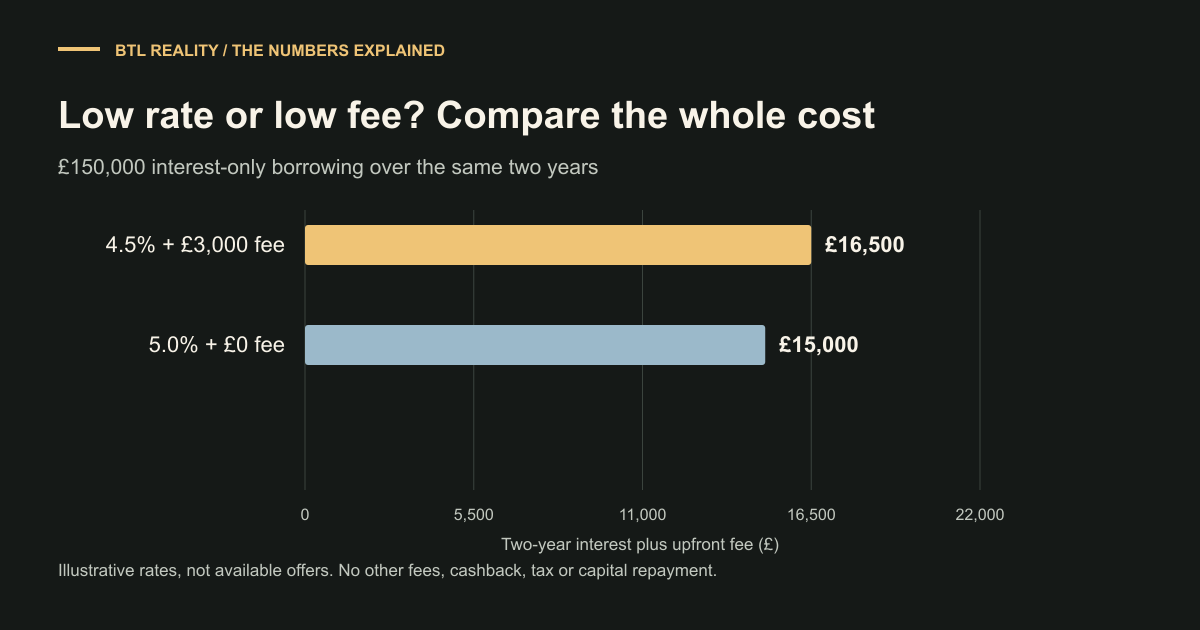
Imagine borrowing £150,000 on an interest-only basis for a two-year comparison. Option A charges an illustrative 4.5% with a £3,000 product fee paid upfront. Option B charges 5% with no product fee. These are invented figures, not current mortgage offers.
| Measure | Option A | Option B |
|---|---|---|
| Annual interest rate | 4.5% | 5% |
| Monthly interest | £562.50 | £625 |
| 24 months of interest | £13,500 | £15,000 |
| Upfront product fee | £3,000 | £0 |
| Total compared cost | £16,500 | £15,000 |
Option A saves £62.50 in monthly interest, or £1,500 over two years. Its £3,000 fee is larger than that saving, so its compared cost is £1,500 higher. Looking only at the monthly payment would point you towards the wrong cost conclusion.
MoneyHelper’s remortgaging guide similarly explains why fees and other switching costs matter alongside the rate. Our example isolates one part of that comparison so you can see exactly what changes the answer.
TRY YOUR OWN ASSUMPTIONS
Compare the same loan over the same period
Two invented interest-only products. Fees are paid upfront in this model; they are not added to the loan.
Move a slider to explore the model.
Constant balances and rates. Total = loan × annual rate × months ÷ 12 + upfront fee. Excludes broker, valuation, legal, exit and early repayment charges, cashback, tax and opportunity cost. No product availability or eligibility assessment. Inputs stay on this page. Figures stay on this page and are not submitted or saved.
Enable JavaScript to use the sliders. The default worked example remains readable below.
The fee break-even calculation
Where one option has a lower rate and a higher upfront fee, divide the extra fee by the monthly interest saving. In this example, £3,000 divided by £62.50 equals 48 months.
That does not mean Option A becomes cheaper after four years in reality. The two-year product may end before then, and later rates and fees are unknown. The calculation tells you the extra fee is not recovered within the selected two-year period under these assumptions.
Increase the loan to £300,000 and the same half-percentage-point reduction saves £125 monthly. The £3,000 fee then breaks even at 24 months. This is why a product that looks unattractive for one loan size can compare differently for another.
Total compared cost on £150,000 over two years
What if the product fee is added to the loan?
Then the fee is not free, and the borrowed balance may be larger. If the £3,000 fee in Option A were added to a £150,000 interest-only loan, the balance would become £153,000, assuming the lender allowed that structure.
At 4.5%, two years of interest on £153,000 is £13,770. The fee remains part of the debt to repay, so the compared financing cost is £13,770 interest plus the £3,000 fee, or £16,770. The extra £270 is interest on the fee during the two-year period.
Do not add the fee twice. You can compare interest plus the fee incurred, or compare payments and the change in ending debt carefully. What matters is showing both the payment effect and the outstanding balance, using a consistent method for each option.
A financed fee may also interact with loan-to-value and lender criteria. Ask the broker how it is treated and whether it changes cash required at completion. The mini-tool above assumes fees are paid upfront to keep those cases separate.
Percentage fees need converting into pounds
A fee expressed as a percentage can look modest beside an interest rate, but they measure different things. A 2% product fee on £150,000 is £3,000. It is not an annual rate reduction and should not be subtracted directly from a yearly interest percentage.
Write every fee in pounds in the comparison sheet. Note when it is due, whether it is refundable and whether it can be added to borrowing. A fee payable before completion can affect the cash plan even if the transaction does not proceed.
The complete buy-to-let costs guide gives these charges a place in the acquisition budget. Keep mortgage-product comparison and property-return comparison connected, so the chosen financing does not quietly consume cash allocated to works or reserves.
Compare like with like on repayment mortgages
The calculator here is interest-only. On a repayment mortgage, part of each payment reduces the balance. Two products can have different payments and different debt remaining at the end of the comparison period.
A useful comparison therefore considers payments, fees and the ending balance, rather than treating every pound paid as interest expense. Ask for an illustration on the same starting debt, repayment basis and mortgage term. Changing the term to lower the payment changes the comparison.
Also distinguish the fixed-deal period from the full mortgage term. A two-year fix on a 25-year mortgage does not tell you the rate for the other 23 years. Avoid presenting a whole-term total based on an unchanged promotional rate as a prediction.
Features and eligibility can outweigh a small cost difference
A product must fit the borrower, property and intended strategy. Early repayment charges, overpayment options, rental-cover rules, permitted use and capital-raising criteria can matter. A slightly cheaper illustration is not useful if it cannot support the transaction.
My refinancing account describes how capital released from earlier properties helped fund later purchases. That history shows why financing should fit the wider plan. It does not establish which product or fee structure is right for a new borrower today.
If you may sell or restructure before a fixed period ends, ask the broker to explain the consequences. Do not choose a longer commitment solely because it makes a spreadsheet's average annual fee look smaller.
Take a complete comparison to the broker
- Starting balance and cash needed: include whether fees are paid or financed.
- Same comparison period: identify when each deal ends.
- All charges: product, broker, legal, valuation, exit and any early repayment charge.
- Incentives: cashback or included services, with the actual conditions.
- Payment basis: interest-only or repayment, with debt remaining shown.
- Flexibility: planned sale, overpayment, works or further borrowing.
- Suitability: borrower, rent, property and portfolio criteria.
Ask what happens if the valuation is lower, completion is delayed or the application does not proceed. Those questions make the comparison more practical than a rate table alone.
Finally, place the selected actual payment into the deal calculator and test a less comfortable rate in the mortgage stress tool. Product cost and sustainable property ownership should tell a consistent story.
Is a no-fee mortgage always cheaper?
No. It depends on the loan size, rate difference, period and other charges. Use the same assumptions for each option and have a qualified adviser assess suitability.
Does this tool show available mortgage products?
No. It explains the arithmetic using assumptions you choose. It does not search lenders, assess eligibility or recommend a product.
Prepared using information checked on 30 September 2026. Check the linked product pages for current availability and terms. This is general property education, not personal financial, mortgage, tax or legal advice. Models and examples are illustrative. Property values and income can fall, and outcomes are not guaranteed.