Can I Get a Buy-to-Let Mortgage After I Retire?
October 7, 2026
Retirement does not automatically prevent a buy-to-let mortgage, but approval depends on the lender, borrower, property and proposed loan. Age rules, income evidence, rental coverage, loan-to-value and the repayment plan can all matter. The useful question is not simply whether a retired person can borrow, but whether a suitable and affordable loan is available for your circumstances.
For someone relying on property income, the mortgage decision needs to fit the retirement plan. Increasing borrowing can release cash while reducing the rent left to spend. A product being available does not establish that it improves your position.
Age at application and age at the end are different
Lenders may assess age when you apply, when the term finishes or under another policy linked to experience and LTV. Two products with the same interest rate can therefore offer very different practical terms.
For example, The Mortgage Works' general criteria set different application-age treatment across borrower and LTV categories. This demonstrates why a universal maximum age is misleading. Policies change, so have a broker check the current position for your exact application.
If you are 65 and request a 25-year loan, the proposed end age is 90. Ask explicitly whether the lender assesses that end point and how the debt is expected to be repaid. Do not focus only on whether you pass an application-age threshold.
Pension income and rental income serve different roles
A lender may ask for personal income information even when the property's rent is central to its calculation. Pension income, other investments, employment and existing rental commitments may need different evidence.
Prepare a clear schedule of dependable income and expenditure. Separate income already in payment from a pension you expect to access later. An estimate of future withdrawals is not identical to an established income stream.
The buy-to-let mortgage guide introduces rental coverage and lending costs. Your broker should explain how a proposed lender uses your particular income, rather than assuming that “buy-to-let is based only on rent” answers every eligibility question.
Calculate what the loan leaves you to spend
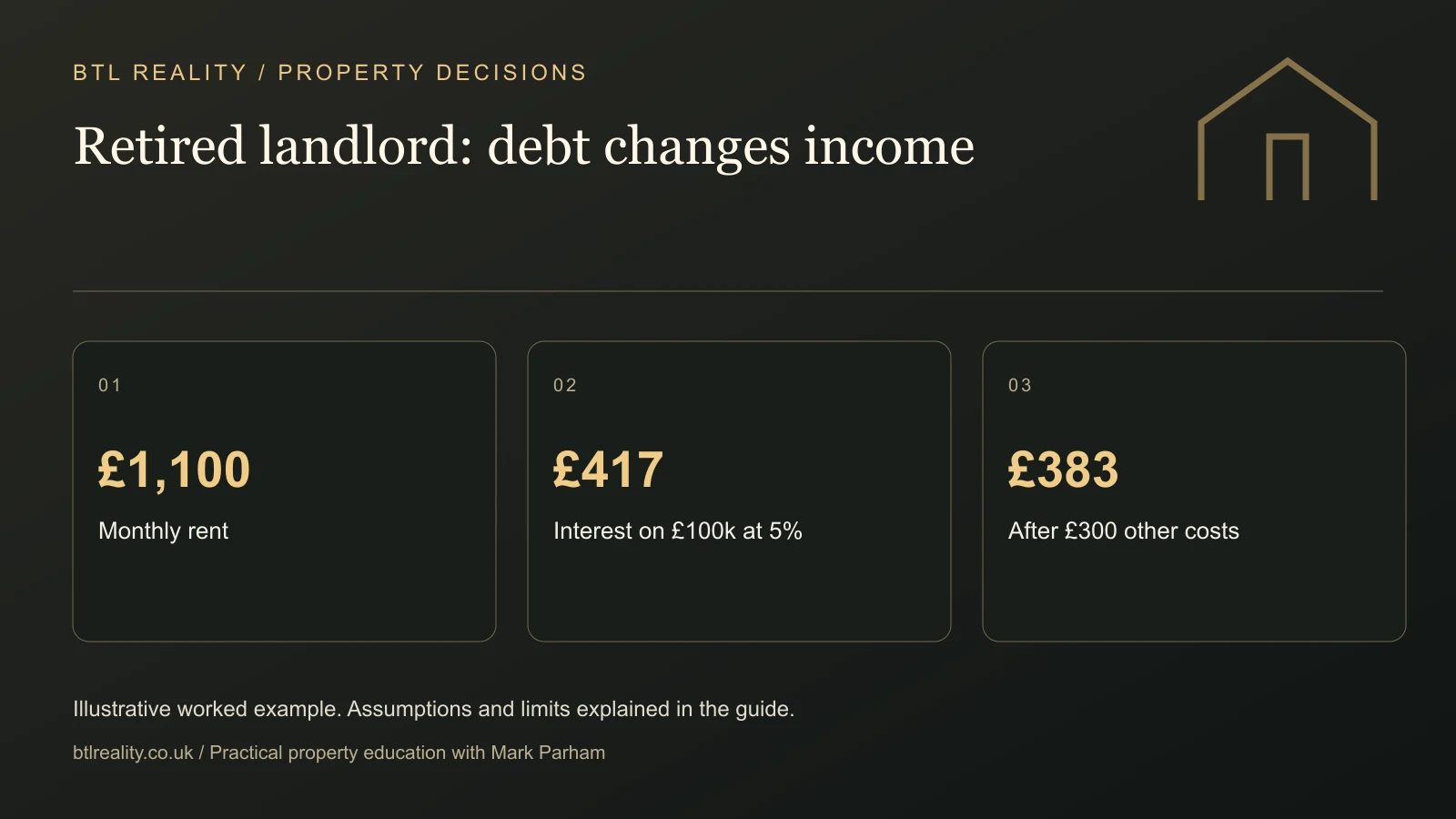
Take an illustrative £200,000 property renting for £1,100 a month. Assume £300 of monthly operating allowances. Before mortgage costs and tax, the property produces £800 a month.
At 5% interest-only borrowing, a £100,000 mortgage costs about £417 a month, leaving roughly £383 before tax. A £150,000 mortgage costs £625, leaving £175. The higher loan may release more cash initially, but recurring income is lower.
This is a useful retirement comparison because it shows both the asset and the lifestyle effect. If your aim is dependable monthly income, the maximum available mortgage may not be the mortgage that best serves the objective.
Make the example your own
How much rent remains after the loan?
Set the debt and interest rate for a £1,100 rent and £300 monthly operating-cost example.
Interest-only illustration, not a lender eligibility assessment or repayment plan. Illustrative only. Inputs stay in this page and are not saved or sent.
Shorter terms can change the payment
For repayment borrowing, a shorter term means the capital is repaid faster and can materially increase monthly payments. For interest-only borrowing, a shorter term may leave the regular interest payment broadly similar at the same rate, but brings the capital repayment deadline closer.
Do not mix the two. A low interest-only payment is not evidence that the debt is being cleared. The mortgage balance can remain substantial even after many years of payments.
Ask for a product illustration and compare the actual payments, fees and remaining balance. Use the mortgage stress calculator to explore higher rates, while recognising that its scenarios are not a lending decision or a substitute for the offer documents.
Plan the eventual repayment of interest-only debt
Possible repayment routes can include selling the property, using other assets or reducing the balance over time. Each needs a realistic assessment. A sale can involve marketing time, costs, tax and a price below your preferred assumption.
Refinancing again might be possible, but should not be treated as a guaranteed exit. The borrower, property and lending market may look different at the next maturity date. A plan that only works if another lender always says yes contains an important dependency.
Write down the repayment date and the intended source of funds. If the source is another asset, avoid simultaneously allocating that same asset to household spending or family commitments. One pot cannot meet several full commitments at once.
Keep property and household reserves separate
Retirement can reduce the ability or desire to cover unexpected property bills through extra employment. That makes the timing of repairs and vacancies especially relevant, even when the annual forecast looks positive.
Identify cash for property interruptions and a separate household emergency reserve. Decide what spending can be reduced temporarily and what cannot. A fixed monthly lifestyle funded by a variable rental surplus needs a buffer between the two.
Suppose a property normally leaves £300 a month but needs a £4,000 repair. That bill represents more than thirteen months of the expected surplus. A reserve is useful because the contractor will not normally accept thirteen months of future profit instead of payment now.
Existing landlords and first-time buyers may be treated differently
Experience can affect available products or criteria, but it does not remove the need to assess the purchase. An established landlord adding a property, a retiree buying their first rental and someone remortgaging a former home may be different applications.
Tell the broker about existing properties, mortgages, ownership structures and guarantees. Include commitments that are held through companies where relevant. A complete picture helps avoid a promising initial assessment changing after important facts emerge.
If you plan to move abroad, disclose that too. Residency can change product eligibility and administration. A mortgage selected while UK-resident should not be assumed to remain suitable for a different arrangement without checking the lender's requirements.
Compare keeping the debt with reducing it
Using cash to reduce borrowing can improve rental surplus and reduce interest exposure. It also reduces liquidity and may involve charges. Keeping cash outside the property can provide flexibility, but has its own return, tax and risk characteristics.
Compare the two as complete household positions. Record mortgage costs saved, charges, cash remaining, expected income and what happens during a repair or vacancy. Avoid deciding solely from one interest rate or an assumed investment return.
The Financial Freedom Calculator can help organise the wider picture of assets, debt and spending. Its projections are illustrations and cannot establish the suitability or availability of a retirement mortgage strategy.
Prepare a useful broker conversation
Take your age, intended term, property details, realistic rent, deposit or current equity, pension evidence, other income and existing commitments. Explain whether the objective is buying another rental, improving cashflow or releasing capital.
Ask which criteria are confirmed and which remain dependent on underwriting or valuation. Request the total cost, not simply a monthly payment. Make sure any intended use of released money is accurately disclosed and permitted.
For a broader review of how property fits your lifestyle, Private Mentorship explains the educational strategy support. A qualified mortgage adviser still needs to assess the borrowing itself. The goal is a loan that supports a workable retirement plan, not merely a successful application.
Frequently asked questions
What is the maximum age for a buy-to-let mortgage?
There is no single maximum applying to every lender and product. Rules may differ by application age, end-of-term age, LTV, experience and other circumstances. Ask a broker to assess your actual case against current criteria. An age quoted without those conditions can give a misleading impression of the options available.
Can I use pension income for a buy-to-let mortgage?
A lender may consider acceptable pension income, subject to its evidence and affordability requirements. Income already being paid can be treated differently from a future expectation or flexible withdrawal plan. Provide accurate statements and explain other commitments. The property's rental coverage and suitability will still require assessment alongside the borrower information.
Can I get an interest-only buy-to-let mortgage after retirement?
It may be possible through an appropriate lender, but the repayment plan and full eligibility still matter. Interest-only payments do not reduce the principal automatically. Establish how and when the balance will be cleared, and test the plan if another refinance is unavailable. Availability alone does not establish suitability.
Is it harder to remortgage buy-to-let property after retiring?
The application may be different because age, income, term or circumstances have changed. Some borrowers will still have suitable options; others may face constraints. Review the position before the current deal or term ends, allowing time for valuation and underwriting. Do not assume a previous approval guarantees the next one.
Do retired landlords need employment income to borrow?
Not every lender requires the same income mix, so employment should not be treated as a universal requirement or universally irrelevant. Pension and other acceptable income may be considered under a lender's policy. Tell the broker the full position and ask what evidence is required for the specific product being considered.
Should I release property equity to top up my pension income?
That creates additional borrowing and may reduce future rental surplus. Compare the cash released with interest, fees, repayment obligations and the risk that future lending is unavailable. A household plan should assess alternatives and consequences with appropriate advisers. It is not automatically a sustainable solution to an ongoing spending shortfall.
Put the next step into practice
Use the free tools to test your numbers, then choose the level of support that fits your next decision.