Buying a Rental With a Private Water Supply: The Checks
October 20, 2026
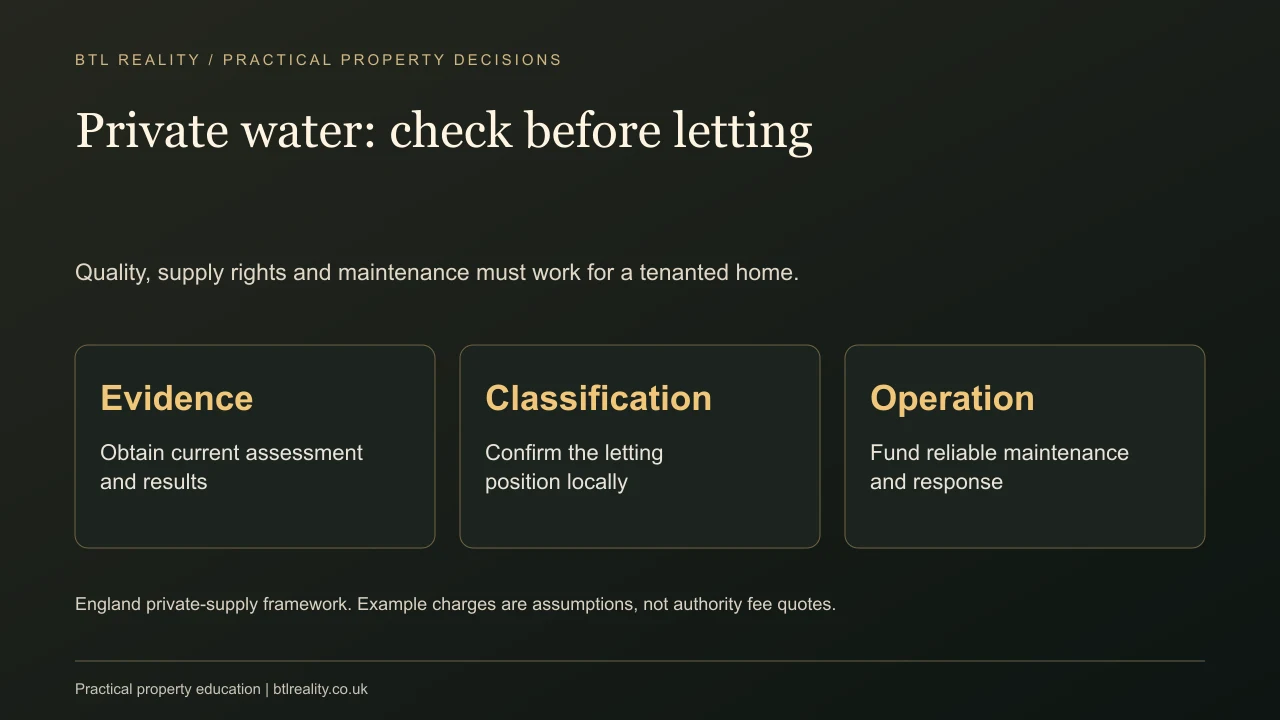
A cottage supplied by a spring or borehole may look independent of the mains network. For a landlord, it creates practical questions about water quality, reliability, access and maintenance. Those questions need answering before the property is valued as a ready-to-let home.
The fact that an owner has lived there for years does not prove the arrangement is suitable for a commercial letting. This guide focuses on England and uses Drinking Water Inspectorate guidance checked on 19 October 2026. The other UK nations have different private-supply frameworks and regulators.
Identify the source and the complete supply route
Ask where the water comes from and which properties use it. Trace the source, storage, treatment equipment, pumps and pipes to the rental. Establish which components sit on the property being bought and which depend on someone else’s land or building.
The Drinking Water Inspectorate’s buyer guidance recommends checking deeds and legally binding arrangements for control and maintenance. Ask the conveyancer to explain the rights and liabilities rather than rely on a statement that the neighbouring estate supplies everyone.
A private source such as a spring or borehole is not necessarily the same as mains water redistributed through privately owned pipes. The classification can differ. Give the local authority the accurate arrangement, including where the source originates and who controls each part.
Request a plan and inspect the practical access. Can a contractor reach the pump, filters and storage without negotiating entry every time? Does a third party hold the key? A right to receive water and the ability to maintain a failing component need to work together.
Check the classification when the property becomes a rental
The DWI’s Regulation 9 information note explains when tenanted premises can fall within the commercial-activity provisions. It sets out conditions and exceptions. Do not turn that into a claim that every private supply has identical monitoring requirements.
Tell the local authority that you intend to let the property and explain who will operate and maintain the supply. Ask for written confirmation of the relevant classification, required risk assessment, monitoring and any outstanding actions or notices. A seller’s owner-occupation arrangements may not answer that question.
The DWI’s guide to types of supply in England distinguishes the main categories. It describes monitoring and assessment arrangements for those categories, with local-authority involvement. Use that framework to ask the right questions, then apply the authority’s answer to the actual property.
Do not change a tenancy clause simply to assume the responsibilities disappear. An arrangement on paper must reflect genuine operation and the applicable legal position. The letting needs a reliable, wholesome supply and a practical plan for looking after it.
Obtain the quality and risk-assessment evidence
Request the latest local-authority risk assessment, monitoring results, relevant correspondence and any remedial work records. Check which sampling points and dates the results cover. A single old sample from the source does not necessarily establish the water supplied at the kitchen tap now.
Ask whether the current treatment arrangements address the risks identified. Obtain service records and the manufacturer’s requirements for equipment. Establish who checks operation, responds to warnings and replaces consumables. A treatment unit present in a cupboard is not evidence that it has been correctly maintained.
Have competent professionals explain unsatisfactory or incomplete results and the work needed before letting. Avoid trying to assess health safety from taste, clarity or a seller’s assurance. A clear-looking glass of water is not a laboratory result or a supply risk assessment.
If the property is occupied, arrange access and sampling appropriately with the seller and relevant parties. Keep the questions focused on the supply you will acquire. Do not treat a neighbour’s satisfactory result as a substitute for evidence relevant to this house.
Test reliability as well as quality
Ask about shortages, reduced pressure, pump failures, power interruptions and seasonal changes. Request records where available and ask how backup supply is arranged. The investment needs a workable response if tenants cannot obtain water for normal domestic use.
Find out whether future development or additional users can draw from the same source. A shared supply that has served three houses may need further assessment if demand changes. Do not assume that more bathrooms or an extra bedroom can be added without considering the water system.
Check storage, equipment age, service access and responsibilities for leaks. Ask who pays electricity for shared pumps and how that bill is divided. Those details affect operating costs and management workload even where the source water itself is not purchased from a mains company.
Tell the broker and insurer about material features and findings. Obtain their requirements rather than assume private supplies are universally accepted or rejected. A finance decision should reflect the actual rights, quality evidence and intended occupation.
Read the shared agreement before assuming a fixed bill
Obtain the deed, contract or other arrangement defining supply rights, maintenance duties and charges. Ask how fees can change, who authorises capital work and what happens if another user does not contribute. A fixed historic payment may not cover replacement equipment or emergency work.
If the source or treatment is controlled by an estate or neighbour, ask what happens on a sale or business failure. The conveyancer should explain the strength and limits of the rights. Longstanding personal goodwill is useful history but should not be the only basis for an essential service.
Give the managing agent clear responsibilities after completion. Establish who receives warnings, holds records and can contact competent service providers. Tenants should know how to report a problem without being expected to operate unfamiliar treatment equipment beyond an appropriate agreed arrangement.
A worked example: there is still an annual water budget
Assume a rental produces £1,000 monthly rent. Mortgage interest is £550 and ordinary costs before private-water expenses are £250. That leaves £200 a month before tax. Now add the following hypothetical annual costs, based on assumed quotations rather than typical charges.
| Illustrative annual private-water cost | Amount |
|---|---|
| Pump electricity | £90 |
| Filters and other consumables | £180 |
| Servicing | £150 |
| Assumed assessment and monitoring charges | £120 |
| Total annual running cost | £540 |
| Monthly equivalent | £45 |
The monthly surplus becomes £155 in this simplified comparison. If a pump replacement quoted at £2,400 is also needed immediately, that belongs in the initial cash requirement. First-year water-related cash would be £2,940, before any other system work.
Use the Buy-to-Let Deal Analyser with actual fees and service costs. If a shared agreement already includes some items, avoid adding them again. A reserve for later replacement should also be distinguished from an immediate funded replacement.
The maintenance budget guide helps keep recurring costs and occasional work separate. There is no useful universal allowance for private water: system condition, responsibilities and required monitoring determine the budget.
Resolve readiness before advertising the rental
Before exchange, establish what evidence and work remain outstanding, the estimated cost and who must act. If the seller will complete remedial work, agree scope and verification through the purchase process. If you take it on, ensure the property can be brought to a suitable letting position within the funded timetable.
Do not promise tenants a service based only on a planned installation or an unanswered local-authority enquiry. Obtain the necessary assessment and evidence, complete required work and confirm the ongoing maintenance arrangements before treating the house as ready.
This is also a handover task. Keep current records, contacts, equipment instructions and the agreement accessible to the people managing the property. Review them when use, equipment or responsibilities change rather than assume the original seller’s arrangements remain adequate indefinitely.
A private supply needs an operating plan
A private-water property can fit a rental strategy where the source, rights, quality and responsibilities are understood. The deal becomes much harder to assess when essential information is missing or one neighbour controls everything through an informal arrangement.
The aim is not to reject a borehole or spring by name. It is to buy a home with a reliable supply you can lawfully and practically manage. Put the actual operating obligations into the figures before comparing the rental with a mains-connected alternative.
Frequently asked questions
Does letting a house change the private-water requirements?
It can. DWI guidance describes circumstances in which tenanted premises fall within commercial-supply provisions, with conditions and exceptions. Tell the local authority about the intended letting and maintenance arrangements and obtain the applicable classification and requirements.
Does clear water prove the supply is safe?
No. Appearance and taste do not replace appropriate monitoring and risk assessment. Obtain current records relevant to the property and have competent professionals address missing information or unsatisfactory results before treating the home as ready to let.
Is a private spring the same as a shared mains pipe?
Not necessarily. A private source and a public supply distributed through private arrangements can fall into different categories. Establish the source and complete route, then ask the authority and conveyancer to assess the actual arrangement.
Can I make the tenant responsible for the whole system?
Do not assume a clause alone achieves that. DWI guidance considers genuine responsibility and operation, with conditions. Obtain advice on the legal and practical position, including access to equipment and how a wholesome supply will be maintained.
Will there be no water costs because there is no mains bill?
No. Pumps, electricity, consumables, servicing, assessment, monitoring and replacement work may still cost money. Check what the supply agreement includes and avoid counting the same item twice. Use actual quotations and records.
What if the source is on a neighbour’s land?
Have the conveyancer check rights to receive water and access, maintain and replace relevant equipment or pipes. Confirm the contribution agreement and what happens when ownership changes. An informal personal arrangement may be too fragile for an essential service.