Buying a Flat With an Absent Freeholder: BTL Checks
October 20, 2026
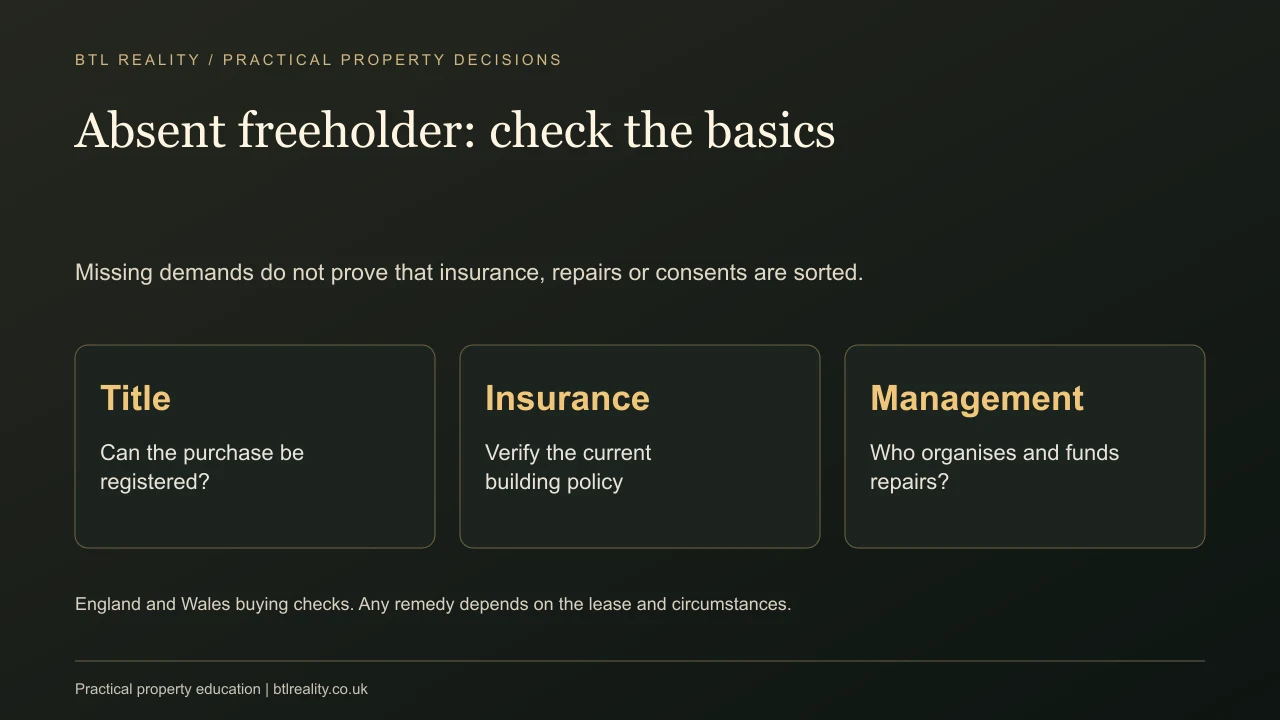
A flat with no ground-rent demands and no visible service charge can look inexpensive to run. But if the reason is a missing freeholder, the apparent saving may conceal unresolved insurance, repairs and consent problems. Those do not disappear when you let the flat to someone else.
The starting point is to establish who is missing, what they are supposed to do and how the purchase will work. An absent freeholder and an unhelpful managing agent are not necessarily the same problem. This guide concerns England and Wales and was checked on 19 October 2026.
Establish the ownership and management structure
Ask the conveyancer to identify the flat’s leasehold title, the freehold title, any intermediate lease and the parties responsible under the lease. A person named in an old lease may no longer own the freehold. The person collecting payments may be an agent rather than the legal owner.
The Leasehold Advisory Service explains how to identify the landlord or freeholder, including using rent demands, the lease, Land Registry information and company records. Those records can be out of date, so the purchase investigation should not stop at the first name found.
Ask the seller what attempts have been made to obtain replies, with dates and copies of correspondence. A freeholder who answers slowly presents a different situation from a dissolved company, a deceased individual with unresolved estate administration or someone whose whereabouts cannot be established.
This distinction affects the next steps. Do not label every missing reply as an absent-freeholder case and assume a standard insurance product will make it acceptable. Your conveyancer needs to diagnose the actual ownership and documentation problem before recommending a route forward.
Check whether the purchase can be registered
Ask whether the title contains a restriction requiring consent or a certificate for the transaction. The Land Registry’s practice guide 19A explains that restrictions naming a landlord or agent can cause registration difficulties when the relevant party changes.
The answer depends on the wording and evidence. Your conveyancer should explain how the restriction will be complied with, cancelled or otherwise properly dealt with if necessary. A claim that nobody has objected to previous sales does not establish that your registration can proceed.
Where a company has been dissolved or an owner has died, specialist steps may be required. Ask for the proposed process, who must act, what documents are needed and the likely timetable. Do not count a possible future application as though it has already delivered the necessary title position.
Coordinate this with the broker. A mortgage offer can expire while documentation is being resolved. The lender must know about relevant missing information and accept the solution. An agreement between buyer and seller does not automatically satisfy the lender’s separate legal requirements.
Buildings insurance needs a real answer
Request the current policy, schedule, insured property description, renewal date and evidence that the premium has been paid. Check who is the policyholder and whether the flat and relevant common structure are covered. A seller saying that each flat insures itself is the start of an investigation, not its conclusion.
The lease sets the framework for insurance responsibilities. Ask an appropriate insurance adviser and your conveyancer whether the actual arrangement meets it and your lender’s requirements. Establish how a substantial claim would be made and who could authorise reinstatement work involving several flats.
A policy covering contents inside one flat should not be mistaken for evidence that the whole building is adequately insured. Equally, a document labelled buildings insurance should be checked for the correct address, scope and period. You need a functioning arrangement after completion, not simply an old certificate.
What happens when the roof needs work?
Read the lease’s repair obligations and contribution proportions. Ask who currently organises common repairs, who can collect money and whether there is a reserve fund. The building may be tidy because the owners cooperate, but that practical history needs examining alongside the legal arrangements.
Request recent invoices and details of known defects or proposed work. Compare the surveyor’s findings with what the seller and other available records show. If repairs have been deferred because nobody can obtain consent or arrange payment, a low current service charge may understate the building’s cost.
A missing freeholder does not make a roof, staircase or insurance renewal maintain itself. For the financial side, read the guide to buy-to-let service charges. Here the additional question is whether there is anyone able and obliged to deliver the services your budget assumes.
A worked example: the cost behind a zero charge
Assume a £140,000 flat rents for £900 a month. A basic forecast includes £4,800 annual mortgage interest and £2,400 other running costs, but no block expenditure because the seller reports paying nothing. That produces £3,600 before tax, or £300 a month.
Now suppose a survey and the proposed management arrangement identify an annual £600 insurance contribution, £300 common maintenance allowance and an immediate £4,000 share of a roof repair. These are illustrative assumptions, not standard charges or a statement that this buyer is legally liable for that particular sum.
| Illustrative cashflow | Annual amount |
|---|---|
| Rent | £10,800 |
| Mortgage interest and ordinary costs | £7,200 |
| Initial forecast surplus | £3,600 |
| Insurance and common maintenance | £900 |
| Revised ordinary surplus | £2,700 |
| First year after £4,000 roof share | £1,300 shortfall |
The ordinary monthly surplus falls to £225. The immediate work needs its own funding. Enter verified costs in the Buy-to-Let Deal Analyser rather than treating a lack of historic demands as proof of no future liability.
Avoid counting an invoice twice as both an acquisition cost and a recurring annual charge. Also test delay costs separately if the title or insurance must be resolved before you can complete or let. A negotiated price discount does not itself arrange repairs or provide the missing consent.
Check permission for letting and planned alterations
Your intended tenancy must fit the lease. Ask whether letting requires permission, notification or a certificate, and how the requirement can be met if the relevant party cannot be found. Do the same for proposed alterations. Lack of enforcement so far does not rewrite the lease.
The government’s leasehold buying guidance recommends checking restrictions, permissions, charges, insurance and freeholder identity before purchase. Apply that to your actual plan, including any layout changes or works that require access to communal areas.
Tell the conveyancer about earlier alterations too. Missing consent for a seller’s work and missing consent for your future project can be different risks. A proposed policy dealing with a past breach should not be assumed to authorise changes after you become the owner.
Read insurance proposals carefully
If absent-landlord indemnity insurance is suggested, ask for a clear explanation of what event triggers cover, the insured parties, financial limit and exclusions. Check what happens if the freeholder reappears and whether planned works or contact affect the policy.
Insurance is not the same as appointing a person to maintain the building, arranging a compliant block policy or obtaining an actual licence for future works. It may address specified financial consequences. Your lender and conveyancer need to decide whether it is an acceptable part of the solution.
Ask before contacting parties about a potential title defect because that can affect available options. At the same time, do not keep relevant facts from the professionals advising you. A coordinated investigation is more useful than a sequence of well-meant calls that complicate a proposed remedy.
Decide whether the management problem has a credible solution
A sensible purchase needs more than a cheap price. Ask for the title route, insurance arrangement, repair responsibilities, letting permission and cash budget in terms you understand. Identify what is resolved now and what still depends on another person’s action or a legal process.
There can be routes to address missing-landlord problems, but eligibility, procedure, cost and timing depend on the case. Ask a specialist solicitor to compare realistic options before exchange. Do not buy on the assumption that a future court application or freehold purchase is guaranteed to solve everything cheaply.
If the unresolved work makes the property unsuitable for your timescale or available cash, there is nothing wrong with declining it. The aim is a rental you can finance and manage, with a viable future sale. A zero service-charge headline cannot demonstrate that on its own.
Frequently asked questions
Can I buy a flat if the freeholder is missing?
It may be possible, depending on the title, lease, insurance, required consents and lender. Ask the conveyancer to explain the exact legal route and remaining risks before exchange. A policy or a previous sale does not by itself establish that your purchase is acceptable.
Does no service charge mean the flat is cheap to run?
Not necessarily. It may mean expenditure is collected informally or work has been deferred. Check repair responsibilities, the building’s condition, insurance and proposed work. Model evidenced future costs rather than relying on a seller’s historic payment figure.
Will absent-freeholder insurance pay for a new roof?
Do not assume so. Read the insured events, limits and exclusions with the conveyancer and lender. Title indemnity is not a general building maintenance fund. A roof contribution and a policy premium belong in different parts of your assessment.
Can I let the flat without asking a missing freeholder?
The lease and applicable law determine the permission or notice requirements. Ask the conveyancer how your intended letting can comply. The fact that the freeholder is difficult to locate does not automatically remove a consent clause.
What if the freeholder is a dissolved company?
Tell the conveyancer immediately and obtain specialist advice on the ownership and registration implications. Do not assume that a dissolved company means there is no owner or that a director can simply sign the documents needed for your purchase.
Should I contact the freeholder myself about the defect?
Coordinate with your conveyancer first. Attempts to trace ownership may be necessary, while contact about a particular title issue can affect a proposed insurance solution. Give your adviser the full history so the investigation and remedy are consistent.